
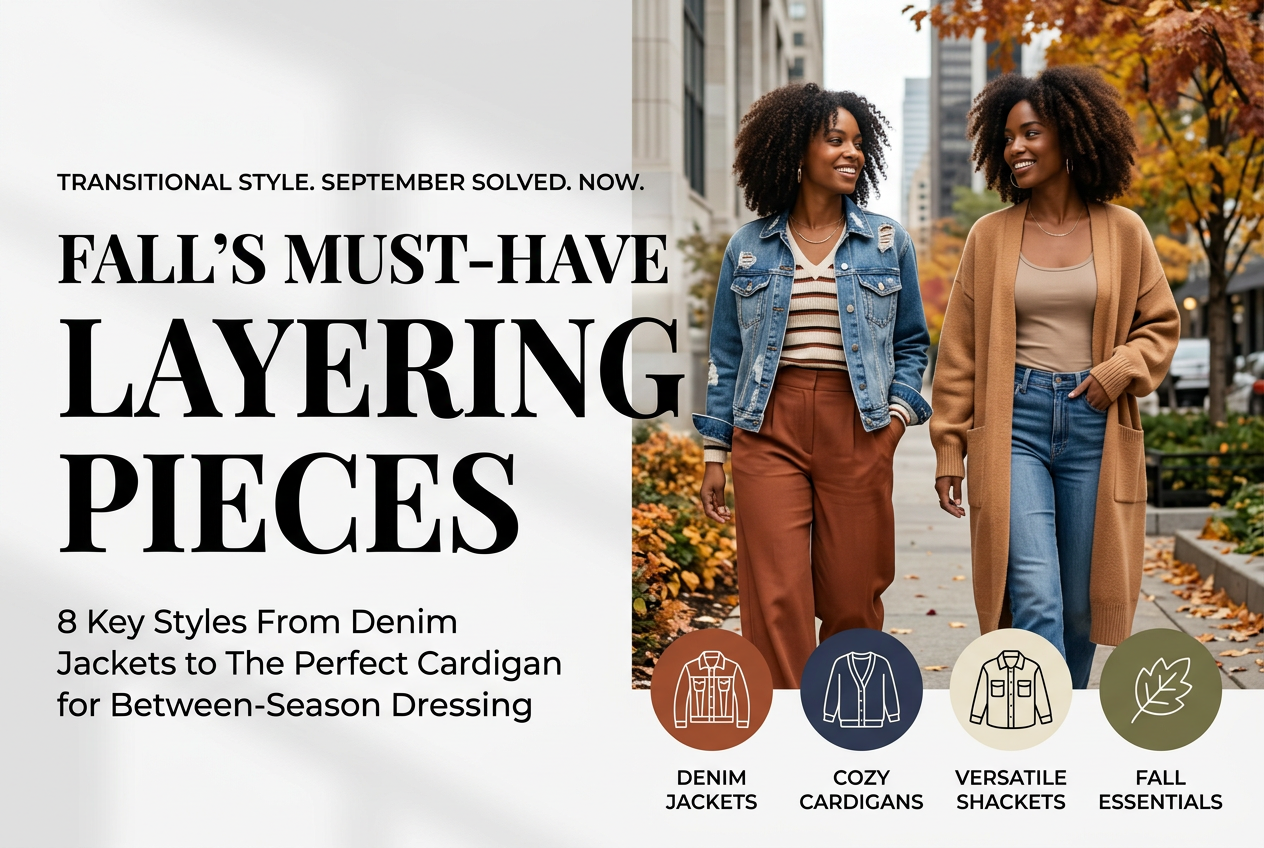
There’s this specific miserable moment — usually a Tuesday in late September — where you leave the house in a jacket, immediately regret it, and spend the rest of the day carrying it around like a punishment. That’s the problem transitional layering pieces actually solve. Not a style problem. A practical, annoying, daily problem.
Here’s the thing most wardrobe advice gets backwards: the goal isn’t to own more clothes, it’s to own fewer clothes that do more work. A well-chosen denim jacket works in May and October. A good cardigan lives in your closet year-round. These are the pieces that earn their space because they show up when your wardrobe logic breaks down — when the temperature can’t commit and neither can you. I’ve pulled the same oversized camel cardigan out of my closet in March, August (for aggressive air conditioning, don’t judge), and November, and it has never once let me down.
Why Most Layering Advice Misses the Point
Transitional dressing only works if you’re honest about your actual life, not the aesthetic version of it.
Fabric weight is where most people go wrong. Something too heavy makes you miserable on a 68-degree afternoon. Something too light becomes a decorative item by late October. Cotton blends, lightweight wools, and structured knits hit the right middle ground — they add warmth without trapping heat, and they look like real clothes instead of an afterthought. Neutral colors (black, navy, camel, grey, cream) matter here too, not because you have to be boring, but because pieces in those shades layer over everything you already own without requiring you to think too hard at 7am. And silhouette matters in ways people underestimate: a fitted blazer reads completely differently than an oversized button-up even in the exact same color, so consider what you’re actually adding to an outfit before you buy something just because it’s technically a layering piece. There’s a version of this where you own four truly great transitional pieces and another where you own twelve mediocre ones that all do approximately the same job — one of those closets is a lot less exhausting to deal with. The restraint is the whole strategy.
The Denim Jacket — Still Non-Negotiable
If you don’t own one, start here.
Women’s denim jackets work over sundresses in late summer, over sweaters in fall, over long sleeves in spring. The fit question matters more than most people think — cropped works beautifully with high-waisted bottoms, oversized feels effortless over almost anything, and a fitted cut is your friend if you like structure and don’t want to look like you borrowed something from a taller person. Classic blue is timeless, but black denim is more versatile if your wardrobe runs to a lot of mixed colors and patterns. Wear it over a slip dress for a completely different vibe than it has over jeans. Layer it under a longer cardigan when you need warmth without bulk. It’s casual enough for a coffee run and structured enough to pass in a business-casual setting when you need it to.
Denim-on-denim is fine, by the way. Vary the wash and stop worrying about it.
Cardigans Are Doing More Work Than They Get Credit For
The best lightweight cardigans are the ones you forget you’re wearing until you need them.
Unlike a heavy knit sweater, a thin merino wool or well-draped cotton blend cardigan doesn’t announce itself. You can throw one on, take it off, tie it around your waist — it works with the outfit instead of competing with it. Cropped cardigans add definition and work particularly well if you want to highlight your waistband or a great top. Long duster cardigans create a more dramatic line and layer beautifully over dresses or loosely over trousers. You want at least one neutral in your rotation (cream, grey, black, or camel), but don’t skip jewel tones entirely — a burgundy or forest green lightweight cardigan adds genuine visual interest without reading as seasonal or heavy. Actually, that’s not quite right: they do read as autumnal, which is exactly the point when it’s October and you want to look like you meant to dress for the season.
Shackets, Blazers — Do You Actually Need Both?
A shacket (shirt-jacket hybrid, in case you’ve successfully avoided the word until now) solves a specific problem: you want more coverage than a cardigan but less formality than a blazer. Shackets for women tend to have relaxed fits, softer shoulders, and casual fabrics like cotton or cotton blends. You can wear them buttoned or open, tucked or untucked, with sleeves rolled for a more off-duty feel. They elevate an outfit without making you feel overdressed for a Saturday.
Blazers are a different tool entirely. A lightweight blazer in a neutral color is one of the fastest ways to make a simple outfit look deliberate — over a t-shirt and jeans, over a slip dress for evening, layered under a longer cardigan when you need actual warmth. The single place blazers fail people is shoulder fit: if the seam is sitting even half an inch off your actual shoulder, nothing else about the blazer works, regardless of how much you love the color or the price you paid. Try them on. Both, if you can afford it. If you have to pick one, the blazer does more in a work context, the shacket does more everywhere else.
How to Actually Build Outfits With These Pieces
Start with a neutral base — a simple t-shirt, a slip dress, a white button-up — and then add your layer based on proportion, not mood. If your top is fitted, an oversized cardigan or shacket creates balance. If you’re wearing something loose, a fitted blazer or cropped cardigan adds definition. When your bottom half is fitted, your layer can afford to be more relaxed. When you’re wearing wide-leg trousers or a full skirt, something more structured on top keeps the whole thing from reading as shapeless. This isn’t a hard rule — it’s just a faster way to get dressed in the morning without standing in front of your closet for ten minutes.
Texture is an underused tool here. A knit cardigan over a silky slip dress creates visual contrast that makes both pieces look more interesting. A structured blazer over a soft cotton tee balances the outfit in both texture and formality. The combinations that feel most intentional are usually the ones that mix something soft with something structured, or something matte with something with a little sheen.
Does anyone actually layer a cardigan over a shacket? Yes, and it works better than it sounds — extra warmth, no bulk, and it looks like you made a choice instead of just grabbing everything near the door.
The unpopular opinion worth saying out loud: don’t buy transitional pieces you don’t actually like wearing. Versatile is useless if you never reach for something. Buy the colors that make you happy. Buy the fits that feel comfortable. The best transitional layering piece in your closet is the one you grab automatically, not the one that technically checks all the boxes.
The Short Version
Four pieces: one denim jacket, one neutral lightweight cardigan, one blazer or shacket, one longer cardigan if that silhouette appeals to you. That’s it. Those four things work across three seasons and mix with whatever basics you already own. Add from there based on your actual life — another blazer if you work in a business-casual environment, a jewel-toned cardigan if you want more color, a second shacket in a different weight if you’re perpetually cold. But the foundation is small on purpose, because the goal was never a bigger closet. It was a more useful one.
At Unwritten, our editors choose every product and story idea independently — we only recommend things we’d genuinely tell a friend about.
Frequently Asked Questions
What counts as a transitional layering piece?
A transitional layering piece is anything you can wear comfortably in unpredictable weather — warm enough to add when it cools down, light enough to remove when it heats up. Denim jackets, lightweight cardigans, shackets, and unlined blazers all qualify. The test is whether you can wear it in both September and April without looking out of place.
How many transitional pieces do I actually need?
Honestly, four solid pieces covers most people: one denim jacket, one neutral lightweight cardigan, one blazer or shacket, and optionally a longer duster cardigan if you like that silhouette. You can build from there based on your lifestyle, but that foundation handles most situations across three seasons.
What fabrics work best for transitional weather?
Lightweight wool, cotton blends, and structured knits are your best options. You want fabrics that breathe well enough for a warm afternoon but have enough body to feel useful when the temperature drops. Avoid anything too heavy (you’ll overheat) or too sheer (pointless once October hits).
Can I wear denim-on-denim with a denim jacket?
Yes, and it looks intentional when you do it right. The key is varying the wash — a light-wash jacket over dark-wash jeans works better than matching washes head-to-toe. Adding a non-denim middle layer (a white tee, a striped shirt) also helps break it up if you’re not fully committed to the Canadian tuxedo.
What’s the difference between a shacket and a regular shirt?
Weight and structure, mostly. A shacket has enough body to function as an outer layer — it holds its shape, has more substantial fabric, and doesn’t need anything underneath it to look finished. A regular shirt is meant to be worn tucked in or as a base layer. Shackets sit somewhere between a casual blazer and a heavy shirt, which is exactly what makes them useful in transitional weather.