
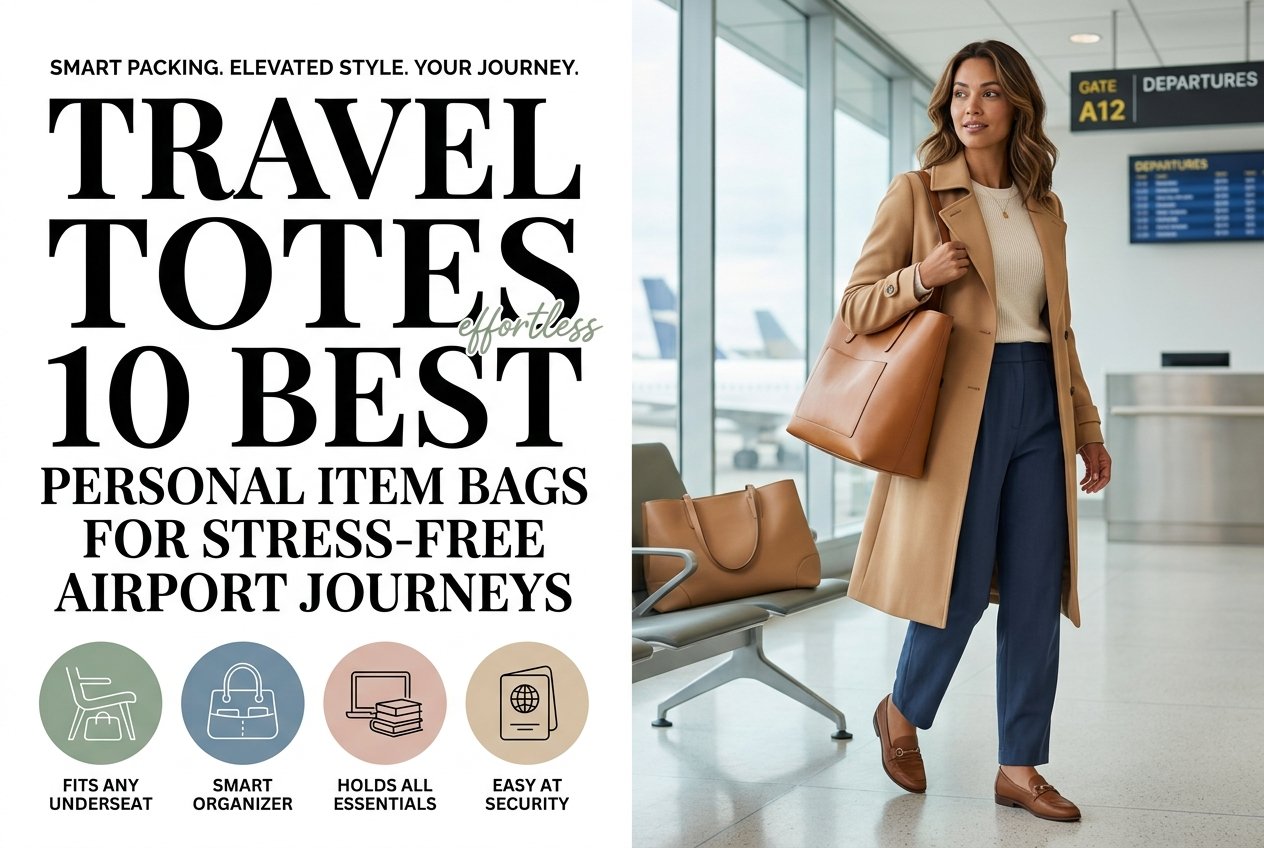
The TSA agent gives you that look. Your bag won’t fit under the seat. Other passengers are sighing behind you, and the whole carefully planned travel day starts unraveling right there at the gate. I’ve stood in that exact spot, bag in hand, completely regretting my choices.
Here’s what I figured out after too many of those moments: the right travel tote doesn’t just prevent that nightmare — it changes the entire texture of airport travel. It’s not a glamorous insight, but it’s a true one. A bag that slides under the seat without a fight, holds your essentials in a sensible order, and doesn’t make you look like you’re relocating permanently is genuinely worth thinking about before your next trip.
Why does your personal item bag matter this much?
A travel tote lives in useful middle ground. Bigger than a crossbody, smaller than a roller carry-on — which means it qualifies as a personal item on most airlines and stays with you under the seat rather than getting shoved into an overhead bin three rows back from where you’re sitting. Medications, valuables, the book you actually intend to read this time: all within arm’s reach. No hunting. No waiting at baggage claim if your connection is tight.
The access question is the one most people underestimate when they’re shopping for a bag. At check-in you need your ID. At security you need your laptop out, your liquids bag out, your shoes off, and somehow your boarding pass ready — all at the same time, while the person behind you is already loading the conveyor belt. A tote with logical pockets means you’re not dumping the entire contents of your bag onto a gray plastic bin to find your keys. (I did this once at LAX and watched a lip balm roll directly into a stranger’s bin. Never again.)
What to actually look for
Not all travel totes are created equal, and the differences that matter aren’t always obvious from a product photo. Start with dimensions: most airlines cap personal items at roughly 18 x 14 x 8 inches, though budget carriers can be stricter. You want a bag that fits comfortably without bulging at the seams, not one that technically meets the measurement but looks like it’s straining to hold itself together. After dimensions, think about material — water-resistant fabrics are non-negotiable if you travel more than twice a year. Coffee spills happen at gate seating. Airport bathroom floors are always wet for reasons no one wants to examine too closely. Unlined cotton absorbs all of it. Beyond that, check the stitching at the handle attachment points and the zipper pulls before you buy; those are the first places a cheap bag fails, usually somewhere between your third and fourth trip. Padded handles matter more than they sound like they would — you’re carrying this thing through terminals, up escalators, and slung over one shoulder while you wrestle a suitcase with the other hand. Finally, think about shape: some totes are tall and narrow, some are wide and shallow, and neither extreme works well under an airplane seat. Balanced proportions, roughly as wide as they are tall, tend to fit most seat configurations without sticking out into the aisle or forcing you to kick it repeatedly for a three-hour flight.
Top Picks: Personal Item Bags That Fit Under the Seat
The bags below were chosen because they get the size-to-usefulness ratio right. Compact enough to meet airline requirements across most carriers, but not so small that you’re playing Tetris to fit a phone charger and a granola bar.
Stylish options that don’t look like airport carpet
Travel doesn’t require sacrificing how your bag looks. Actually, that framing is slightly wrong — it’s not about sacrifice at all. The totes worth buying are the ones you’d carry on a normal Saturday, not ones you only pull out when you’re catching a flight.
Color, material, and silhouette matter here, not as vanity considerations but as practical ones: a bag you genuinely like carrying is a bag you’ll actually use, which means you’ll learn where everything is, you’ll repack it efficiently, and you won’t show up at the airport trying to transfer everything into it from whatever bag you grabbed last minute.
Pack it smarter, not fuller
Even a great tote fails you if everything inside it is chaos.
Pick one spot for your boarding pass and ID and never deviate. Not a different pocket depending on the day. Not loose at the bottom. One spot, every trip, so grabbing them at 5 a.m. is muscle memory rather than a minor crisis. Use exterior pockets for flight-only access items — phone, headphones, gum — and resist the urge to cram them with extras just because the space is there. Heavier things go to the bottom of the main compartment: water bottle, shoes, anything dense. Actually, that’s not quite right — it depends on your bag’s structure. If your tote has a rigid base, heaviest items at the bottom works perfectly. If it’s unstructured, distribute weight more evenly or the whole thing will pull awkwardly to one side. A small cable pouch for chargers and earbuds is worth the three dollars it costs, because tangled cables at a dying-phone gate situation are a specific kind of miserable. And leave some room. The magazine from Hudson News, the snacks from the terminal Starbucks — they have to go somewhere.
The right bag is the one you’ll actually use.
Minimalist or maximum-pockets. Sleek leather or technical nylon. Business trip or beach week.
What defeats the whole purpose is buying a travel tote that ends up sitting in your closet because it’s uncomfortable or doesn’t match how you actually dress or travel. The bag should reduce airport friction, not add to it. If you’re second-guessing it before you even leave the house, that’s your answer.
At Unwritten, our editors choose every product and story idea independently — we only recommend things we’d genuinely tell a friend about.
Frequently Asked Questions
What size should a travel tote be to count as a personal item?
Most airlines allow personal items up to 18 x 14 x 8 inches, but policies vary. Budget carriers like Spirit and Frontier are stricter than Delta or United. Always check your specific airline’s website before you fly — and when in doubt, go smaller rather than risk a gate-check fee.
Can a tote bag really replace a backpack as a personal item?
Absolutely. Tote bags often fit under seats more naturally than backpacks because they’re shaped to sit flat rather than stand upright. The key is finding one with enough internal structure that it doesn’t just collapse into a shapeless pile the moment you set it down.
What materials hold up best for travel totes?
Nylon and coated canvas are the two workhorses. Nylon is lighter and usually water-resistant out of the box. Coated canvas is more polished-looking but can crack over time in extreme temperatures. Avoid unlined cotton for airport use — it absorbs everything.
How many pockets does a travel tote actually need?
At minimum: one zippered exterior pocket for your phone and boarding pass, one interior pocket for your passport or wallet, and a main compartment big enough for a jacket and small laptop. More pockets than that is nice but not essential — what matters is whether the pockets are placed where you’d actually reach for them.
Are expensive travel totes worth it?
For frequent flyers, yes. A $200 tote that survives five years of weekly trips costs less per use than a $40 bag you replace every season. That said, there are genuinely solid options in the $60–$90 range that punch well above their price. You don’t need to spend a fortune — but you probably shouldn’t go bargain-bin either.