
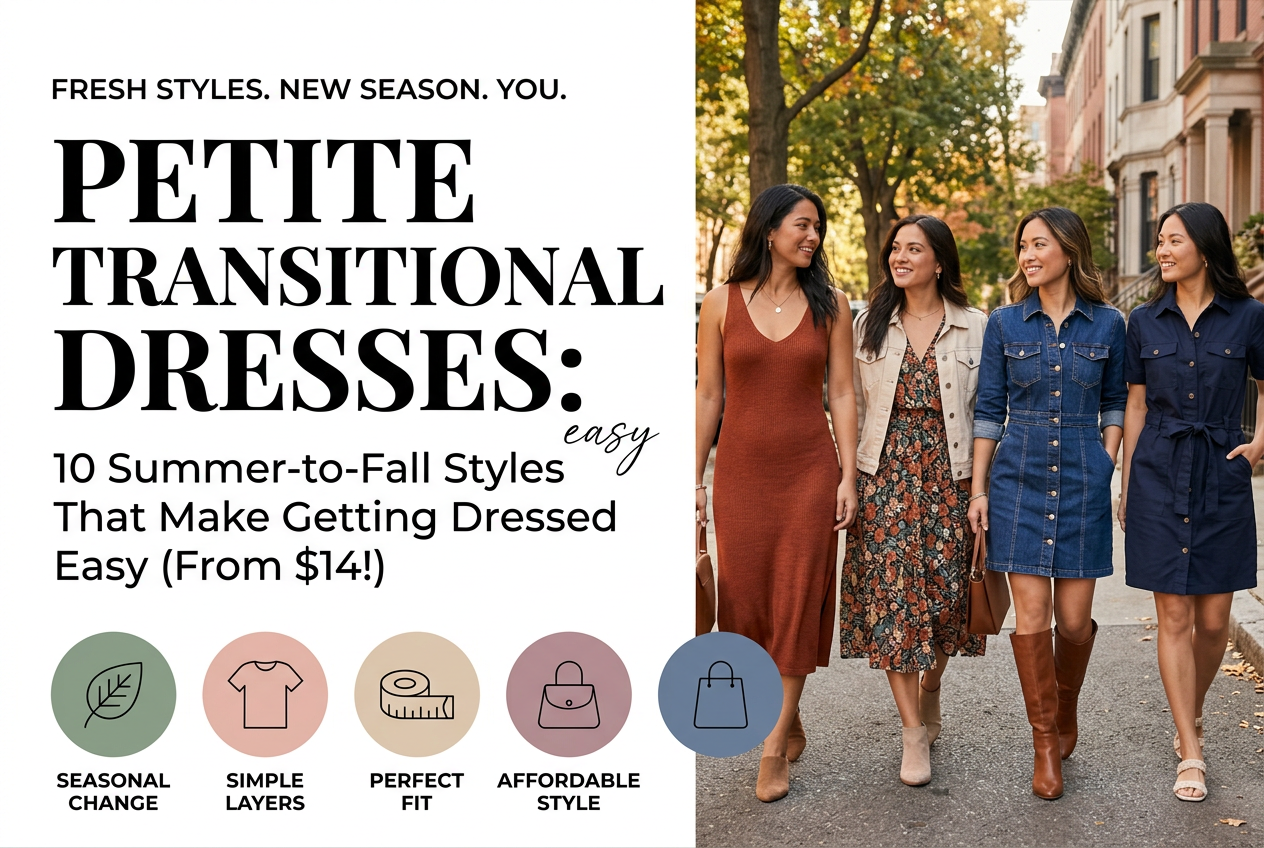
Here is the thing nobody tells you about dressing for the seasonal in-between: the answer is not buying more clothes. I spent two Septembers doing exactly that — grabbing pieces that felt right for the moment but were completely useless by October — before I figured out that a handful of well-chosen petite transitional dresses does more work than a closet full of season-specific stuff.
The temperature drops 15 degrees overnight and suddenly your sleeveless slip dress feels absurd. But pulling out your full fall wardrobe in August feels equally wrong. That tension is exactly what a good transitional dress resolves — not by being a compromise, but by being genuinely built for both.
Why Petite Sizing Actually Matters Here
When you’re 5’4″ or under, a regular-sized dress doesn’t just fit differently — it fits badly. The waist hits somewhere around your hips, the hem drags, and the shoulders gap. Petite transitional dresses are cut to account for a shorter torso, adjusted proportions, and hem lengths that work without alterations. That last part matters most during seasonal dressing, because a midi that hits at the right point on your leg reads as intentional. The same dress two inches longer just looks like you grabbed the wrong size. Getting the proportions right is not a vanity thing. It is a practicality thing.
The Fabric Question
Cotton blends, lightweight knits, and structured materials. Not thin, summery fabrics that feel wrong once the leaves start changing — those have their moment, but that moment ends in August. The fabrics that carry you through are the ones with a little weight and structure, enough to feel seasonally appropriate in September but not so heavy that you’re sweating in late summer heat. (Actually, linen blends are worth mentioning here too — they breathe well enough for warm days but layer cleanly under a jacket in a way that pure linen sometimes doesn’t.)
Does Your Dress Actually Layer?
This is the real test. A transitional dress that doesn’t work under a cardigan, denim jacket, or blazer is not earning its place in your closet — it’s just a dress you’ll stop wearing in September. Sleeveless styles are the most flexible because they give you maximum room to add whatever layer you need as temperatures shift. Three-quarter sleeves are a solid second option: they read as more seasonal than short sleeves, but they still sit under jackets without bunching at the wrists. The one thing to avoid is anything with a dramatic or structured sleeve that fights with outerwear. You want the dress to disappear under the layer, not compete with it.
Enough room in the shoulder and torso is non-negotiable.
Midi Length Is Not Optional
For petites navigating the summer-to-fall shift, midi dresses are the most useful silhouette — full stop. They are not summery-short, they are not winter-heavy, and they look right with sandals in August and ankle boots in October without any styling gymnastics. A well-fitted midi on a shorter frame hits at a flattering point that longer dresses on taller women take for granted. The A-line cut specifically works because it moves well, layers cleanly, and doesn’t cling in a way that makes adding a belt feel like a structural decision.
Accessories Do More Work Than You Think
The same dress worn with strappy sandals and a thin scarf in August feels completely different from that same dress belted, with booties and a longline cardigan in October. Belts are the most transformative tool here — they define the waist, make a dress feel considered rather than thrown-on, and shift the overall vibe from casual to intentional. Scarves add warmth without bulk, which matters when you’re not ready for a full jacket. And tights deserve more credit than they get: they extend a dress well into cooler weather without requiring any additional outerwear, and on a petite frame, the right pair of tights can actually sharpen the whole silhouette.
Spend Less Than You Think You Need To
Good petite transitional dresses start around $14. That price point is not a red flag — it means you can build a real rotation without treating each piece like an investment. The pieces that hold up longest are usually the simplest ones: solid-colored midis, basic sleeveless styles, classic A-lines in neutral or jewel tones. Skip the trendy prints that scream a specific season. A small-scale geometric or a subtle floral reads fine in late summer and doesn’t look out of place in October, but a bold tropical print has an expiration date and you both know it.
Getting dressed during this weird in-between stretch should not feel like a daily negotiation with your closet. With the right pieces — proportioned for a petite frame, made in fabrics that work across temperatures, and actually built to layer — it just works. My honest take: two or three solid midi dresses in warm neutrals will do more for your September wardrobe than any amount of seasonal impulse buying.
At Unwritten, our editors choose every product and story idea independently — we only recommend things we’d genuinely tell a friend about.
Frequently Asked Questions
What makes a dress ‘transitional’ for petite women?
A transitional dress for petites is cut to fit smaller frames proportionally — shorter torso, adjusted hem length — while being made from fabrics and silhouettes that work in both warm and cool weather. Think midi lengths in cotton knits or structured blends, not flimsy sundress fabrics.
What length dress works best for petites during the fall transition?
Midi dresses are the sweet spot. They’re not summery-short and not winter-heavy, and for women 5’4″ and under, a well-cut midi hits at a genuinely flattering length without needing alterations. Pair with sandals in August or ankle boots in October and it reads right both times.
How do I layer a petite dress without looking bulky?
Start with sleeveless styles — they give you the most flexibility. Look for dresses with a relaxed shoulder and slightly looser torso so jackets and cardigans sit cleanly on top. Avoid thick or puff-sleeved outerwear over fitted bodices; a denim jacket or a longline knit cardigan will layer without adding visual weight.
What colors and prints work from summer into fall?
Warm neutrals, jewel tones, and earthy shades carry across both seasons without looking out of place. For prints, lean toward subtle florals, small-scale checks, or geometric patterns rather than anything too tropical. These read as late summer in August and feel completely natural by October.
Can I find good petite transitional dresses on a budget?
Yes — some of the most versatile options start around $14. Focus on simple silhouettes in natural or natural-blend fabrics: solid-colored midis, classic A-lines, basic sleeveless cuts. Straightforward pieces last longer and style more easily than trend-driven ones.


