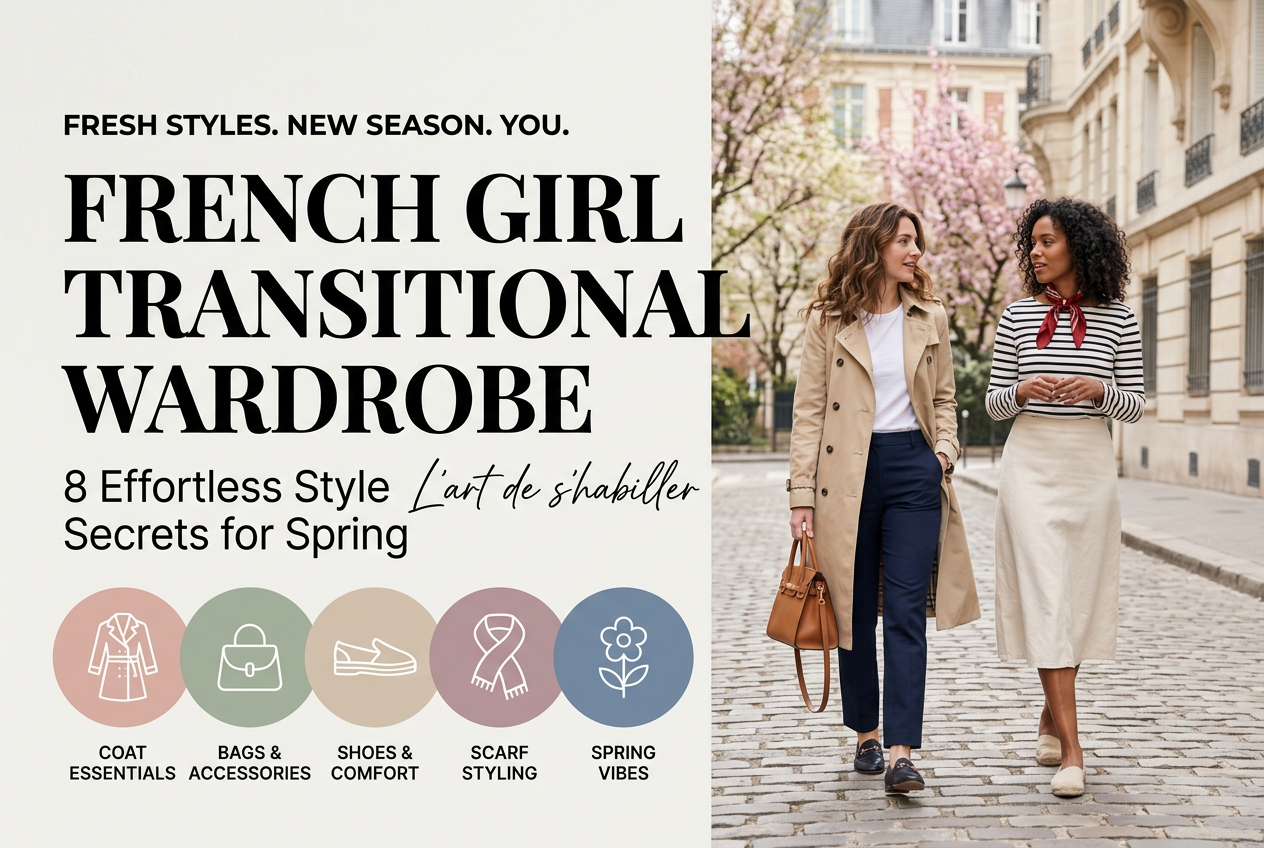
Here is the thing most people get wrong about French style: they think it is about looking Parisian. It is not. It is about getting dressed in under five minutes and still walking out the door looking like you thought about it for an hour. That is the actual goal — and once you understand that, building a french girl transitional wardrobe becomes a lot less precious and a lot more practical.
The pieces that make this work are not magical. They are just chosen with a specific question in mind: Will this work with at least four other things I already own? If the answer is no, it does not belong in the wardrobe. That single filter eliminates about 80% of impulse purchases and most of the closet chaos that leads to the 7am panic-stare.
Why restraint is the whole strategy
French wardrobes anchor on neutrals — black, white, navy, cream, warm gray — not because those colors are boring, but because they are the foundation that lets everything mix freely. Accent colors come in through smaller pieces: a scarf, a pair of shoes, maybe a bag. A pop of burgundy as a scarf works in October and March and still looks right in May. A burgundy coat is a gamble. The difference is that one decision commits you for a season and the other commits you for three years. French women think in three-year increments, not three-month ones, and that shift in thinking is what separates a wardrobe that works from one that just accumulates.
Fit matters more than anything on a price tag. A $40 shirt tailored to your actual body will look more expensive than a $200 shirt that is slightly loose through the shoulders. I learned this the hard way after spending more than I want to admit on a beautiful linen blazer that I never wore because the shoulders were just slightly off — not enough to look obviously wrong, but enough to feel wrong every time I put it on. It sat in my closet for two years. A $35 alteration would have saved the whole thing. French women budget for tailors. That is not an exaggeration.
The 8 pieces worth building around
These are not trend pieces. They work in March, in early May, on a cool June morning when summer has not quite committed. Build around these and everything else becomes easier to figure out.
1. The Breton Shirt
Not a trend. A uniform. Horizontal navy-and-white stripes in a fitted cotton-blend cut that works under blazers, over white tees, tucked into high-waisted trousers, or with a cardigan on top. Buy one that will not pill after six washes and you will reach for it constantly — I am talking 70-plus times a year, minimum.
2. A Neutral Blazer That Actually Fits
Not oversized, not cropped. A structured blazer in navy, black, or camel that hits at the hip with sleeves ending at your wrist. This is the piece that transforms everything underneath it. Look for a natural fiber — wool, linen blend, cotton — because synthetics fight your body instead of moving with it. It is the single highest-impact purchase in this entire list.
3. High-Waisted Trousers or Jeans
High-waisted silhouettes elongate the leg, define the waist, and read as inherently more put-together than their low-rise counterparts. Choose a neutral — black, navy, cream, warm gray — in a fabric that holds its shape through a full day. Cotton-blend twill or a structured denim works. Anything flimsy that bags at the knees by noon does not.
4. A Crisp White Button-Down
Wear it alone, tucked or untucked. Wear it under a sweater with just the collar visible. Knot it at the waist over a tee. Layer it under a slip dress. The white button-down has more configurations than almost anything else in this list, and the only requirement is that it fits through the shoulders and is made from cotton or a cotton-linen blend that does not crumple into complete chaos by 10am.
5. A Lightweight Knit or Cardigan
This is pure temperature regulation. A thin merino or cotton-knit cardigan in a neutral tone — the kind you throw over a slip dress on a cool morning and tie around your waist when you warm up. It is not a statement piece. It is infrastructure. Its best quality is that it disappears into an outfit without demanding attention.
6. A Slip Dress or Neutral Midi
A slip dress in black, cream, dusty rose, or soft gray is the piece that makes you feel put-together without any real effort. Wear it over a white tee when it is cold, on its own when it warms up, under a blazer when you need polish. Look for a cut that skims rather than clings — you want elegance, not exposure — and avoid anything with so much structure it reads as formal.
7. Leather Flats or Loafers
French women do not rotate shoes constantly. They own a few neutral pairs — black, cream, tan — and wear them until they are broken in and beautiful. A quality leather flat or loafer is the shoe you reach for most days. Comfort is non-negotiable here; uncomfortable shoes change your posture and your mood. And scuffed, worn-down shoes will make an expensive outfit look cheap faster than almost any other mistake. Invest in shoe care: a good polish, a brush, maybe a professional cleaning once a year.
8. A Lightweight Scarf
Silk or linen, in a solid neutral or a small-scale pattern. Tie it around your neck for polish, wear it as a headscarf, drape it over your shoulders on a cool morning. It is a small piece that signals intention without announcing it. Keep it simple — nothing so trendy it will feel dated in two years, nothing so loud it competes with the rest of what you are wearing.
Where to shop without overthinking it
High-street retailers have genuinely figured out the foundational pieces. The Breton shirt, the white button-down, the neutral trousers — these are not categories where you need to spend a lot to get something good. High-street is also where you test ideas before committing. Not sure if you will actually wear a lightweight cardigan? Try a $30 version first. You will know within two weeks whether it earns permanent wardrobe space.
The trick is patience and fit. Try everything on. Do not settle for close enough.
When it actually makes sense to spend more
An investment piece is something you will wear hundreds of times over several years — not something that will feel dated by next spring. French women spend on pieces that touch their skin most often or form the backbone of daily dressing. A cashmere cardigan qualifies: you will wear it constantly, it will hold its shape, and it will feel better against your skin than a cheaper knit in a way you notice every single time you put it on. Well-made leather flats qualify. A silk scarf from a heritage brand qualifies. What does not qualify? Trendy pieces, anything where the logo is the main design element, or pieces that only work one specific way. A $300 cream cashmere sweater is an investment because it goes under blazers, over slip dresses, with jeans, with trousers — four distinct configurations minimum. A $300 sweater in a color that was everywhere last season is a gamble, and French women do not gamble on clothes.
The styling moves that make it look effortless
Owning the pieces is half of it. Here is the other half.
Layer with intention, not decoration. The Breton shirt under a blazer with a scarf tied loosely at your neck is a formula — each piece has a defined role. Once you understand the roles, you can remix endlessly without starting from scratch every morning.
Learn the half-tuck. A full tuck reads as trying hard. A front half-tuck reads as effortless. It changes the silhouette and the vibe more than you expect, and it takes about four seconds.
Balance proportion deliberately. Loose blazer means fitted trousers. Fitted dress means something oversized on top. Your eye already knows when something is off — trust that instinct rather than second-guessing it.
One statement accessory per outfit. A scarf, a belt, a watch, a bag. Everything else stays quiet. This is not a rule about minimalism; it is a rule about where attention goes.
Use texture to create interest without color. A cream silk blouse with cream linen trousers and a cream wool cardigan works because silk, linen, and wool catch light completely differently. Tonal dressing is one of the most underused tools in transitional wardrobes, and it solves the problem of wanting to look put-together without relying on color combinations that can go wrong.
Repetition is not boring. French women wear the same combinations constantly — the same Breton shirt with different blazers, the same trousers with different tops. They are not reinventing the wheel every morning. They are refining something that already works, which is a completely different and much more efficient approach to getting dressed.
Start here, not everywhere
Do not buy all eight pieces at once. That is expensive and overwhelming and is almost certainly how you end up with another closet full of things that do not quite work together.
Start with three: the Breton shirt, the neutral blazer, the high-waisted trousers. Wear them together and separately for a few weeks. Get comfortable with how they work. Then add one more piece. Build slowly and pay attention to what you actually reach for, because your wardrobe should reflect your real life — not some idealized version of it set in a Paris arrondissement you have never visited. (Actually, that is not quite right — it should reflect your real life and the version of your life you want to be living. Those two things are usually closer together than we think.)
A french girl transitional wardrobe should make getting dressed easier. Full stop. If you are stressing about whether something fits the aesthetic, it does not belong. The point of the whole system is that the pieces work together, they work with your body, and they work with your actual schedule — so that getting dressed stops being a problem you have to solve every morning and starts being something you just do.
That is worth more than any single piece in this list.
At Unwritten, our editors choose every product and story idea independently — we only recommend things we’d genuinely tell a friend about.
Frequently Asked Questions
How many pieces do I actually need for a French-inspired transitional wardrobe?
Eight core pieces is a workable starting point, but you don’t need all of them immediately. Begin with three — a Breton shirt, a neutral blazer, and high-waisted trousers — and add from there. The goal is a small group of pieces that work together in multiple combinations, not a full wardrobe overhaul.
Can I build a French girl wardrobe on a budget?
Yes. High-street retailers do the foundational pieces well: Breton shirts, white button-downs, neutral trousers. Save investment spending for pieces you’ll wear constantly against your skin, like a merino cardigan or leather flats. A well-fitting $40 shirt will always outperform a poorly fitting $200 one.
What colors work best for a French transitional wardrobe?
Anchor everything in neutrals: black, white, navy, cream, warm gray. These aren’t boring — they’re the foundation that lets pieces mix freely. Introduce color through smaller items like scarves or shoes, and keep those accent colors in the muted or jewel-tone range so they don’t feel seasonal.
Is the French girl aesthetic still relevant, or is it dated?
The specific trend label comes and goes, but the underlying principles — quality over quantity, fit over size, restraint over maximalism — are just good dressing advice. Call it whatever you want. The approach of owning fewer pieces that genuinely work together has never gone out of style.
How do I style a slip dress for transitional weather?
Layer it. Over a fitted white tee in the morning when it’s cool, remove the tee as the day warms up. Add a structured blazer for work or evening. Tie a lightweight cardigan at your waist when you don’t need it on your shoulders. A slip dress in a neutral — black, cream, dusty rose — is arguably the most versatile single piece in a transitional wardrobe.