
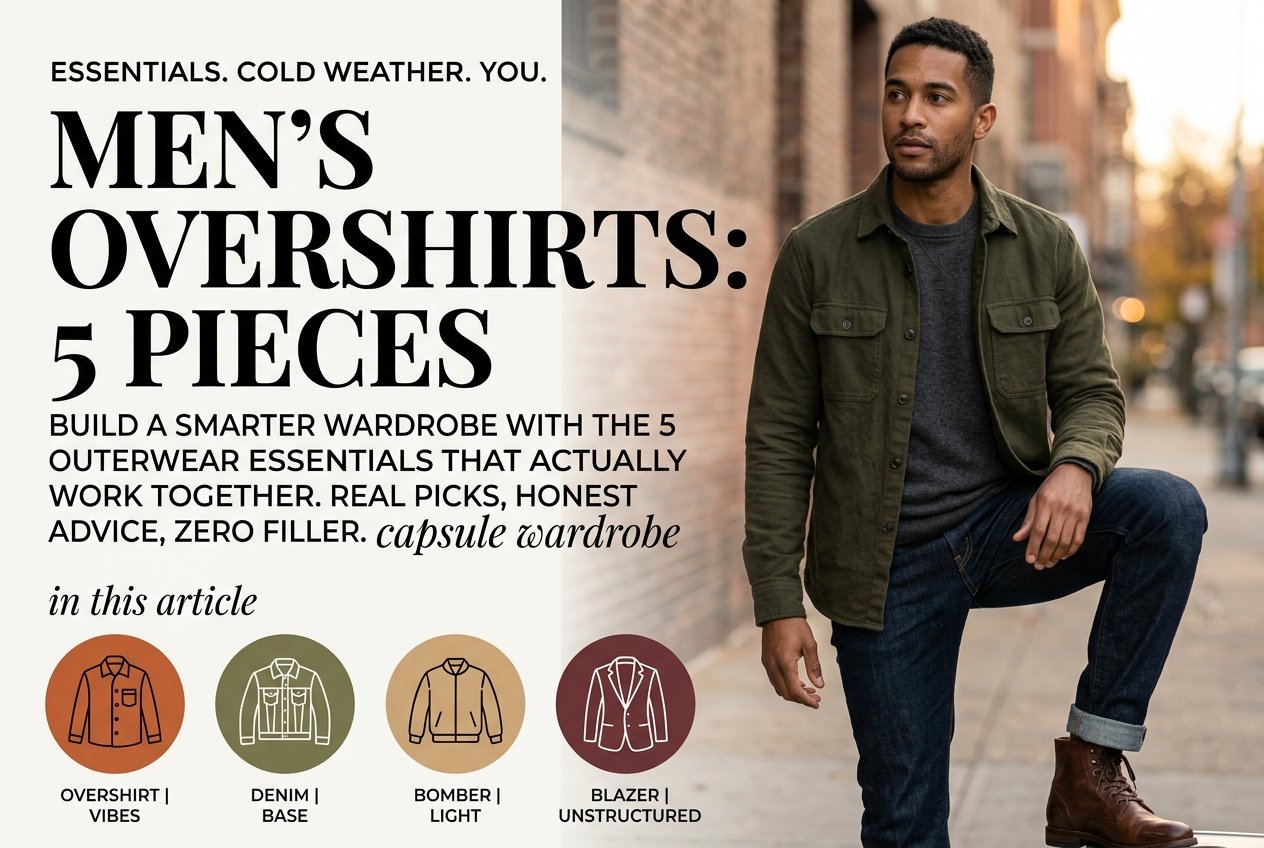
Here’s the thing about cost per wear: it stops being abstract the moment you own a men’s overshirt you actually reach for four times a week. At $80 or $90 across 150+ wears in a year, you’re paying under a dollar each time. That math is what a real capsule wardrobe is built on — not minimalism for its own sake, but pieces that pull enough weight to justify the space they take up.
Most outerwear doesn’t do that. Most outerwear sits.
The problem with building a functional wardrobe isn’t finding options. There are too many options. The problem is that most of them are single-use — one season, one vibe, one specific outfit they actually work with before they start collecting dust. What follows are five pieces that genuinely don’t do that: a men’s overshirt, a denim jacket, a lightweight bomber, an unstructured blazer, and a packable rain jacket. Each one justifies its existence. None of them demand a specific costume to surround them.
Why the Overshirt Wins
I’ll admit I resisted overshirts for longer than I should have. They seemed redundant — I had shirts, I had jackets, why did I need something in between? Then I bought one in a warm charcoal cotton and wore it approximately every other day for three months straight. That changed everything. An overshirt sits in that middle ground where it’s structured enough to look intentional but relaxed enough to throw over a sweater without the whole thing looking stuffed. It’s a shirt that’s also a jacket. It works alone in September, works under a heavy coat in November, and somehow still reads as put-together when you’ve paired it with jeans and nothing else. The best ones come in neutral tones — charcoal, olive, tan, cream — with a texture that adds some visual interest without demanding attention. Look for a slightly nubby cotton or a linen blend. The fit should be relaxed without being shapeless; you want to move in it comfortably, not swim in it.
Denim. Still.
A denim jacket works because it was never really trendy in the first place — it just always made sense. Medium wash or dark indigo, both age well and handle daily abuse better than lighter options. The weight matters more than most people think; you want fabric with real heft, the kind that softens gradually over a year rather than thins out. Fit-wise, it should hit at your hip with sleeves ending at your wrist when your arms hang naturally — nothing that hangs off your frame, nothing that restricts your shoulders. Oversized denim is everywhere right now, but that doesn’t mean it’s right for your particular build. (Actually, that’s not quite right — oversized can work, but only if you’re deliberately pairing it with something more fitted underneath, otherwise the whole thing reads as accidental rather than considered.) Most denim jackets honestly look better after twelve months of regular wear than they do brand new. That’s not a flaw in the design. That’s the design.
What fills the gap between a t-shirt and a real coat?
A lightweight bomber. Spring mornings when the air hasn’t warmed up yet. Fall evenings that drop faster than expected. The aggressively air-conditioned office in July. These are the moments where a heavy jacket is comically wrong and a single layer isn’t enough, and a bomber handles all of them without requiring you to think about it. Technical fabrics — nylon blends, cotton-poly mixes — pack down easily and dry fast when you get caught in light rain. Color matters here more than with other pieces in this list: navy, sage green, or a muted burgundy all add some personality without demanding you rethink the rest of your outfit. The fit should be close but not tight. Too baggy reads juvenile; too fitted defeats the whole point of having a layer. You’re looking for something that sits comfortably over a long-sleeve tee and doesn’t bunch up when you zip it.
The Blazer You’ll Actually Wear
Unstructured blazers solve a specific problem: looking like you made an effort without actually making that much effort. Soft shoulders, natural fabric, a drape that settles on your body instead of imposing a shape — these are the things that separate a blazer you’ll wear with jeans and sneakers on a Tuesday from one that lives in your closet waiting for a wedding. Cotton, linen, and wool blends all work well here; avoid anything synthetic that looks slightly shiny under overhead lighting. Navy and charcoal are the safe choices, though a warm camel reads as more interesting if you want something with a bit more personality in the mix. The fit needs to be close through the shoulders with enough room in the chest to wear a light sweater underneath without it looking cramped, and the length should hit at your hip or just slightly below — longer than that starts to look formal in a way that undercuts the whole casual-but-polished point.
Rain Gear That Doesn’t Embarrass You
You’ll forget this jacket exists until you need it.
Then you’ll be very glad it does. A good packable rain jacket folds down to roughly the size of a water bottle, weighs almost nothing in your bag, and actually keeps you dry — not damp, dry — when it matters. Look for taped seams, a hood that adjusts properly, and a neutral color: black, navy, or olive all work. The fabric should feel like it means business, not like a thin plastic bag you’re wearing. Pit zips or underarm vents sound like a minor detail until you’re actually wearing the jacket and realize you can regulate your temperature without overheating or taking it off entirely. This is one of the few places in a wardrobe where spending more consistently pays off — a $100 jacket packs smaller, lasts longer, and has better seam construction than a $40 one. You might only reach for it a dozen times a year, but those twelve times, you’ll want it to actually work.
How It Fits Together
An overshirt over a crew neck with chinos and clean sneakers. A denim jacket over a henley with dark jeans. A bomber with a polo and joggers when you’re not trying at all but still want to look like you are. A blazer with a t-shirt and tailored trousers when the occasion calls for something more. A rain jacket over whatever you’re already wearing when the sky goes gray mid-afternoon and you didn’t check the forecast.
What the capsule approach actually changes is the buying habit, not just the closet. When every piece has to justify its existence against what you already own — when you’re asking “does this multiply what I have or just add to the pile?” — you stop purchasing things because they were on sale or because you thought you should own them eventually. Build it slowly. Buy one piece, wear it for a few weeks, see whether you’re reaching for it constantly or finding reasons to skip it. The answer tells you everything you need to know before buying the next one. A wardrobe that actually works isn’t built in an afternoon; it’s built by paying attention.
At Unwritten, our editors choose every product and story idea independently — we only recommend things we’d genuinely tell a friend about.
Frequently Asked Questions
What makes a men’s overshirt different from a regular shirt or jacket?
An overshirt sits between those two things — it has the structure of a light jacket but wears like a shirt. You can throw it over a t-shirt on a cool morning or layer it under a heavier coat in winter. That middle-ground functionality is exactly why it earns so much use.
How many outerwear pieces does a capsule wardrobe actually need?
Five is a reasonable ceiling. Beyond that, pieces start competing with each other rather than complementing each other. The goal is coverage across weather conditions and occasions — not variety for its own sake.
What’s the best fabric for a men’s overshirt?
A slightly textured cotton or a linen blend tends to work best across seasons. You get visual interest without anything that feels precious or high-maintenance. Avoid anything that wrinkles badly or pills after a few washes.
Is an unstructured blazer casual enough for everyday wear?
Yes — that’s the whole point of buying unstructured over structured. Soft shoulders, natural fabric, and a relaxed drape mean you can wear it with jeans and sneakers without looking like you forgot to take off your work clothes.
When is it worth spending more on a packable rain jacket?
When you actually live somewhere it rains. A $40 option works, but the more expensive ones pack smaller, last longer, and usually have better seam taping. If you’re only reaching for it a handful of times a year, spending more per use still makes sense because you’ll have it for a decade.