
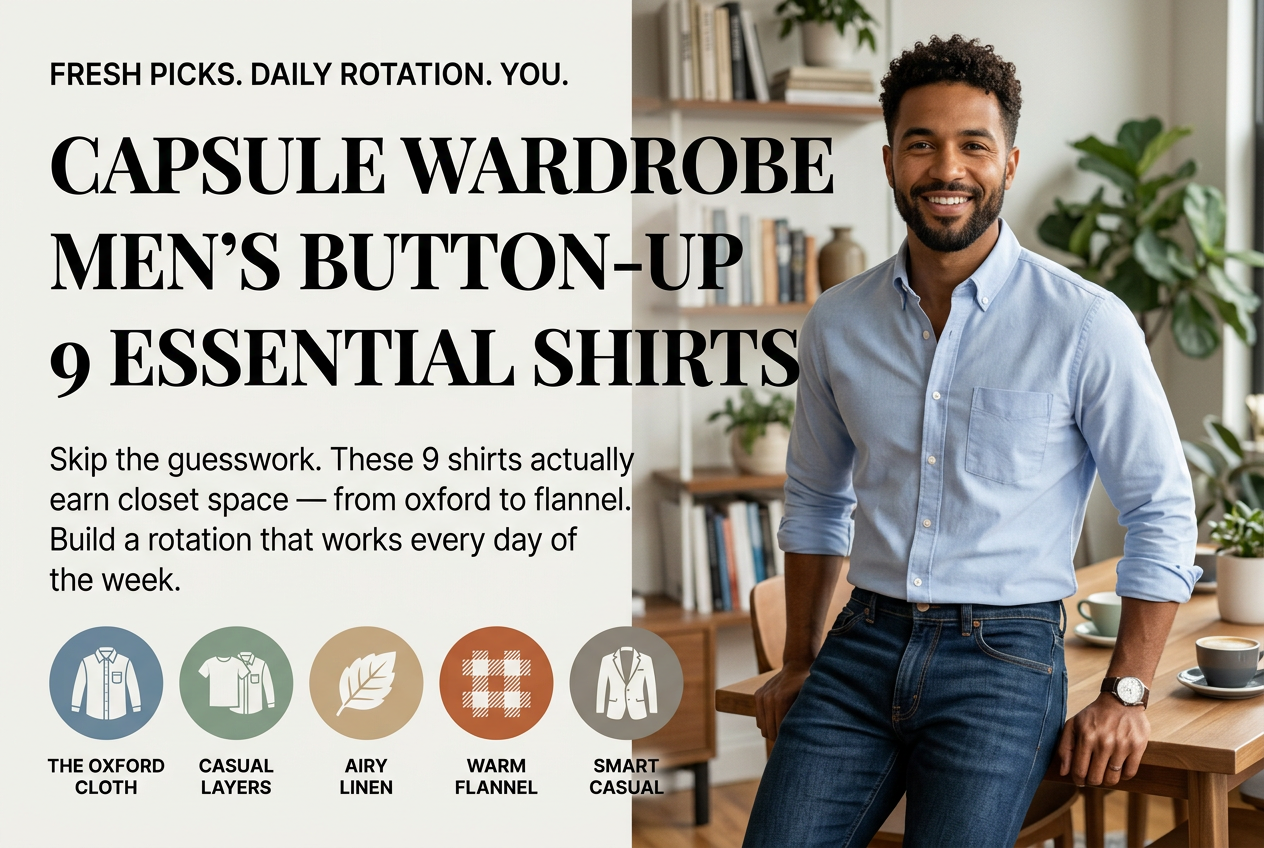
Here’s the thing about men’s button-up shirts that most wardrobe guides bury in the final paragraph: you only need a few of them, and you probably already own the wrong ones. Not bad shirts, necessarily — just shirts that don’t actually get worn, that hang there looking fine in theory while you reach past them for the same three pieces every morning. The goal isn’t a bigger collection. It’s a better one.
So instead of padding this out with filler, let’s get straight to what actually earns closet space.
Start Here: The Oxford
An oxford cloth button-up is the one shirt that genuinely does everything. The fabric — that slightly textured, durable weave — has a casual credibility that dressier materials can’t fake. Wear it untucked over a t-shirt on a Tuesday, layer it under a sweater for a work meeting, throw a blazer over it for dinner. I’ve worn the same light blue oxford to a job interview and a backyard birthday party in the same week, and it didn’t feel out of place at either one. The secret is that it doesn’t try too hard, which is exactly why it works.
Start with white and light blue. Those are your workhorses. White pairs with literally everything; light blue is forgiving enough for weekends but polished enough when you need to look like you made an effort. Fit matters more than most men realize — you want something that skims your torso without clinging, with sleeves that land near your wrist bone. A slightly relaxed cut actually reads as more intentional than something pulling at the buttons.
Does Linen Actually Work, or Is It Just Wrinkled?
Both. That’s the honest answer.
Linen has a reputation for looking slept-in, and to be fair, it does wrinkle — but those soft creases are part of the fabric’s appeal, not a flaw you’re fighting against. A linen button-up in summer isn’t trying to look pressed. It’s trying to keep you cool while looking like you put in some thought without stressing about it. Cream and soft white work year-round, but a pale blue or muted sage adds a bit more personality without veering into costume territory. One practical note: linen’s looser weave means sizing up slightly doesn’t look sloppy the way it might with a tighter-woven fabric — if anything, the extra room improves the drape. Wear it with shorts, roll the sleeves and throw it over a tee on a cooler evening, or pair it with lightweight chinos when you need something that reads as intentional rather than accidental.
Chambray: Not Denim, But Close Enough to Matter
Chambray sits in interesting territory. It looks like denim because technically it shares some DNA with it, but the plain weave makes it lighter, softer, and more shirt-like in how it drapes. The subtle two-tone texture gives it depth without being loud about it — casual enough for a Saturday but structured enough that it doesn’t disappear into purely relaxed territory.
A medium blue is your safest starting point. Darker than a light blue oxford, lighter than actual denim, and it plays well with both. Wear it with jeans (the slight color difference actually works, despite what you might think), chinos, or shorts. It layers cleanly under a crewneck sweater and looks deliberate when worn open over a plain white tee. Chambray also hides wrinkles better than smoother fabrics, which matters more than it sounds when you’re traveling or just running late.
Flannel
Flannel is comfort that also happens to be a shirt. Soft, warm, and carrying that inherent coziness that makes you want to wear it on a Saturday with no plans — which is exactly the right energy for it. The mistake most guys make is sizing up too much and reaching for the loudest plaid on the rack, which tips the whole thing from intentional into something that looks like you borrowed it from a camping trip. A slightly slimmer cut and a restrained color palette fix both problems immediately. Start with a red-and-black plaid or a navy-and-white check — patterns structured enough to feel purposeful, casual enough to actually relax in. Wear it untucked with jeans, layer it under a chunky sweater with just the collar showing, or throw it open over a long-sleeve tee when the temperature can’t make up its mind. Spring and fall are flannel’s best seasons. And unlike most shirts, flannel genuinely looks better with a little extra room — so if you’re between sizes, go up.
The One That Works When Jeans Feel Too Casual
There’s a specific situation most men don’t have a great answer for: not business attire, but not weekend mode either. A nice dinner. A work lunch where the client matters. Meeting someone’s family for the first time. These moments need a shirt that looks like you thought about it without looking like you tried too hard, and that’s a harder gap to fill than it sounds.
What you’re after here is a solid-color shirt in a slightly more refined fabric — premium cotton with a subtle structure, or a cotton-blend that holds its shape without feeling stiff. Crisp white and soft gray are your anchors. The fit should be clean without being tight, and the hem length matters: 28 to 30 inches from shoulder to hem gives you the option to tuck or leave it out depending on the situation. (Actually, that range assumes a standard build — if you’re taller, add an inch or two, otherwise the shirt rides up the moment you reach for anything.) These are the shirts worth spending a bit more on, because they’re the ones doing the heaviest lifting in your rotation.
Building the Rotation Without Overbuying
Don’t buy all of these at once.
Start with one oxford, one linen, one chambray, and one flannel. Wear them for a few months and notice which ones disappear into your regular rotation and which ones you keep skipping. The ones you reach for without thinking are the ones worth upgrading — better fabric, better construction, maybe a second colorway. The ones collecting dust are telling you something worth listening to. Pay attention to fit above every other variable. A $40 shirt that fits well will look sharper and last longer than a $150 shirt that’s slightly off in the shoulders. Stick to neutral colors and classic patterns — not because playing it safe is the goal, but because those are the pieces that pair with four other things in your closet instead of one.
At Unwritten, our editors choose every product and story idea independently — we only recommend things we’d genuinely tell a friend about.
Frequently Asked Questions
How many button-up shirts does a man actually need?
Five to seven covers most situations. One oxford, one linen, one chambray, one flannel, and a couple of smarter options gets you through nearly every dress code without redundancy.
What’s the difference between chambray and denim shirts?
Chambray uses a plain weave while denim uses a twill weave, which makes chambray noticeably lighter and softer. They look similar at a glance, but chambray drapes more like a dress shirt and works in warmer weather where denim would feel heavy.
Should button-up shirts be tucked or untucked?
It depends on the shirt’s hem length and the occasion. A hem that hits around mid-fly is designed to be worn untucked. Anything longer — 28 to 30 inches from shoulder to hem — gives you both options without looking sloppy either way.
What colors should I start with when building a button-up collection?
White and light blue oxfords first, full stop. After that, a medium blue chambray, a cream or pale linen, and one flannel in a two-color check. These four cover more ground than a closet full of trending shades.
Does fit matter more than fabric quality?
Yes, and by a wider margin than most people expect. A well-fitting $40 shirt reads as more intentional than a $150 shirt that pulls across the shoulders or bags at the waist. Get the fit right first, then upgrade materials over time.