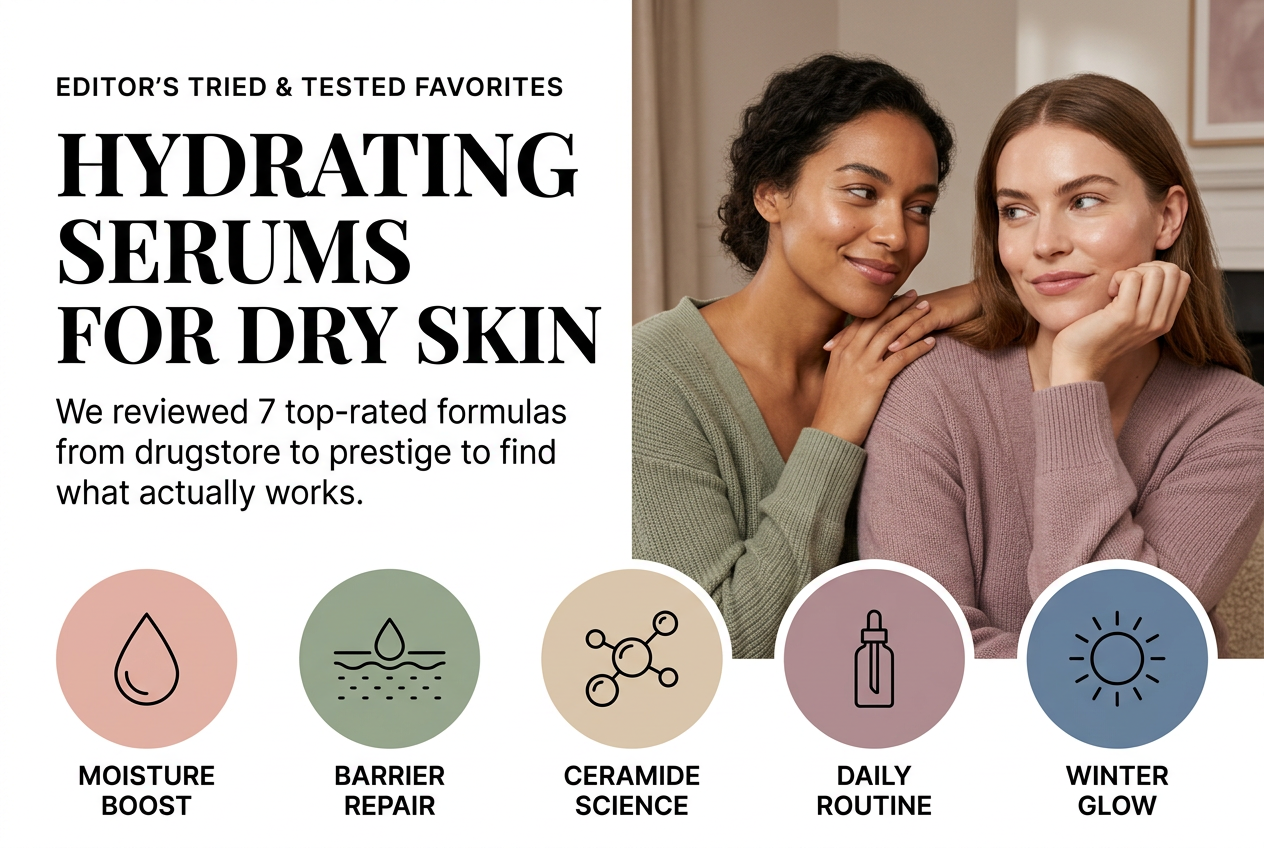
Your moisturizer isn’t the problem. I know that’s not what the packaging implies, but after three months of testing hydrating serums at every price point — from an $8 drugstore tube to a $120 prestige bottle — I’m convinced the real issue for most people with dry skin happens one step earlier, before the cream ever touches their face.
Here’s the thing most skincare content gets wrong: dry skin isn’t a single condition. It’s usually one of two failures happening at once — your skin isn’t producing enough natural oil, or your moisture barrier is compromised and can’t hold water. Slathering on a thick cream without fixing the barrier underneath gives you greasy skin on top and dehydration underneath. A hydrating serum is what bridges that gap, delivering water-soluble humectants that pull moisture into your skin and holding it there so your moisturizer actually has something to work with. Think of it as laying a foundation before you paint a wall. The paint still matters. But without the primer, nothing sticks.
Why Dry Skin Lies to You
Winter makes barrier damage worse. So does over-exfoliating, using a cleanser that strips your skin, or just living somewhere with low humidity for six months of the year. I learned this the hard way after assuming my chronically tight cheeks were just “my skin type” — turns out I was using a foaming cleanser twice a day that was wrecking my barrier before any serum could do its job. Actually, that’s not quite right: the serum was working, just fighting an uphill battle every single morning.
Molecular weight matters more than most ingredient lists let on. Hyaluronic acid comes in different sizes — low-molecular-weight versions penetrate into the skin, while high-molecular-weight versions sit on the surface and create a plumping effect you can see. The best serums use both. Beyond that, look for humectants (glycerin, panthenol, hyaluronic acid) in the first five ingredients, and be cautious with anything that lists alcohol early in the formula — it’s actively dehydrating and undercuts everything else in the bottle.
What Actually Separates a Good Serum from Expensive Water
Texture is a proxy for consistency. If a serum feels too thick you’ll skip it on rushed mornings; if it’s too thin it feels like nothing is happening even when it is. The products I kept reaching for had a gel-like weight — present but not sticky, absorbed in under 30 seconds. I also paid attention to what serums didn’t contain: essential oils, which can irritate a compromised barrier, and fragrance, which does the same thing while adding zero hydration benefit.
Does price predict performance?
Not reliably. Some of the most effective formulas I tested cost under $15. A few of the priciest felt like I was paying for the glass bottle and the brand’s ad spend. That said, two of the prestige picks genuinely outperformed everything in the drugstore tier — specifically for deeper dehydration and barrier repair, not just surface-level plumpness.
Drugstore Picks That Held Their Own
You do not need to spend a lot here.
This serum is the definition of ‘does what it says.’ It’s got hyaluronic acid, glycerin, and panthenol — three of the most effective hydrating ingredients available — and it costs about the same as a coffee. The texture is slightly thicker than water but absorbs in seconds. I’ve been using it for two months, and my skin feels noticeably less tight, especially in the morning. The only minor downside? The bottle is plastic and feels a bit cheap, but honestly, at this price, I’m not complaining.
Niacinamide is underrated for dry skin. This serum combines it with ceramides and hyaluronic acid to both hydrate and calm irritation. It’s especially good if your dryness comes with redness or sensitivity. I’ve noticed my skin barrier feels more resilient since I started using it — less reactive, less tight. It layers beautifully under any moisturizer and doesn’t pill.
This one’s a sleeper. It’s mostly glycerin and panthenol with a touch of hyaluronic acid, and it feels like a hydration drink for your skin. It’s the lightest of the drugstore picks, so it’s perfect if you have dry skin that’s also slightly oily or if you just hate heavy serums. I use it on days when my skin feels dehydrated but not necessarily tight.
Splurge-Worthy? The Prestige Case
This serum feels like the prestige version of everything I love about drugstore hydrators, but with more layers. It’s got three different molecular weights of hyaluronic acid plus a peptide complex and antioxidants. The texture is silky without being heavy, and it absorbs into skin that feels almost dewy. I’ve been using it for six weeks, and my skin looks plumper and feels less reactive. It’s expensive, but the bottle lasts a solid two months of twice-daily use. If you’re dealing with severe dryness or winter damage, this one’s worth the investment.
This is the serum I reach for when my skin is truly suffering — after a harsh winter or when I’ve been over-exfoliating. It’s packed with ceramides, peptides, and a proprietary complex that’s supposed to mimic the skin’s natural moisture factors. Does it work? Yes, noticeably. My skin feels softer and more resilient within a few days. The only catch is the price tag, which makes it more of an occasional splurge than a daily driver.
This one has a slightly different angle — it’s got hyaluronic acid and glycerin like the drugstore versions, but it also includes a blend of botanical extracts and a small amount of niacinamide. The result feels more like a treatment serum than just hydration. It’s thicker than the drugstore picks, almost serum-meets-essence, and it leaves skin looking genuinely glowing. I use it at night mostly, but it works in the morning too if I layer it right.
The Right Way to Apply It (Most People Skip This)
Apply to skin that’s still slightly damp — about 10 seconds after rinsing, not bone dry and not dripping. Use three to four drops for your whole face; more doesn’t mean more hydration, it just means a sticky mess that pills under your SPF. Press the serum in with your fingertips rather than rubbing, wait 30 seconds, then go in with your moisturizer. That sequence — serum delivers water, moisturizer seals it — is what actually changes dry skin over time. Do it morning and night, not just whenever you remember.
One more thing worth saying: if you’re using a solid hydrating serum and your skin still feels tight or flaky by midday, the problem might not be the serum at all. Harsh cleansers and over-exfoliation strip your barrier faster than any serum can rebuild it. Dry skin needs a gentle, non-foaming cleanser and exfoliation no more than twice a week. The serum can only do its job if you stop undoing it every morning in the shower, which — speaking from experience — is an easier fix than buying a more expensive bottle.
If I had to pick just one thing three months of testing taught me: start drugstore, stay consistent, and only move to a prestige formula if mild-to-moderate dryness hasn’t responded after six weeks. Chronic barrier damage responds better to the advanced ceramide-peptide formulas, but most seasonal dryness doesn’t need them. The $12 bottle and the $90 bottle can both work — the one that works is the one you actually use every day.
At Unwritten, our editors choose every product and story idea independently — we only recommend things we’d genuinely tell a friend about.
Frequently Asked Questions
What ingredients should I look for in a hydrating serum for dry skin?
Hyaluronic acid, glycerin, and ceramides are the workhorses. Panthenol is also worth seeking out — it hydrates and helps repair the barrier simultaneously. For best results, look for at least two of these in the first five ingredients on the label.
Should I apply a hydrating serum to wet or dry skin?
Slightly damp skin is the sweet spot. Wait about 10 seconds after rinsing — not soaking wet (that dilutes the formula) but not fully dry either. Humectants like hyaluronic acid need some surface moisture to actually pull water into your skin.
Can I use a hydrating serum if my skin is oily or combination?
Yes, and you probably should. Oily skin can still be dehydrated — that’s your skin producing excess oil to compensate for lack of water. A lightweight hydrating serum actually helps regulate that cycle over time.
Do I still need a moisturizer if I use a hydrating serum?
Always. The serum delivers water into your skin; the moisturizer seals it there. Skipping the moisturizer means that hydration just evaporates — especially in dry or cold climates where transepidermal water loss is already a problem.
How long does it take to see results from a hydrating serum?
Most people notice their skin feeling less tight within three to five days of consistent use. Visible changes — more plumpness, less flaking, better texture — usually show up after two to four weeks. Barrier repair takes longer, closer to six to eight weeks of daily use.