
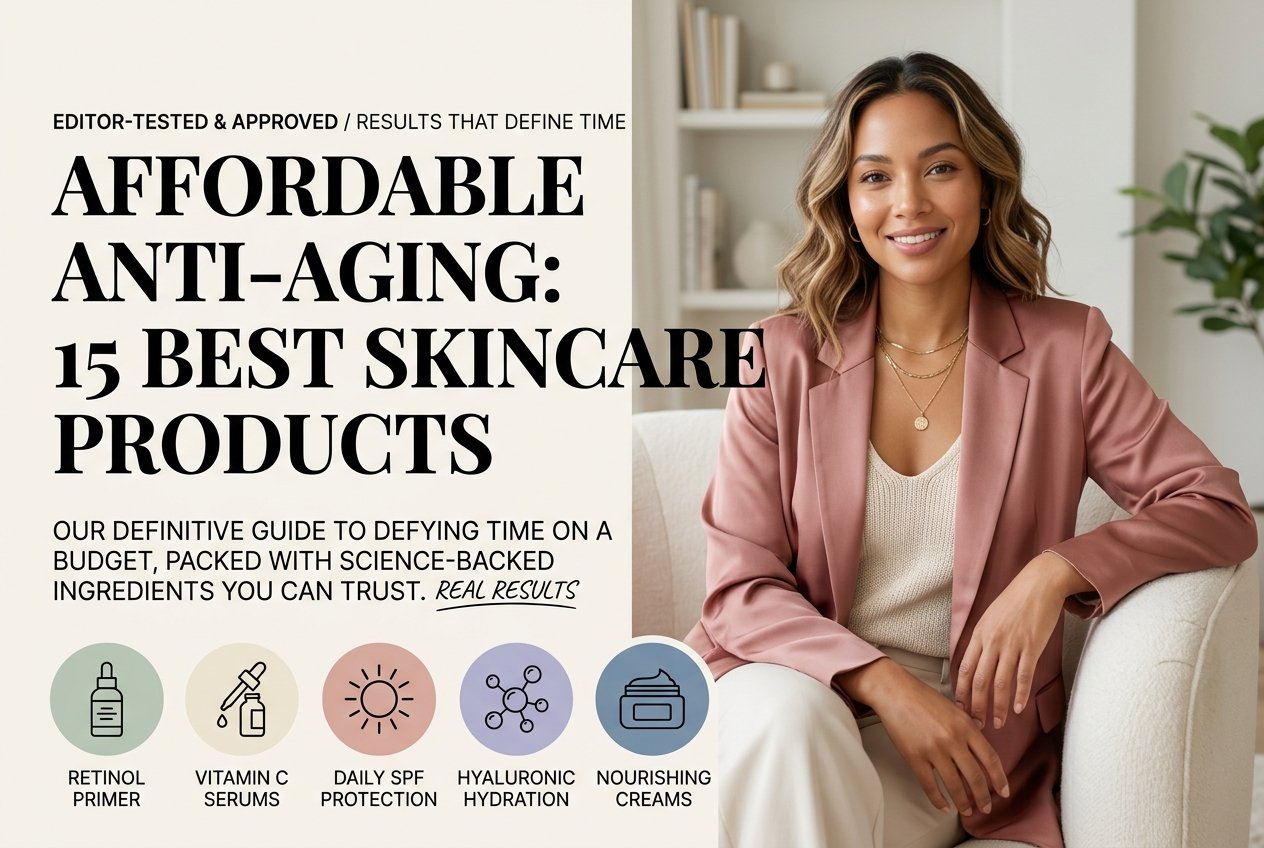
I bought my first retinol at 27, standing in a drugstore aisle.
Here is what the past two years taught me. Affordable anti-aging comes down to proven ingredients and steady habits, not a ten-step shelf or a luxury price tag. You need a cleanser, a vitamin C serum, a retinol, a moisturizer and SPF. Everything else is a bonus. Start there.
Your skin has a memory. Every late night, every sunny day without SPF and every stressful week shows up eventually, usually right when you are not expecting it. The good news is that affordable anti-aging doesn’t need a second mortgage or a dermatologist on speed dial. I’ve tested dozens of products over the past two years, and the ones that actually work share a trait: they are honest about what they can and cannot do, and they are packed with ingredients that have real science behind them.
Anti-aging skincare isn’t about erasing time, it is about working with your skin instead of against it. Whether you are 25 and thinking preventatively or 45 and ready to tackle fine lines head-on, the right products can change how your skin looks and feels, and you will not need to spend $300 on a single serum to see it, since some of the most effective ingredients sit on your local drugstore shelf. I’m here to show you which ones deserve a spot in your routine.
So what actually works?
What really happens to skin as we age?
Before we talk products, let’s talk about what happens to skin as we age. Collagen production drops by about 1% each year after 20, which sounds slow until you realize that adds up to 20% less by 40. Elastin breaks down. Cell turnover slows. Sun damage piles up. I noticed it myself around 30, when a sunburn from a single beach weekend left a mark that took months to fade instead of weeks. The good news is that this isn’t some unstoppable avalanche. It is a process you can influence with the right ingredients, and the earlier you start, the less ground you have to win back. Think of it as maintenance on a house, not a rescue after the roof caves in. Nothing dramatic happens in a week, and that is exactly why people give up.
The most evidence-backed ingredients fall into a handful of groups. Retinoids, including retinol, increase cell turnover and boost collagen. Vitamin C protects against free radicals and brightens. Peptides signal your skin to produce more collagen, while hyaluronic acid plumps fine lines by holding moisture. Niacinamide strengthens your skin barrier and calms inflammation. SPF prevents future damage, which honestly might be the most anti-aging thing you can do. None of these are flashy or new. They work because decades of research back them up, not because they are trendy.
Most people make the same mistake: they try to use every active at once. Your skin doesn’t work that way. A solid affordable anti-aging routine starts with a cleanser, a hydrating toner or essence, a targeted serum or treatment, a moisturizer and daytime SPF. Add retinol at night and maybe a vitamin C serum in the morning. That’s it. More isn’t better, consistency is.
Six ingredients that earn their place
Not all anti-aging ingredients are equal, and knowing what each one does helps you build a routine that works. Let me break down the heavy hitters.
Retinol and retinoids are the gold standard. Retinol is vitamin A’s cousin: your skin converts it to retinoic acid, which tells cells to turn over faster and produce more collagen. Start low, around 0.25 to 0.5%, and build up. My first tube made my cheeks peel for a week, so I dropped to every third night. Your skin might get slightly irritated at first, and that is normal. Within 8 to 12 weeks you will see smoother texture and fewer fine lines. Prescription retinoids like tretinoin are stronger, but over-the-counter retinol works beautifully for affordable anti-aging.
Next comes vitamin C, an antioxidant. It protects against free radicals from sun and pollution, and it brightens dark spots while supporting collagen. Look for L-ascorbic acid, the most effective form, or stabilized versions like ascorbyl palmitate. A good vitamin C serum feels like a morning essential because it preps your skin for the day ahead.
Gentler than retinol, peptides are short chains of amino acids that signal your skin to produce collagen and elastin. They work well alongside retinol. If your skin is sensitive, peptides are your friend.
To plump fine lines from the inside out, hyaluronic acid holds up to 1000 times its weight in water. It’s a humectant, and it’s especially powerful in humid climates or layered under a moisturizer. Use it on damp skin for best results.
Also called vitamin B3, niacinamide strengthens your skin barrier and reduces inflammation, and it makes pores look smaller. It plays well with most other ingredients, which makes it a reliable addition to any affordable anti-aging routine.
For exfoliating, there are AHAs and BHAs. Glycolic acid (an AHA) and salicylic acid (a BHA) work by dissolving the bonds between dead skin cells. They speed up cell turnover and smooth texture, and they brighten too. Two or three times a week is plenty. Daily is too much.
Drugstore skincare is not prestige on a budget
The beauty of affordable anti-aging is that some of the best-performing products live on drugstore shelves. These are not watered-down versions of prestige formulas. They work well, often because the brands nailed the ingredient concentrations without the luxury packaging markup. I’ve found that drugstore anti-aging products tend to be more straightforward, doing one or two things really well instead of trying to be everything.
What I love about shopping the drugstore is the price-per-ounce reality. You can afford to use these products consistently, which matters far more than owning one expensive jar you are afraid to touch. And honestly, some of the retinol formulas I have tested for under $20 rival prestige options at three times the price. The active ingredient is the active ingredient. Your skin doesn’t care whether it came from a luxury brand or a mass-market label.
Prestige picks for when you want to splurge
Sometimes you want to splurge. There’s something satisfying about a beautifully packaged serum that feels like a ritual instead of just a step. Prestige anti-aging products often justify their price with higher concentrations of actives and more sophisticated delivery systems. Some also contain ingredients you will not find at the drugstore. They aren’t always better, but they can feel more intentional.
The key to prestige shopping is knowing what you are actually paying for. A $150 serum that’s mostly water and glycerin isn’t worth it, no matter the packaging. But a serum with a proper retinol dose, stabilized vitamin C, peptides and a gentle base? That’s worth considering if it fits your budget. I think of prestige products as the next tier. Once you’ve nailed your drugstore routine and want to deepen results, that’s when you might upgrade one or two steps.
Build a routine you will actually use
The best affordable anti-aging routine is the one you will actually use. That means starting simple and adding complexity only when you are ready. Here’s how I’d structure it, whether you are shopping the drugstore or mixing in prestige picks.
Mornings are short: cleanser, vitamin C serum, moisturizer, SPF 30 or higher. That’s it. Vitamin C preps your skin for the day and protects against environmental stress. SPF is non-negotiable, and it is the single most important anti-aging step you can take. Sunscreen prevents new damage, which is far easier than reversing it later.
At night, the heavier actives come out: cleanser, a hydrating toner if you like (optional but nice), retinol serum or cream, then moisturizer. Start with retinol two or three nights a week if your skin is new to it, then build to nightly use. Your skin does most of its repair work at night, so this is when you bring the stronger stuff.
Once or twice a week, swap your evening retinol for an AHA or BHA exfoliant. This boosts cell turnover without overwhelming your barrier. If you exfoliate, skip retinol that night.
Optional extras include an eye cream with peptides or caffeine for the delicate under-eye area, or a hydrating mask when your skin feels tight. They aren’t essential, but they’re nice when you want to feel like you’re doing something extra.
No serum erases deep wrinkles
Here’s the honest part. No product can erase deep wrinkles or turn back time completely. If you want that, you need a dermatologist, not a serum. But products can prevent new damage, smooth fine lines, brighten dullness and improve texture. They can make your skin look fresher and feel more resilient, and they can change how you feel about your reflection. That’s not nothing.
The other thing is consistency, which matters more than perfection. Using an affordable anti-aging routine every single night for six months will give you better results than sporadic use of expensive products. Your skin responds to routine and patience, not to how much you spend. I’ve seen more dramatic improvements in people who stuck with a $15 retinol for three months than in people who bounced between five expensive serums.
Building the routine is really about knowing what your skin needs and then committing. You don’t need ten steps or a luxury price tag. Be patient and your skin will thank you. If I could keep only two products, I’d keep the retinol and the SPF.
At Unwritten, our editors choose every product and story idea independently — we only recommend things we’d genuinely tell a friend about.
Frequently Asked Questions
How long does retinol take to show results?
Most people see smoother texture and fewer fine lines within 8 to 12 weeks of steady use. Start with a low strength, use it two or three nights a week, and build up slowly.
Do I need expensive products for anti-aging skincare?
No. Drugstore products with proven actives work well, and consistency matters far more than price. Prestige products can be a nice upgrade once your basic routine is solid.
What is the most important anti-aging step?
Daily sunscreen of SPF 30 or higher. It prevents new damage, which is much easier than reversing it later.
Can I use retinol and an exfoliating acid on the same night?
It is better not to. Skip retinol on the nights you use an AHA or BHA exfoliant, and keep the acids to once or twice a week so your skin barrier stays calm.