
My passport was somewhere at the bottom of a tote bag in a crowded Rome train station when I decided I was done with every bag style except one. That moment — frantic, sweaty, mildly panicked — is exactly what a good crossbody bag is designed to prevent.
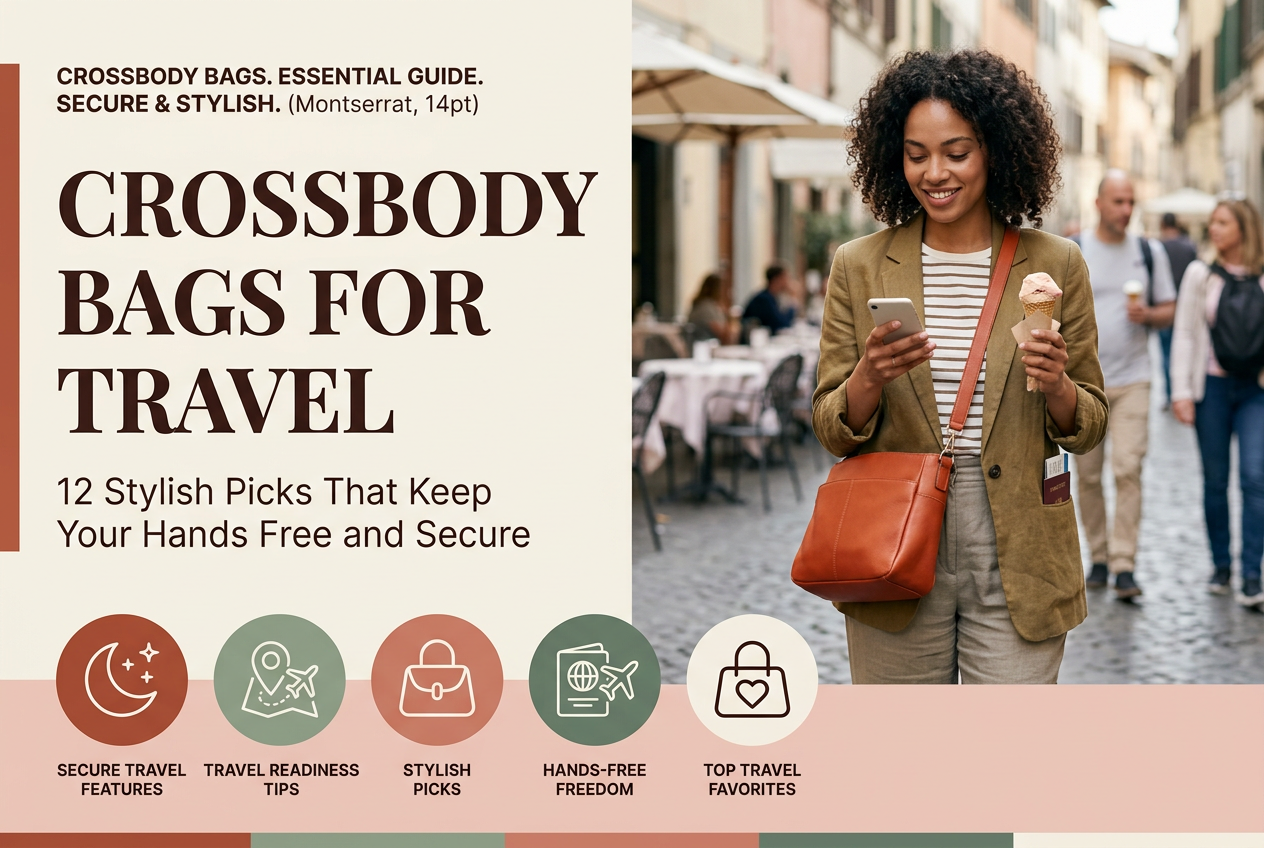
Crossbody bags for travel solve a problem you might not fully appreciate until you’re standing in a cobblestone square with a gelato in one hand, a map on your phone in the other, and absolutely nowhere to put either of them safely. The strap distributes weight across your body instead of killing one shoulder, your stuff stays exactly where you left it, and your hands are actually free to do things like, say, eat the gelato. Once you travel this way, going back to a tote or a shoulder bag that keeps sliding off feels genuinely absurd.
Why Your Bag Choice Is the Most Underrated Travel Decision You’ll Make
Here’s the thing about crossbody bags that nobody really talks about: they don’t just carry your stuff, they change how you move through a place. When your bag is secure and settled against your body, you stop doing that unconscious reach-and-check that every traveler does in crowded spaces. You stop mentally cataloguing where your wallet is. You stop hunching over a cafe table with your tote wedged under your feet because you don’t trust the floor. That low-grade anxiety just… disappears. Which means you can actually pay attention to where you are instead of what you’re carrying.
They also sidestep the whole backpack-versus-tote standoff neatly. A tote has no organization. A backpack requires you to stop walking, swing it around, and dig through it every time you need your transit card. A crossbody bag sits in front of you, zips open in one motion, and closes just as fast. For a full day of sightseeing, that difference adds up to a lot of saved minutes and zero shoulder strain.
What Actually Makes One Worth Buying
Security first. You want multiple compartments — at minimum a zip inner pocket for your phone or passport and a separate section for everything else — so you’re not treating the bag like a black hole you fish around in. RFID-blocking lining is worth having if you travel internationally with any frequency, because it scrambles the signals from your credit cards and passport chip. The strap deserves more scrutiny than people give it: it should be wide enough that it doesn’t cut into your shoulder after three hours, adjustable enough to wear over a coat, and sturdy enough that it genuinely couldn’t be sliced through in a crowd. (Yes, that happens. Especially in tourist-heavy European cities.)
Style matters more than it sounds like it should. A crossbody bag is on your body for hours at a stretch. It’s in every photo. It becomes part of whatever you’re wearing, whether that’s a sundress in Lisbon or jeans and a sweater in Edinburgh. A bag that makes you feel good to look at is one you’ll actually reach for — and one you’ll want to use when you get home, too, which brings the cost-per-wear down considerably. Don’t talk yourself into a bag that’s purely functional if you’re going to resent it every morning.
Comfort is where a lot of otherwise solid bags fall apart. Thin straps dig. Bags that are too heavy on one side pull. And here’s the specific thing I wish someone had told me earlier: a crossbody bag that swings around when you walk is a bad bag. It should sit against your hip or rib cage and stay there. If it’s bouncing with every step, either the strap is too long or you’ve packed it too heavy — and both of those things will make you miserable by afternoon.
Our 12 Favorite Crossbody Bags for Travel
Not every traveler needs the same thing. Some of you are packing light on principle. Others need room for a backup battery, a journal, a snack, and a rain jacket that may or may not fit. The bags below cover the full range — sleek and minimalist, roomy and structured, a few that are frankly beautiful enough to feel like an upgrade to your whole trip.
How to Pack One Without Hating Yourself by Noon
This is genuinely an art, and getting it wrong is how crossbody bags get blamed for back pain they didn’t cause.
Start with the non-negotiables in the innermost zip pocket: your ID or passport, your payment method, your phone. These don’t move. Add your keys to a small clip inside so they’re not loose and rattling. Then — and this is where most people go wrong — stop and think about what you actually use during a day versus what you’re bringing because it feels safer to have it. A lip balm, yes. Hand sanitizer, yes. Your full skincare routine in a separate pouch, no. Sunglasses go in a soft case or not at all, because loose lenses in a crossbody bag are a scratch waiting to happen. (I learned this in Barcelona. It was not a good day for my sunglasses.)
Actually, that’s not quite right — I learned it in Barcelona the second time. The first time was in a hostel common room, which was somehow worse. The point is: case your sunglasses.
Outer pockets are for fast-access items only. Your transit card. A folded map if you’re the kind of person who uses those. Gum. The goal is a bag you can carry for eight hours without consciously noticing it. The moment you start noticing it, you’ve overpacked.
These Bags Don’t Live in Your Suitcase
A crossbody bag that only comes out for travel is a bad investment. The best ones in this roundup earn their place in your regular rotation — errands, coffee, the farmers market, any situation where your hands are better off free and your stuff is better off close. A leather crossbody that works beautifully on a market street in Porto works just as well on a Sunday morning in your own neighborhood. That everyday versatility is what justifies spending real money on one instead of grabbing something disposable.
Buy the bag you’ll actually want to use. Your trips will be better for it.
At Unwritten, our editors choose every product and story idea independently — we only recommend things we’d genuinely tell a friend about.
Frequently Asked Questions
Are crossbody bags safe to use while traveling internationally?
Yes, and they’re actually one of the safer bag styles for international travel. The strap keeps the bag against your body, which makes opportunistic theft much harder. Look for bags with RFID-blocking pockets if you’re carrying a passport or credit cards — that extra layer of protection is genuinely worth it in high-traffic tourist areas.
What size crossbody bag is best for a full day of sightseeing?
Aim for something in the 6–9 inch height range with at least two interior compartments. You want enough room for your phone, wallet, passport, a compact umbrella, and a few small essentials — but not so much space that you end up overpacking and straining your shoulder by noon.
Can I wear a crossbody bag through airport security?
You’ll need to remove it and place it in a bin, just like any other bag. The upside is that crossbody bags are quick to slip off and back on, which makes the whole security shuffle less annoying than digging through a backpack. Some travelers keep their boarding pass and ID in an outer pocket specifically for this reason.
What features should I look for in a travel crossbody bag?
Prioritize an adjustable, sturdy strap (wide enough not to dig into your shoulder), a secure inner zip pocket for valuables, and a structure that sits flat against your body rather than swinging around when you walk. RFID blocking, water-resistant material, and a locking zipper are all worth having if you travel frequently.
Do travel crossbody bags work as everyday bags too?
The best ones absolutely do. A well-made leather or structured nylon crossbody that holds up to cobblestones and airport chaos will also handle a farmers market run or a coffee date without missing a beat. It’s one of the few travel purchases that genuinely earns its keep year-round.