
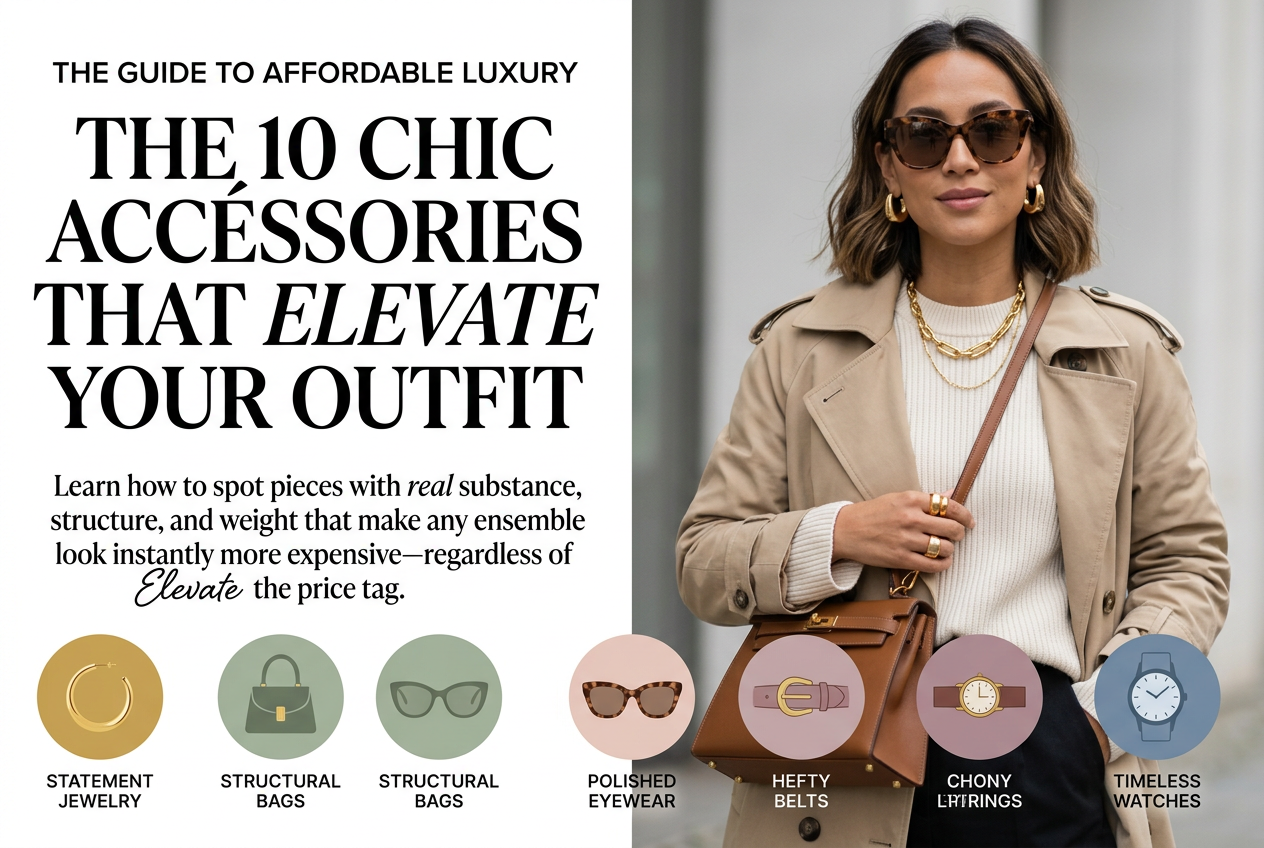
Start with this: a $25 necklace with real weight and architectural detail will almost always look more expensive than a $100 necklace that’s flimsy and poorly proportioned. That’s the whole argument, really. Everything else is just working out what that means in practice.
I spent a while convinced that looking put-together required actually spending money. Then I started paying attention to why certain pieces read as expensive—and it almost never came down to price. It came down to proportion, material weight, and a kind of deliberate restraint that cheap accessories rarely bother with. A $30 belt with the right heft and a solid buckle can look like it cost three times that. A pair of sunglasses from a fast-fashion retailer can make you look like you own a house in the south of France, if the frame shape is right.
Being strategic about this stuff isn’t about gaming the system. It’s just about knowing which details people actually notice—and which ones you’ve been wasting money on.
The Jewelry Question
Jewelry shifts how expensive an outfit looks faster than almost anything else. Not because of the price tag, but because the wrong piece at the wrong scale can undermine everything around it, and the right piece can make a plain black sweater look like a considered choice. What actually works here is substance. Flimsy chains read cheap no matter what metal they’re plated with—you want something that has real presence when you hold it, that catches light in more than one direction, that has a little architectural interest to the design. A chunky gold necklace with layered links or a bold pendant does more work for a basic outfit than five delicate pieces ever could, and the reason is simple: it’s the thing people’s eyes go to first, and if that thing looks good, the outfit looks good.
Oversized gold hoops are a classic for a reason. But here’s the thing—hoops with a slight twist, hexagonal instead of perfectly round, or with a subtle hammered texture, read as more intentional than smooth basic circles. Same price point. Completely different impression.
Stacked rings are worth understanding properly. Four thin gold or silver rings on one hand, mixed metals if you’re feeling bold, reads as deliberate styling rather than random jewelry. Each individual ring can be inexpensive. It’s the combination that creates the effect.
Bags: Restraint Wins Every Time
A handbag is the punctuation mark on an outfit. Get it wrong and your $300 jeans feel cheap by association.
What makes a bag read as expensive is mostly proportion and structure. A top-handle bag in cognac, black, or chocolate brown that holds its shape signals quality in a way a slouchy tote with visible stitching simply doesn’t. It doesn’t have to be leather—though that helps—but it does need enough structure that it doesn’t look like it’s slowly deflating over the course of the day. Minimal hardware matters too. One gold clasp on a simple black bag looks more designer than a black bag covered in three competing types of hardware. This trips people up because we’re taught that more detail equals more expensive. In high-end fashion, the opposite is almost always true.
If you want something smaller, a structured crossbody in a rich jewel tone—emerald, burgundy, deep sapphire—reads as incredibly intentional. It’s the kind of piece that makes people assume you planned your entire outfit around it.
Which, yes. That’s exactly what you want them to think.
Sunglasses Are Kind of a Cheat Code
You can be wearing sweats. Put on the right pair of sunglasses and suddenly you look like you have somewhere important to be. It’s pure psychology, but it works every time.
The most expensive-looking frames share a few traits: they’re oversized without tipping into costume territory, they have a slightly vintage proportion, and they have actual weight to them. You want to feel them on your face. Frames that feel light and flimsy telegraph cheap regardless of what’s printed on the arm. Cat-eye styles are inherently chic right now, but the difference between expensive-looking and costume-y comes down to clean lines and a slightly exaggerated angle—not too literal, not too perfect. A rectangular or square frame in black, tortoiseshell, or clear acetate is essentially the sunglass equivalent of a white button-down: it works with everything and makes everything look more considered. The frame thickness matters here. Too thin reads as fragile. Too thick reads as novelty. There’s a range in the middle that just reads as right, and once you see it you’ll recognize it immediately.
Small Leather Goods (People Notice These More Than You Think)
This is where a lot of people miss an opportunity entirely.
A belt with real weight—substantial buckle, leather that actually feels like leather, enough thickness that it holds its shape—changes the silhouette of an entire outfit. A thin flimsy belt with a cheap buckle does the opposite, dragging everything around it down. A slim leather card holder in a neutral color is infinitely more chic than a bulky wallet with visible branding. If people see your wallet, they’ll form an opinion about it. Might as well make it a good one. A quality keychain in leather or simple metal—clean lines, maybe a leather tag with your initials—is something you pull out multiple times a day. Avoiding anything with cartoon characters or aggressive branding here costs nothing and pays off constantly.
How to Actually Style These Things
Having good pieces isn’t enough if they’re fighting each other. The styling rules that actually matter are simpler than most people make them: if you’re wearing a statement necklace, your earrings should be minimal; if your bag is bold, your jewelry should step back. One thing does the heavy lifting. Everything else supports it quietly. Fit matters more than the accessories themselves—a perfectly fitting basic white tee with one great piece of jewelry looks more expensive than that same tee with five mediocre pieces layered on top. Pay attention to proportions too: oversized sunglasses pair well with a structured bag because they balance each other; a chunky necklace needs a fitted top so the necklace reads as the focal point instead of competing with loose fabric. Pick a color story and stick to it—all gold jewelry, neutral bags, jewel-tone scarves—because intentionality reads as expensive, and randomness reads as the opposite. Mix textures deliberately: smooth leather with chunky knit with delicate metal creates visual interest without chaos. That gap between ‘I threw this together’ and ‘I styled this’ lives almost entirely in texture contrast.
One More Thing: Scarves
A silk scarf tied at the neck, worn as a headband, or draped over the shoulders is instant sophistication—specifically when it’s in a neutral or subtle geometric print, not something loud. Cream, black, or navy reads as incredibly chic. A scarf with a large graphic or character on it reads as… well, like a scarf with a large graphic on it. Actually, that’s not quite right to frame it as a hard rule: a bold vintage-style print on the right scarf can work, but only if every other element in the outfit is deliberately understated. The more interesting use is as a belt—threaded through the loops of a dress or tied around the waist of a cardigan—which creates a completely different silhouette and reads as genuinely fashion-forward in a way that’s hard to fake with anything else.
None of this requires spending a lot. It requires paying attention. Choose pieces based on weight, proportion, and finish. Let one thing be the focal point per outfit. Fit your base pieces properly. The most expensive-looking outfits are almost always the most considered ones—not the most expensive ones.
At Unwritten, our editors choose every product and story idea independently — we only recommend things we’d genuinely tell a friend about.
Frequently Asked Questions
What accessories make an outfit look most expensive?
Structured handbags in neutral tones, substantial gold jewelry, and well-fitted belts with quality buckles tend to do the most work. The common thread is restraint—clean lines and good materials read as expensive far more reliably than logos or excess hardware.
Can cheap jewelry actually look expensive?
Yes, if you pick the right pieces. Weight and finish matter more than price. A chunky gold necklace with real heft and architectural detail will read as expensive even at a $30 price point. Thin, flimsy chains won’t, no matter what you paid.
How do I choose sunglasses that look high-end?
Look for frames with actual weight to them, a slightly vintage proportion, and a neutral colorway—black, tortoiseshell, or clear. The frame should feel solid on your face. If they feel flimsy, they’ll look flimsy.
What bag features signal quality without a designer price tag?
Structure is the biggest one—bags that hold their shape look more expensive than slouchy ones. Minimal hardware, neutral colors, and clean stitching also help. Avoid visible branding or competing buckles; restraint genuinely reads as luxury.
Is mixing metals considered a styling mistake?
Not if it looks deliberate. Stacking a few thin rings in mixed metals on one hand reads as intentional. The trick is consistency elsewhere—if your rings are mixed, keep your bag hardware and belt buckle in the same family so it feels chosen, not random.