
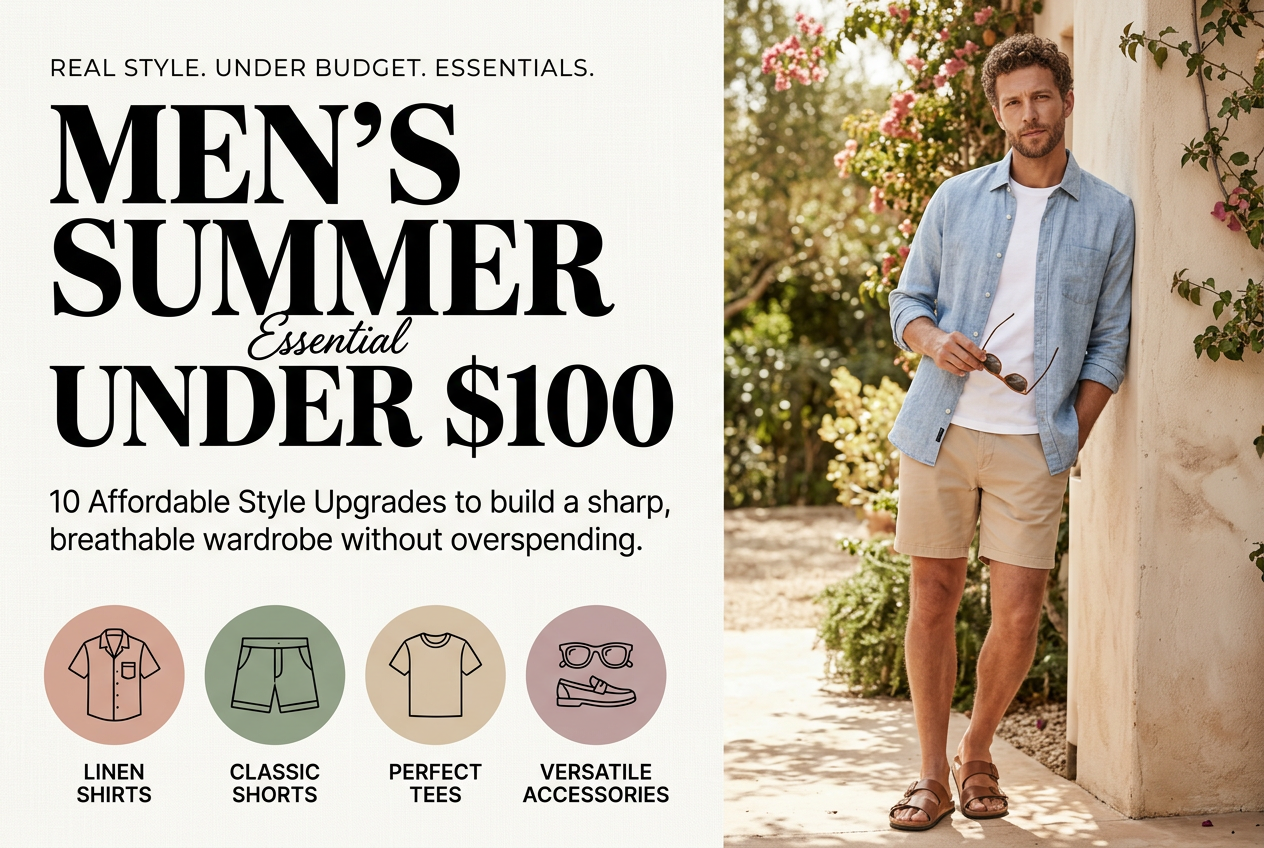
A $40 linen shirt worn 50 times over three months costs you less per wear than a cup of coffee. That single realization changed how I shop for summer clothes entirely — and it’s the reason I stopped treating a tight budget as a limitation and started treating it as a filter.
Most guys hit June and realize their cold-weather rotation has nothing useful to offer once temperatures climb. Heavier fabrics, darker colors, nothing that breathes. The instinct is to go spend a bunch of money fixing that problem fast. But that’s exactly how you end up with a pile of stuff you barely wear. What actually works is buying fewer things that you’ll reach for constantly — pieces with real cost-per-wear value, not just low sticker prices.
Fit, fabric, versatility. Those three things matter more than any label ever will.
The Pieces Doing the Real Work
Every reliable men’s summer essentials rotation is built on basics that don’t demand attention — they just show up and do their job. A lightweight tee in a neutral. A linen shirt you can wear untucked or thrown over a tee. A short-sleeve button-up that works for a Tuesday errand run and a Saturday dinner. These aren’t exciting purchases, which is exactly why they’re the right ones. I spent part of last summer tracking what I actually grabbed off the shelf every morning, and it was almost always one of four pieces rotating on a loop. Everything flashier just sat there.
Fabric is where most guys stop paying attention, and it’s a mistake. Cotton breathes and holds its shape through repeated washing. Linen wrinkles almost immediately after you put it on — but that’s the whole aesthetic, not a flaw. Blends give you a middle ground if the wrinkling bothers you. What you want to avoid is anything with a lot of synthetic content in real heat. Polyester blends might look fine on a hanger but feel miserable by noon on a warm day.
Smart-Casual Without Overthinking It
There’s a version of smart-casual that looks deliberate and a version that just looks like you grabbed whatever was closest. The difference usually comes down to fit and one or two intentional choices rather than a complete outfit overhaul. Shorts that actually fit through the seat and thigh — not board shorts, not pleated dad shorts — change everything about how put-together you look from the waist down. Pair those with a camp collar shirt in a subtle print and you’ve done more with two pieces than most guys do with five.
A lightweight chino in khaki or olive is worth owning even in summer. Jeans feel oppressive once it gets genuinely hot, and chinos in a lighter fabric fill that gap on nights when shorts feel too casual.
Shoes and the Small Stuff That Ties It Together
Here’s where the whole thing either comes together or falls apart.
Wrong shoes wreck an otherwise solid outfit faster than anything else. White sneakers are non-negotiable for summer — they go with nearly everything and stay versatile across casual and smart-casual situations. Canvas slip-ons handle low-effort days well. If you’re spending any time near water or leaning into a more relaxed aesthetic, leather sandals are worth considering, though I’d steer toward simple ones without too much hardware (Actually, I’d skip the hardware entirely — it dates the look faster than you’d expect). Beyond footwear, you don’t need much: a leather or woven belt in tan or brown, a watch that isn’t too precious to wear in the heat, maybe a canvas tote if you’re carrying things around. None of this is flashy. It’s just the layer that makes an outfit feel finished rather than assembled by accident.
Thinking About Cost-Per-Wear
The math is simple once you run it. An $80 pair of shorts worn once in July costs $80 per wear. A $45 shirt you grab twice a week from June through August costs you somewhere around 35 cents per wear by the end of the season. Budget dressing isn’t about finding the cheapest item in the store — it’s about buying things you’ll actually live in, which requires being honest about how you really spend your time rather than how you imagine you might spend it someday.
Before buying anything, ask yourself two things: Does this work with at least three things I already own? And can I picture grabbing this on a random Wednesday with no particular occasion in mind? If the answer to either is no, put it back.
Summer’s short. You genuinely don’t need a massive rotation.
Where to Actually Find Good Deals
Target and Kohl’s have solid basics that hold up better than their prices suggest. Online retailers frequently beat brick-and-mortar prices, especially if you’re flexible on color. Outlet stores can be worth a trip for slightly older inventory at real discounts — just go in knowing what you need rather than browsing, or you’ll leave with things that seemed like deals and weren’t. Timing matters here too: late June into early July tends to hit the sweet spot where sales are starting but selection hasn’t been gutted yet. End-of-season clearance in August gets you the deepest discounts, but you’re often sorting through whatever’s left in sizes that didn’t move for a reason.
Try things on when you can. Online returns are easy enough, but an in-store fit check saves the whole cycle of ordering, waiting, trying on, repacking, and returning. A $30 shirt that fits right beats a $60 shirt that’s slightly off in the shoulders every single time — no contest.
Building a sharp summer wardrobe on a budget is a solved problem. Buy fewer things. Make sure they fit. Pick pieces that work together. The guys who look like they spent a lot usually just spent carefully.
At Unwritten, our editors choose every product and story idea independently — we only recommend things we’d genuinely tell a friend about.
Frequently Asked Questions
What are the most important men’s summer essentials to buy first?
Start with a lightweight tee in a neutral color, one linen or cotton button-up shirt, and a well-fitting pair of shorts. These three pieces form the core of almost every summer outfit and give you the most versatility per dollar spent.
Can you actually build a good summer wardrobe for under $100 per item?
Yes, easily. Brands at Target, Kohl’s, and various online retailers consistently offer well-made basics under $50. The key is prioritizing fit and fabric over brand names. A $40 linen shirt that fits perfectly will outperform a $120 shirt that’s slightly off every single time.
What fabrics should men look for in summer clothing?
Cotton and linen are your best friends. Cotton breathes well and holds its shape, while linen keeps you cooler in extreme heat (yes, it wrinkles — that’s part of the look). Cotton-linen blends offer a middle ground if you want some wrinkle resistance without sacrificing breathability.
When is the best time to shop for men’s summer clothes?
Late June through early July tends to be the sweet spot. Early-season sales start kicking in, but stores haven’t been picked over yet. End-of-season clearance in August gets you the deepest discounts, but sizing and color options are limited by then.
How many pieces do you actually need for a complete men’s summer wardrobe?
Less than you think. Four or five tees, two pairs of shorts, three shirts in different styles (one casual, one smart-casual, one that can dress up slightly), and two pairs of shoes covers the vast majority of summer situations. Fewer pieces worn more often beats a bloated closet full of things you never reach for.