
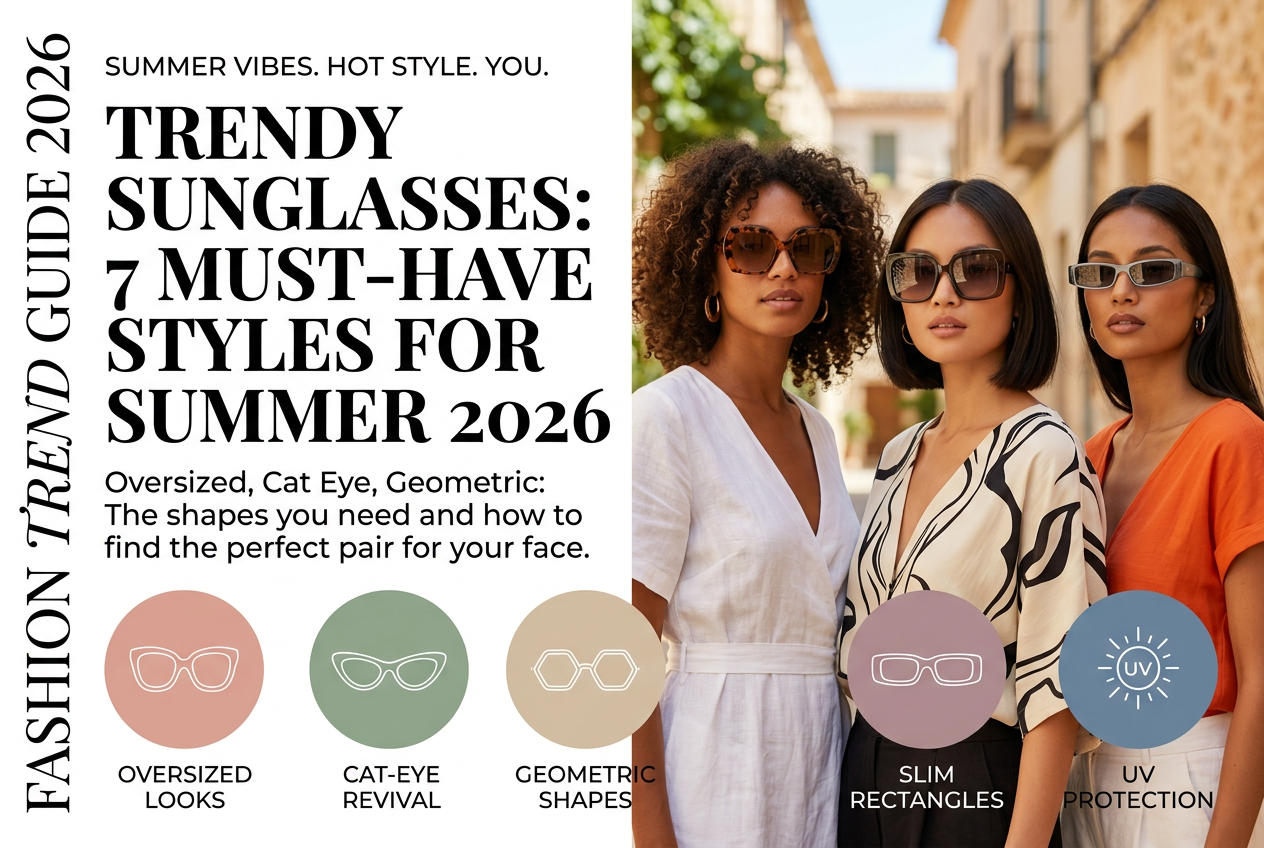
The right pair of sunglasses does something a lot of accessories can’t: it pulls a whole look together without trying. I learned this the hard way after spending two summers cycling through cheap pairs that either fogged up, snapped at the hinge, or just made me look faintly ridiculous. The seventh pair finally clicked. That changed everything.
So here’s the honest version of what’s worth your attention this season — the styles that are genuinely everywhere right now, why they work, and what to look for beyond the aesthetic.
What’s Actually Trending (And Why It Works)
Oversized frames never really left, but this summer they feel more intentional than ever — less “hiding behind sunglasses” and more “I know exactly what I’m doing.” Cat-eye silhouettes are back too, which shouldn’t be surprising since they’ve cycled in and out of fashion for about sixty years and always manage to feel fresh. Geometric shapes — think hexagons, sharp trapezoids, angular ovals — have carved out a real moment, and slim rectangular frames have become the default “I put effort in without looking like I put effort in” choice for a lot of people. What connects all of these is that none of them are trying to disappear. They’re all unapologetically themselves, which is exactly what makes them feel current.
Does Your Face Shape Actually Matter?
Genuinely, yes — but probably not as rigidly as every style guide makes it sound. The basic logic holds: round faces tend to look sharper in angular frames, square jaws benefit from softer curves, heart-shaped faces often want frames that are wider at the bottom to balance a narrower chin, and oblong faces usually need a style with some vertical height so the frame doesn’t disappear on the face. Oval faces are, annoyingly, compatible with almost everything.
What the rigid face-shape rules miss is that this year’s trends actually give you room to move within those parameters. You want oversized but your face calls for angles? That combination exists in about a dozen frames right now. Prefer cat-eye but need something softer? Rounded cat-eye styles are everywhere. The shape is the constraint. The specific style is still yours to choose.
The UV Thing Isn’t Optional
Here is something that gets buried in fashion coverage because it’s not glamorous: dark lenses without UV protection are worse for your eyes than wearing no sunglasses at all. When you put on dark lenses, your pupils dilate to compensate for the reduced light. If those lenses aren’t actually blocking UV radiation, you’ve just given more unfiltered UV light direct access to your retina. Years of that adds up to cataracts and macular degeneration — neither of which announces itself while it’s happening. Look for frames labeled 100% UVA/UVB or UV400, which means the same thing. Polarized lenses are worth considering if you drive frequently or spend time near water, since they cut glare significantly, but polarization and UV protection are separate features — confirm you’re getting both.
Styling Them Without Overthinking It
Oversized frames and a linen dress. That’s basically a complete outfit. Rectangular frames work across contexts in a way that’s almost unfair — they sit comfortably on athleisure, sundresses, and tailored shorts without requiring any adjustment in approach. Cat-eye frames carry a slightly more deliberate energy, so they tend to complement structured pieces or anything with a retro lean. (Actually, that’s not quite right — I’ve seen cat-eye frames look incredible with very casual, thrown-together outfits. It depends more on confidence than on what you’re wearing underneath.)
If you gravitate toward classic pieces, tortoiseshell and black are the safe bets that somehow never feel boring. If your wardrobe runs toward color and personality, a bold frame in cobalt, amber, or cherry red costs the same as a neutral one and does considerably more work.
Cheap Sunglasses Will Disappoint You
Not always. But often enough that it’s worth thinking about before you buy. Quality frames use materials that don’t get brittle and warped after a few weeks in a hot car. Good lenses are optically correct, meaning they don’t introduce distortion that gives you a low-grade headache by midafternoon. The hinges on better frames are reinforced in ways you don’t notice until you compare them to the ones that snap off in your bag. None of this requires spending $300. Mid-range sunglasses from brands that actually test their UV claims hit a reasonable balance between durability and price. The category to avoid is truly cheap frames from unverified sources with no UV labeling — those are the ones that fail the most basic job the sunglasses are supposed to do.
Buy the pair that makes you want to put them on every time you walk out the door. That part matters more than following any particular trend.
At Unwritten, our editors choose every product and story idea independently — we only recommend things we’d genuinely tell a friend about.
Frequently Asked Questions
What sunglasses styles are trending this summer?
Oversized frames, cat-eye silhouettes, geometric shapes, and slim rectangular frames are all over feeds and sidewalks right now. The common thread is that each style commits to a distinct personality rather than playing it safe.
How do I pick trendy sunglasses for my face shape?
Round faces generally look great in angular or rectangular frames. Square jawlines benefit from softer, rounder shapes. Oval faces can pull off almost anything. Heart-shaped faces tend to suit frames that are wider at the bottom, while oblong faces need styles with a bit more vertical height.
Do I really need UV protection in sunglasses?
Yes, and this matters more than most people realize. Dark lenses without UV protection can actually cause more harm than no sunglasses at all, because your pupils dilate behind dark lenses and let in more unfiltered UV light. Look for labels that say 100% UVA/UVB or UV400.
Are expensive sunglasses actually worth it?
Sometimes. Pricier frames typically use better materials, have optically correct lenses that won’t distort your vision, and have reinforced hinges that survive being tossed in a bag repeatedly. That said, solid mid-range options exist. The thing to avoid is buying the cheapest possible pair from an unknown brand with no UV verification.
What is the difference between polarized and UV-protected lenses?
UV protection blocks ultraviolet radiation that damages your eyes. Polarized lenses reduce glare from reflective surfaces like water, roads, and snow. You can have one without the other, so always check for both if you spend a lot of time driving or near water.