
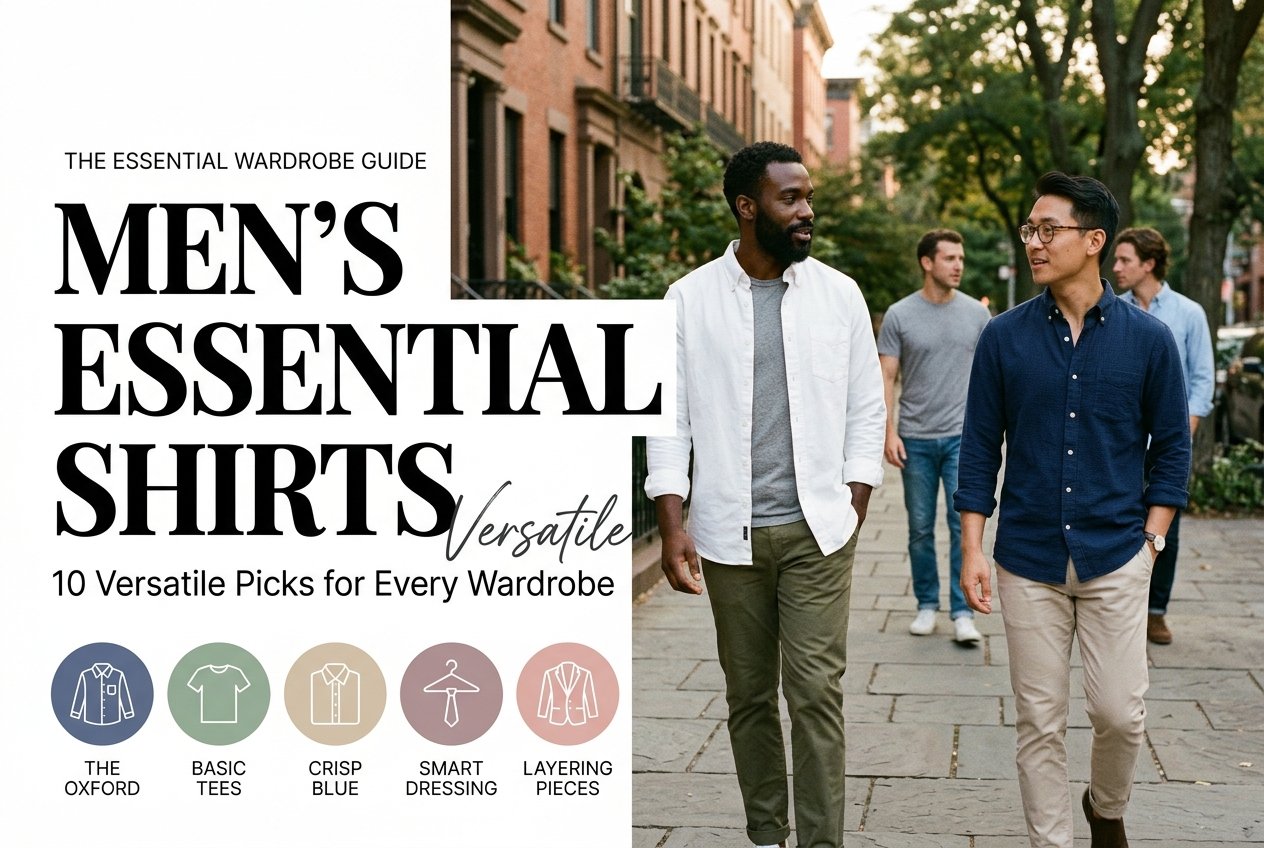
Men’s essential shirts are the backbone of a functional closet. You probably already know the feeling: standing in front of your dresser with nothing to wear, even though it’s full. That’s usually because you’re missing the right foundational pieces—the shirts that actually work with everything else you own.
A solid collection of men’s essential shirts doesn’t require much. We’re talking about 10 pieces that mix and match across work, weekends, and everything in between. These aren’t trend pieces that’ll feel dated in six months. They’re the quiet workhorses that make getting dressed easy and keep you looking intentional without trying too hard.
Building Blocks: The Foundation of Your Shirt Collection
Start with the basics. A white oxford button-down, a crisp white t-shirt, and a solid gray crewneck tee form the foundation of any functional wardrobe. These three pieces are like the flour, eggs, and butter of menswear—you can build almost anything from them. The white oxford works under sweaters, over tees, or on its own with chinos. The white tee layers under almost everything and stands alone on weekends. Gray? It’s the most forgiving neutral in existence.
Then add a navy oxford and a light blue dress shirt. Navy reads as casual or formal depending on how you style it—wear it untucked over a tee for weekend vibes, or tuck it in with dress pants for the office. Light blue is slightly more interesting than white but still neutral enough to pair with almost any bottom you own. These five pieces alone get you through most weeks without repeating an outfit.
From Casual to Formal: Men’s Essential Shirts for Every Occasion
Beyond the basics, you need pieces that handle specific situations. A charcoal or navy sweater-knit shirt (sometimes called a rugby or henley-adjacent piece) adds texture and works for casual hangouts or slightly dressier weekends. A burgundy or forest green button-down gives you color without being loud—these shades feel sophisticated and pair well with jeans or chinos.
For the office or dressier events, a proper white dress shirt (not the oxford—something with a smoother finish) and a light blue dress shirt in a similar fabric are non-negotiable. The difference between a casual oxford and a dress shirt matters more than you’d think. Dress shirts typically have a slimmer cut, finer fabric, and a more formal drape. They’re the pieces you’ll reach for when jeans aren’t an option.
Finally, add one statement piece—maybe a subtle striped shirt, a small-scale pattern, or a richer tone like terracotta or olive. This is your ‘I put thought into this’ piece. It’s not essential in the way white cotton is, but it rounds out a collection and gives you options on days when you want something more interesting than solid colors.
Cost-Per-Wear: Investing in Quality Men’s Essential Shirts
Here’s where cost-per-wear thinking changes everything. A $25 t-shirt you wear once a month for five years costs you $0.10 per wear. A $80 oxford you wear twice a week for seven years? About $0.22 per wear. The math seems to favor cheaper pieces until you factor in replacement. That $25 shirt might pill, fade, or lose its shape after two years. The $80 oxford? It’ll probably still look solid.
The sweet spot for men’s essential shirts is usually $35–$75 for basics and casual pieces, $60–$120 for dress shirts. You don’t need to spend premium prices on everything, but investing a bit more in pieces you’ll wear constantly makes sense. A quality white oxford from a mid-range brand will outlast three cheap versions and actually feel better against your skin.
Pay attention to fabric content. Cotton is standard, but cotton-blend shirts (with a small percentage of polyester or elastane) tend to wrinkle less and hold their shape better. That said, 100% cotton feels nicer and breathes better—it’s a trade-off. For dress shirts, higher thread count matters more. For casual tees, it matters less.
Fit is where most guys waste money. A $60 shirt that doesn’t fit right is a $60 mistake. A $30 shirt that fits perfectly is a bargain. Try things on. If the shoulders don’t sit right or the sleeves are too long, no price point fixes that.
Styling Your Men’s Essential Shirts: Outfit Ideas for Every Shirt
The whole point of essential shirts is that they work together. A white oxford isn’t just for work—it layers under sweaters, goes over a tee for a casual-smart look, or pairs with chinos for weekend plans. Your gray tee works under almost everything and stands alone with jeans. Navy reads as casual or dressy depending on context.
Here’s a practical breakdown: pair your white oxford with navy chinos and white sneakers for smart casual that works almost anywhere. Throw it under a sweater with jeans for cooler weather. Tuck it into dress pants with a blazer for actual formal situations. That one shirt does at least five different jobs.
Your casual button-downs (burgundy, forest green, striped) pair with jeans, chinos, or even dress pants depending on the occasion and how you style them. Wear them untucked with sneakers or loafers for weekends. Tuck them in with a belt for slightly dressier vibes. Layer them under sweaters when it’s cold.
Dress shirts are more specific—they’re for work, dates, weddings, and situations where you need to look intentional. But they’re not as formal as they sound. A light blue dress shirt with dark jeans and white sneakers is a genuinely cool casual look. The key is not overthinking it.
The real strategy is buying pieces that work with what you already own. If you have navy chinos, a white oxford becomes immediately useful. If you have a gray sweater, add a light blue shirt underneath for texture. Build around what’s already in your closet, not against it.
The Bottom Line on Men’s Essential Shirts
You don’t need 50 shirts. You need 10 good ones that actually work together. Start with white, gray, and navy basics. Add a couple of casual button-downs in richer tones. Invest in proper dress shirts for formal situations. Then stop. Wear them, mix them, build outfits around them.
The best men’s essential shirts are the ones you actually reach for—not the aspirational pieces collecting dust in the back of your closet. Focus on fit, fabric quality, and versatility. A $50 shirt you wear twice a week beats a $150 shirt you wear twice a year. Build slowly, buy deliberately, and you’ll end up with a closet that actually works.
At Unwritten, our editors choose every product and story idea independently — we only recommend things we’d genuinely tell a friend about.