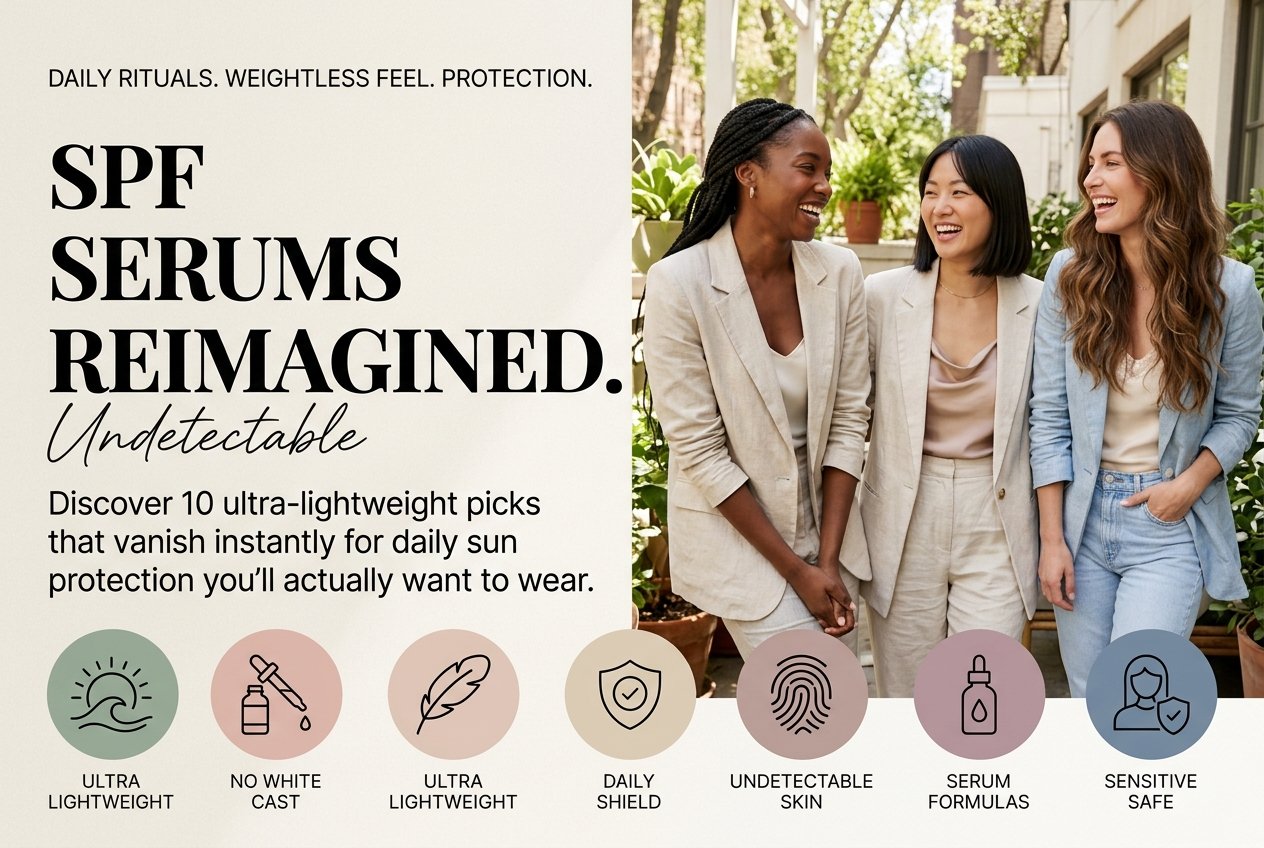
Nothing in skincare clicks quite like finding an SPF serum you forget you’re wearing. No film. No white cast ghosting your jawline. No foundation sliding south by 11am. Just protection that disappears into your skin and gets out of the way — and that single quality is the whole reason this category has quietly taken over morning routines everywhere.
I’ll be honest: I was skeptical of SPF serums for longer than I should have been. They felt like a marketing reframe — regular sunscreen in a dropper bottle with a prettier price tag. I tried six different formulas before one finally convinced me otherwise, and that one changed how I think about sun protection entirely. Because when the texture is right, you stop negotiating with yourself about whether to apply it. You just use it. And that consistency is what actually prevents sun damage — not the fanciest formula or the highest SPF number on the shelf.
Why Your Regular Sunscreen Is Working Against You
Traditional sunscreens are thick by design. The barrier effect is the whole point, but in humidity that same barrier traps heat, turns tacky, and makes your skin feel like it’s wearing a raincoat from the inside. SPF serums are formulated around a completely different logic — hydrating bases with sun filters built in, rather than sun filters with hydration reluctantly added. They absorb in under a minute, they don’t compete with your moisturizer, and they almost never cause that maddening foundation-pilling situation where your whole base separates by mid-morning because your sunscreen and your primer had a disagreement. If you’ve watched your makeup ball up and roll off your cheeks, you already know this problem intimately. SPF serums sidestep it almost entirely because their finish is smooth enough that other products just layer right over them without friction. There’s also the practical reality that people use more of a product they actually like — and using the right amount of SPF (that quarter-teaspoon for face and neck, which most people never hit with a thick cream) is what gets you the protection the label promises.
What Actually Makes One “Ultra-Lightweight”?
The word gets thrown around a lot. Here’s what it actually means in practice.
Genuinely lightweight SPF serums have a water or glycerin base rather than an oil base, which is what lets them sink in fast without the tacky residue. They tend to rely on chemical filter systems — avobenzone, octinoxate, newer options like Tinosorb — because those absorb into skin rather than sitting on top of it the way zinc oxide does. (Mineral formulas have gotten much better at this, to be fair, but the lightest textures are still mostly chemical.) The real test isn’t the ingredient list, though. It’s what happens five minutes after you apply it. If you can still feel it, it doesn’t qualify. The best SPF serums set to a matte or satin finish and become genuinely imperceptible — you’d forget you applied anything at all, except your skin looks a little more even and your reflection eventually reminds you that you’re actually protected.
One thing worth saying clearly: lightweight does not mean less protection. SPF 30 is SPF 30 whether it feels like water or wax.
The Drugstore Picks That Actually Compete
You don’t need to spend a lot here. The drugstore SPF serum category has gotten genuinely competitive — some of these rival prestige picks on texture alone, and a few have made it into my permanent rotation simply because they work and they’re always in stock.
Worth Spending More On?
Sometimes, yes. Prestige brands invest in more sophisticated filter systems and skin-identical ingredients that do produce a noticeably different feel — silkier, more serum-like, less obviously “sunscreen” in the way they wear. These aren’t necessary. But if you’ve tried drugstore options and still find yourself skipping SPF because the texture annoys you, a prestige formula might be the thing that finally ends that pattern. Annoying texture is the single biggest reason people skip sun protection, and if spending more fixes that, it’s probably worth it.
Apply It Right or You’re Wasting It
A quarter teaspoon. That’s the amount you need for your face and neck, and almost nobody uses that much. Most people swipe on a thin layer, feel covered, and move on — but they’re getting maybe a third of the labeled SPF. With a lightweight serum, a full quarter teaspoon won’t feel like anything, which is exactly the point. Apply it after moisturizer, give it sixty seconds to set, then go in with makeup. If you want to mix it into your moisturizer instead, do that on your palm before it goes on your face — it blends more evenly that way and you’re less likely to miss spots. And reapply every two hours if you’re outside. I know that sounds like a project, but a thin SPF serum smoothed over your face is genuinely one of the least disruptive things you can do mid-day. It doesn’t disturb your makeup the way a spray or a cream would.
Also: your neck and ears. Every time. No exceptions.
The best SPF serum isn’t the one with the most impressive ingredient list or the highest number on the label. It’s the one you’ll actually use tomorrow morning without thinking twice about it.
At Unwritten, our editors choose every product and story idea independently — we only recommend things we’d genuinely tell a friend about.
Frequently Asked Questions
Can I use an SPF serum instead of sunscreen?
Yes, as long as it’s labeled with broad-spectrum SPF 30 or higher. SPF serums provide the same UV protection as traditional sunscreens — the difference is purely texture and formulation, not efficacy.
How much SPF serum should I apply to my face?
About a quarter teaspoon for your face and neck combined. Most people apply far less, which means they’re only getting a fraction of the labeled SPF protection. With a lightweight serum, the full amount won’t feel heavy.
Does SPF serum go on before or after moisturizer?
After moisturizer, before makeup. Give it about a minute to set before applying foundation. If you want to mix it into your moisturizer, do it on your palm first so it distributes evenly.
Do SPF serums leave a white cast?
The better ones don’t. Chemical filter formulas are the most invisible, but even mineral-based SPF serums have improved a lot. Look for ‘no white cast’ or ‘invisible finish’ on the label if that’s a concern.
How often should I reapply SPF serum?
Every two hours if you’re spending time outdoors. One of the underrated advantages of a lightweight SPF serum is that it’s genuinely easy to smooth over makeup without wrecking your base.