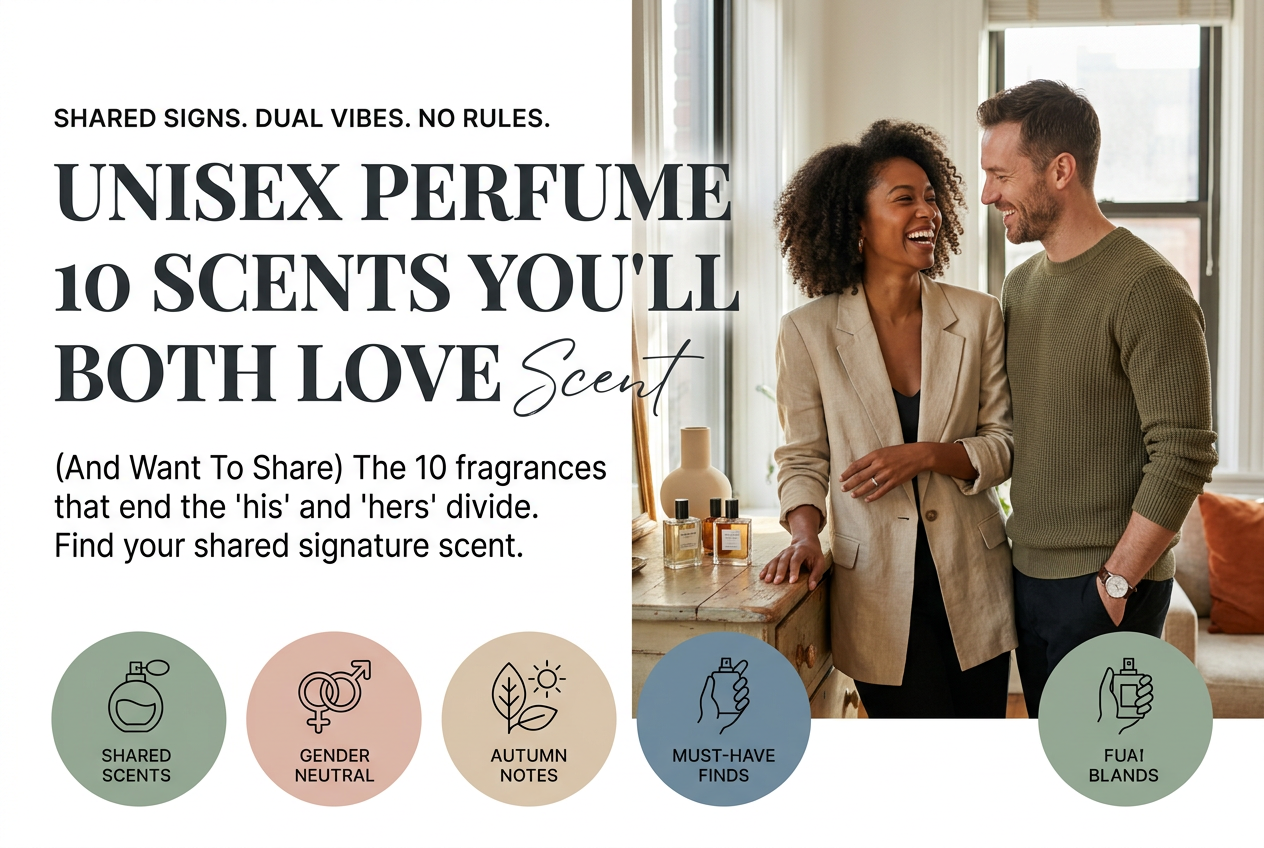
My partner has been stealing my perfume for months. Not sneakily — openly, unapologetically, sometimes while making direct eye contact. And here’s the thing I didn’t expect: it smells better on them than it does on me. That realization quietly dismantled any idea I had about keeping a “his” and “hers” shelf in the bathroom.
We aren’t looking for compromise. The best unisex perfumes don’t ask you to meet in the middle — they’re just good enough that the question of who owns the bottle stops mattering entirely.
Why Shared Scents Work Better Than You’d Think
Fragrance retail still loves a gender binary. Walk into any department store and the layout makes the rules clear: structured bottles and dark packaging on one side, florals and soft curves on the other. But that division has always been more about marketing than chemistry. A dry cedar note doesn’t know what gender you are. Neither does clean linen or sun-warmed skin.
There’s also a financial argument hiding in plain sight here. Two people buying one well-made fragrance instead of two mediocre ones is just better math. You’re pooling attention and budget toward something worth keeping rather than settling twice. I’ve watched friends spend $60 each on separate scents they feel lukewarm about when they could have spent $90 once on something they’d both reach for every single morning. The economics aren’t complicated — they’re just easy to ignore when you’re standing in a store being funneled toward separate aisles.
What Actually Makes a Fragrance Wearable by Anyone?
Clean and minimal scents — soap, water, warm skin — don’t belong to anyone. Neither do warm, resinous bases built on amber or musk, or green and herbal compositions that smell like something growing in dry soil. These categories sidestep the whole masculine-feminine conversation because they were never really part of it to begin with. The gendering of fragrance is largely a 20th-century marketing invention anyway. (Actually, that’s not quite right — perfume has been gendered in various ways for centuries, but the hard binary we know now really did get locked in by mid-century advertising.)
When you’re shopping together, skip the copy on the box. Ask each other two questions: what do you want to smell like, and what do you want to smell on the other person? Those answers don’t always match, but the overlap is where you find something worth buying.
Same Bottle, Completely Different Energy
Here’s what nobody tells you about sharing a fragrance: it will smell different on each of you, and that’s not a flaw in the formula.
Skin chemistry — pH levels, moisture, even diet — shifts how a scent develops after it hits your skin. A fragrance that opens with sharp green bergamot might dry down to something warmer and woodier on your partner while staying crisper and lighter on you. You’re technically wearing the same thing, but you’re not smelling like twins. You’re smelling like two people who share a preference, which is its own kind of intimacy.
Versatility matters for a different reason too. A scent you’ll both actually wear has to work across contexts — easy enough for a Tuesday morning, interesting enough that you’d still reach for it before dinner on Saturday. Longevity plays into this. If it’s gone in 90 minutes, you’re both reapplying constantly and burning through a shared bottle at double the speed. Four to six hours of real wear is the floor; anything longer is a bonus.
Does Sharing a Scent Change How You Experience Each Other?
Genuinely, yes.
There’s something disarming about catching your own fragrance on someone else’s skin — someone you chose. You’re not smelling a product anymore. You’re smelling a person who smells like something you love. It’s a small thing. It doesn’t need to be made into more than it is. But it does shift something.
For occasions where that quality matters — a dinner out, a weekend away — lean toward unisex perfumes with a little more presence. Not loud, not aggressive, but noticeable. Something that lingers after you’ve left the room. A touch of musk or a warm base note that makes someone lean in slightly without quite knowing why. The best ones for this have staying power and a drydown that gets better as the evening goes on rather than fading into nothing by dessert.
Making One Bottle Last for Two People
Buy the 100ml. Every time.
If you’re both wearing a fragrance regularly, a 50ml bottle disappears faster than you’d expect — usually before either of you has decided whether you even love it yet. The larger size gives you time to actually live with the scent, figure out when you each reach for it, and decide whether it’s worth restocking. A travel decant kept separately from the main bottle also helps: it stops the daily negotiation over one shared object sitting on one shared surface.
The real upside of sharing a fragrance, though, isn’t logistical. It’s that you can’t wear it mindlessly. When you know someone else is going to reach for the same bottle, you notice it differently. You choose it instead of just grabbing it. That small act of intention — picking something because you know your partner loves it on you — turns out to be a better reason to wear a perfume than any note pyramid on the back of the box.
Find something so good that ownership stops being the point. That’s the whole idea.
At Unwritten, our editors choose every product and story idea independently — we only recommend things we’d genuinely tell a friend about.
Frequently Asked Questions
What makes a perfume truly unisex?
A truly unisex perfume is built around notes that don’t lean heavily masculine or feminine by convention — think clean skin, warm amber, dry wood, or fresh herbs. The best ones smell genuinely different on each person because individual skin chemistry shifts how a scent develops, which is part of what makes sharing one so interesting.
How do you pick a unisex perfume you’ll both actually like?
Test it together in person if you can. Spray it on both wrists and wait 20 minutes — the dry-down is what you’re actually committing to, not the first spray. Talk about what categories you both gravitate toward: clean and airy, warm and resinous, green and herbal, or something spicy. Overlap there is where you’ll find your answer.
Is sharing one bottle of perfume practical?
More practical than it sounds. Buying one high-quality 100ml bottle almost always costs less than two separate fragrances of comparable quality. The only real friction is running out faster, which is easily solved by going straight for the larger size or keeping a travel decant in your bag.
Will a unisex perfume smell the same on both of us?
No, and that’s the point. Skin pH, moisture levels, and natural body chemistry all affect how a fragrance develops. The same bottle might read warmer and woodier on one person and fresher and lighter on another. You’re wearing the same scent, but it belongs to each of you differently.
How long should a good unisex perfume last on skin?
Aim for at least four to six hours of noticeable wear. Eau de parfum concentrations generally outperform eau de toilette for longevity. Application matters too — pulse points like the wrists, neck, and inner elbow hold scent longer than spraying into the air and walking through it.