
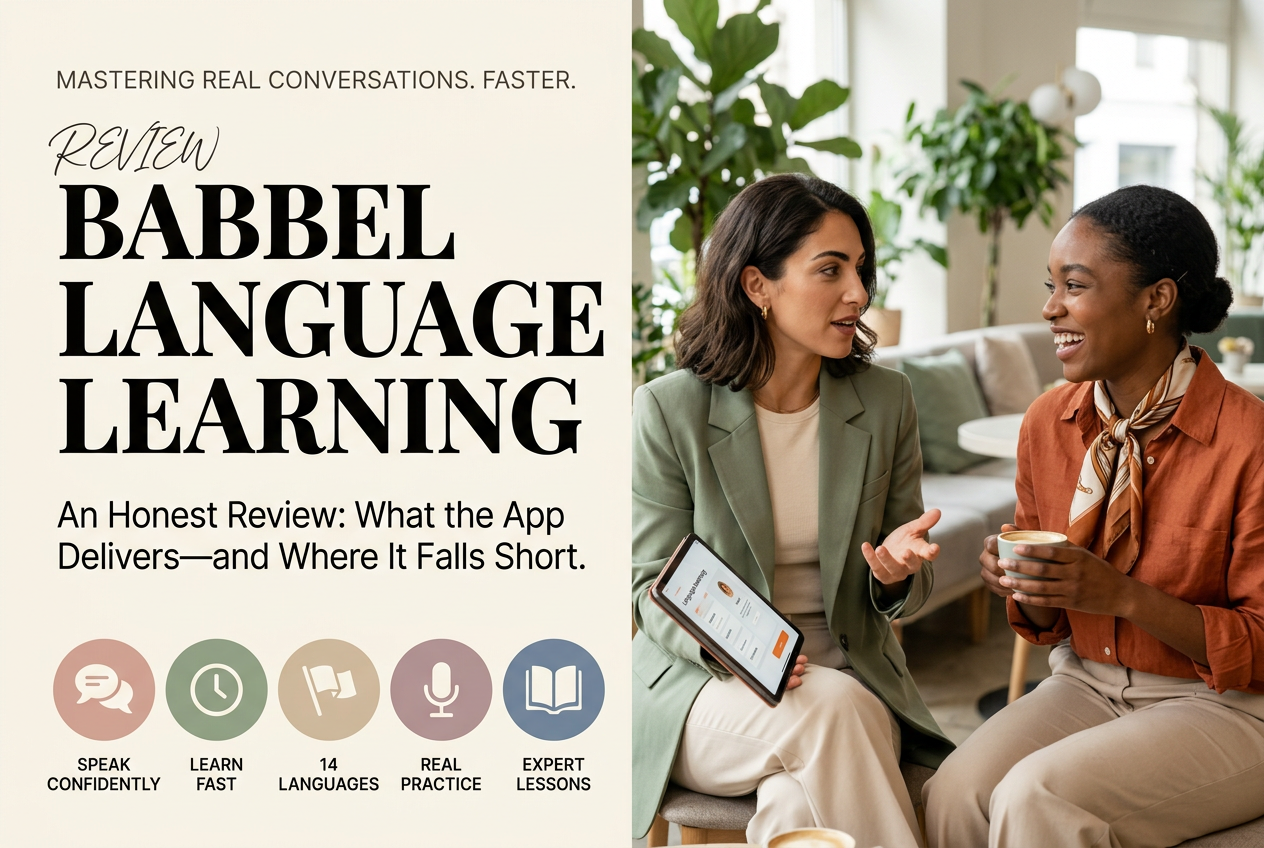
Fifteen hours. That’s Babbel’s oddly specific claim—that 15 hours of lessons equals roughly a semester of college language study. I kept turning that number over when I first saw it, because most language apps just promise you’ll be “conversational in weeks” and leave it at that. The specificity either means someone ran actual research, or someone got very creative with their marketing copy. (It’s research, conducted independently, which does matter.)
Here’s what that number really signals about the Babbel language learning app: it’s built around efficiency. Not gamification, not streaks, not the dopamine loop of collecting virtual coins. The whole product is designed around getting words and phrases into your long-term memory as fast as honest pedagogy allows. Whether that’s what you want depends entirely on why you’re learning a language in the first place.
Why Most Apps Feel Like Homework
I’ve watched friends download language apps with real enthusiasm, then quietly delete them two weeks later. The pattern is almost always the same: the app starts with vocabulary drilling—tap the word, match the picture, repeat—and somewhere around day ten, they realize they’ve memorized fifty words and still couldn’t order a coffee without panicking. The Babbel language learning app takes a different angle from the first lesson. Every unit is anchored to a real situation: checking into a hotel, making small talk at a party, asking someone to slow down because you didn’t catch what they said. You’re not memorizing ‘gato’ means cat and ‘perro’ means dog in isolation. You’re learning those words inside a sentence you might actually say, which is a completely different cognitive experience and the reason context-based learning produces better retention than word lists.
Lessons run 10-15 minutes. That’s not an accident.
Short sessions fit into real life without requiring you to reorganize your schedule around them, and they end before your attention starts to drift, which means you actually complete them. There’s no gamification pushing you to keep going past the point of usefulness. You finish a lesson, you close the app, the material has a chance to consolidate. It’s a low-drama product, which sounds like faint praise but genuinely isn’t.
What the AI Speaking Practice Gets Right
Speaking out loud to a phone feels ridiculous. I won’t pretend otherwise. The first time I tried the speech recognition feature, I said a Spanish phrase into my phone while sitting alone in my kitchen and felt genuinely absurd. That feeling fades fast, though, because the AI does something important: it doesn’t demand robotic precision. It recognizes natural variation in how people pronounce things, so you’re not endlessly failing because your accent doesn’t match a single recorded target. You speak, it listens, it tells you what landed and what needs work. Nobody hears you. Nothing is recorded for someone to critique later. The low-stakes environment turns out to matter a lot for people who are self-conscious about sounding stupid—which is most people learning a new language.
Speaking practice is woven through every lesson from day one rather than saved for some advanced stage you have to earn your way into. By the time you’re handling longer dialogues, speaking out loud already feels normal rather than like a test you might fail.
The actual content: 14 languages, real depth differences
Spanish and French have the deepest content libraries because demand is highest. Mandarin is newer and still growing. Russian, Polish, and Turkish are solid for getting to conversational basics but won’t take you as far as the Romance languages will. Each language’s content is built by native speakers, which means cultural context actually makes it in—you’re not just learning translated phrases that technically mean the right thing but would sound strange to a native speaker. That’s a detail that separates Babbel from apps that build one template and apply it across every language they offer.
The 14 languages available are: Spanish, French, German, Italian, Portuguese, Russian, Polish, Turkish, Dutch, Swedish, Norwegian, Danish, Indonesian, and Mandarin Chinese.
Daily Use: What You’re Actually Doing
You pick a language, place yourself on a level (the app helps you figure this out if you’re unsure), and it generates a lesson path based on your level and how much daily time you can commit. You can change that time estimate whenever you want, which is useful because the version of yourself who signed up with ambitious goals and the version of yourself three weeks later sometimes have different ideas about available time. Each lesson moves through a dialogue between two people in a realistic scenario, vocabulary practice pulled from that dialogue, exercises where you use those words in context, and then speaking practice where you reproduce the dialogue yourself. Review sessions cycle back to material from two or three weeks ago—because that’s when forgetting starts, and most apps skip reinforcement because it feels like going backward even though it’s actually how memory consolidates over time. The app also works offline. Download lessons before a flight or a commute with spotty signal, practice them wherever you are, and they sync when you reconnect. Small feature, real impact on whether you actually maintain consistency.
Honest About What It Won’t Do
No app makes you fluent. Babbel doesn’t claim otherwise, which earns it some credibility. What you get is functional conversational ability—enough to navigate a trip, handle basic work introductions, or stop feeling completely lost in a country where you don’t speak the language. Actually, that undersells it a little: consistent Babbel users report being able to hold real conversations with native speakers after a few months, not just recite memorized phrases. But there’s a ceiling, and it’s below professional proficiency. For that, you need immersion, real conversation partners, and time no app can substitute for. Babbel does offer live classes with human teachers as a paid add-on, which bridges some of that gap, but it costs extra beyond the base subscription.
The free version gives you one lesson. That’s it.
Subscriptions run roughly $7-15 per month depending on whether you pay monthly or commit to a longer plan upfront. It’s not cheap compared to free apps, but it’s not expensive compared to a class. Whether that math works depends on whether you’ll actually use it—which is the question every language app comes down to eventually.
So who is this actually for?
Travelers with a trip in 2-3 months who want to handle real conversations rather than just pointing at menus. People learning a language for work who need to reach functional intermediate level. Anyone who’s tried gamified apps and found the format patronizing or too easy to game without actually learning anything. If you’ve quit three apps already, the structured, conversation-first format here is different enough that it’s worth trying before you write off app-based learning entirely. If you need fluency for translation or interpretation work, you’ll need more than this. If you learn best through immersion with real people, the app-only experience might feel too isolated to sustain.
My honest take: the Babbel language learning app is the most structurally sound language app I’ve encountered, and the AI speaking practice removes the biggest barrier most self-learners face. It won’t do the work for you, but it’s built in a way that makes doing the work considerably less painful than the alternatives.
At Unwritten, our editors choose every product and story idea independently — we only recommend things we’d genuinely tell a friend about.
Frequently Asked Questions
How long does it take to see real progress with Babbel?
Most users report basic conversational ability after 3-4 weeks of daily practice. Babbel’s own research claims 15 hours of lessons equals roughly one college semester of language study, though your pace depends on how consistently you practice and which language you’re learning.
Does Babbel work for complete beginners?
Yes. You can start with zero knowledge of a language and the app builds from the ground up, teaching vocabulary through real-life scenarios rather than abstract grammar rules. Absolute beginner courses are available for all 14 languages.
Is Babbel worth paying for if free apps exist?
Free apps like Duolingo are game-like by design, which works for some people and frustrates others. Babbel costs roughly $7-15 per month depending on your plan, and it takes a more structured, conversation-first approach. If you’ve quit free apps before, the different format may be what you need.
Can Babbel actually make you fluent?
No app can, including Babbel. What it does well is get you to functional conversational basics—enough to order food, navigate a city, or handle work introductions. Genuine fluency requires immersion, real conversation partners, and time beyond any app.
What languages does Babbel offer?
Babbel covers 14 languages: Spanish, French, German, Italian, Portuguese, Russian, Polish, Turkish, Dutch, Swedish, Norwegian, Danish, Indonesian, and Mandarin Chinese. Spanish and French have the deepest content libraries; Mandarin is newer but expanding.