
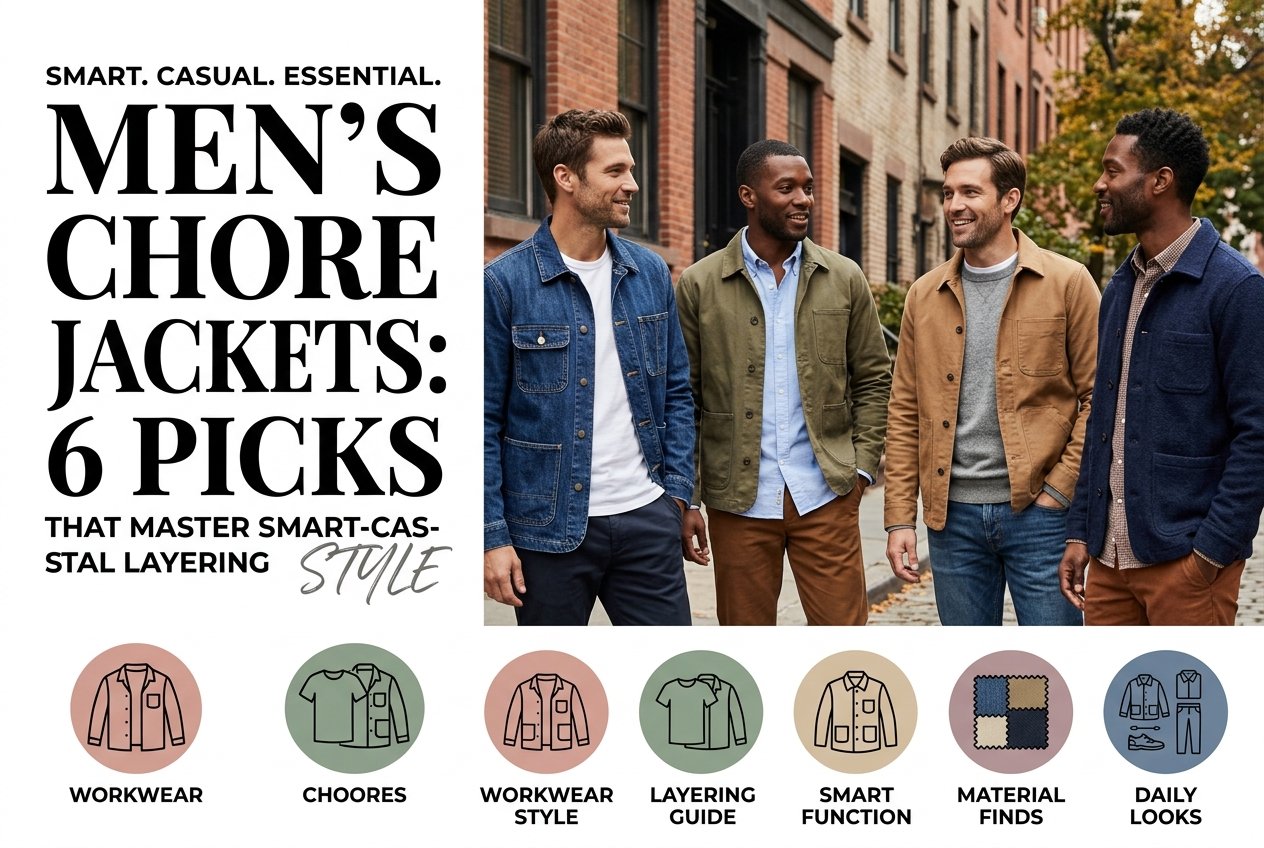
Here is the thing nobody tells you when you start building a real wardrobe: one jacket can quietly fix about a dozen outfit problems you didn’t know you had. The men’s chore jacket is that jacket. I own three of them now, which is probably one too many, but every time I’ve tried to rotate one out I keep reaching for it anyway.
Start with one. Pick the fabric that matches how you actually dress, wear it until it’s your default, and you’ll understand why people have been grabbing chore jackets off hooks for over a century. It’s not nostalgia. It’s just good design that refuses to stop working.
Why Does This Jacket Keep Coming Back?
Factory workers wore them. Farmers wore them. French railroad laborers wore them. Then designers discovered the silhouette sometime in the early 2000s and prices quadrupled overnight — but the underlying jacket didn’t change, and that’s the whole point. A chore jacket is built around honest construction: reinforced seams, hardware that feels like it weighs something, pockets deep enough to actually use, and fabric in the 12-to-14-ounce range that develops character instead of just wearing out. You’re not buying a trend when you pick one up. You’re buying something that’ll still look right when whatever else is in your closet has cycled out twice.
What makes it so useful for smart-casual specifically is the way it bridges things that shouldn’t bridge. Throw one over a plain tee and raw denim and you look considered without looking like you spent twenty minutes on it. Layer it under a sweater and the structured shoulders help everything sit better. Wear it over a linen button-up with chinos and suddenly you’ve got real dimension going on, the kind that makes people assume you have opinions about clothes even if you just grabbed what was on the hook by the door. The jacket does the heavy lifting. Literally and figuratively, honestly.
Canvas, Duck Cloth, Moleskin — Does It Actually Matter?
Yes. More than most people expect.
Canvas is the classic starting point — durable, affordable, ages well, hides a light stain better than it has any right to. Duck cloth is heavier and has a tighter weave, which makes it wind-resistant in a way that canvas isn’t, and it softens faster than you’d think after a few washes. Moleskin is the refined option: it drapes instead of standing away from the body, it feels noticeably softer against skin, and it photographs in a way that makes people ask where you got it. The tradeoff is that moleskin shows wear more honestly — a scuff or a snag is more visible than it would be on canvas.
If you’re buying your first chore jacket and you plan to actually wear it hard, start with canvas or duck cloth. If you want something that works at a casual dinner without looking like you came from a job site, moleskin is the move.
Three Ways to Actually Wear This Thing
The easiest version, and the one I end up in probably four days a week from September through April: white or gray tee, the jeans that fit you best (color doesn’t matter much), and whatever sneakers you’d reach for anyway. The jacket handles everything else. No accessorizing required, no overthinking the color palette.
For a step up — say, Saturday errands that turn into lunch somewhere you didn’t plan on — swap the tee for an oxford shirt in white or pale blue, keep the jeans, add a leather belt if it feels right. The chore jacket still anchors the whole thing and keeps it from reading as trying-too-hard, which is the main pitfall of smart-casual dressing. The slight visual tension between a structured shirt and a workwear jacket is actually the point; it’s what makes the outfit look like a choice instead of an accident. And for the rare occasion when you need to push it even further, the jacket layers surprisingly well under a long overcoat — the boxy cut sits flat instead of bunching, and the chest pockets give you a place to put things without ruining a coat’s silhouette. Actually, that last bit only works if your overcoat has some room through the body. A slim topcoat will fight the chore jacket’s shoulders and lose.
Budget Picks Worth Your Attention
Spending $100 to $150 on a canvas chore jacket from a brand that comes from workwear rather than fashion is almost always the right call. These companies have already solved the durability questions because their original customers needed jackets that survived actual work. Look for buttons that feel weighty when you handle them, seams that are stitched twice, and fabric that doesn’t go transparent when you hold it up to light. Color options will probably be limited to navy, olive, khaki, and black — which is fine, because those four cover everything.
A $130 chore jacket you wear 180 days a year for five years costs you about fourteen cents per wear. Do the math on the $60 fast-fashion version that pills and fades by spring.
When Premium Is Actually Worth It
Spending more gets you better fabric, tighter construction, and usually a more considered fit — but it doesn’t get you a warmer or more functional jacket. A $280 moleskin chore coat from a brand that has been making the same pattern for thirty years will feel extraordinary in your hands and last an absurd amount of time, but it will not keep you warmer than a well-made canvas version at half the price. What you’re paying for is the experience of wearing it: the weight of brass hardware, triple-stitched seams that will outlast the rest of your wardrobe, fabric that gets better-looking with age rather than just older-looking. That’s worth real money if it matters to you. Be honest with yourself about whether it does before you spend it.
The premium version also tends to come from brands with a specific point of view — sourcing fabric from a particular mill, making everything domestically, that kind of thing. If that story is part of why you buy clothes, there’s nothing wrong with paying for it. Just don’t buy the expensive version and then be afraid to wear it. A chore jacket that lives on a hanger has already failed at its job.
One Jacket, Most of Your Wardrobe Problems Solved
The men’s chore jacket is not flashy. It doesn’t require a perfectly assembled outfit around it. It just shows up, does exactly what it’s supposed to do, and makes you look like someone who has figured out how to get dressed — which, in smart-casual dressing, is the entire goal. If your closet currently has a gap between “too casual” and “too formal” for the middle eighty percent of your life, this jacket fills it better than almost anything else at the price point. That’s my actual opinion, not a hedge.
At Unwritten, our editors choose every product and story idea independently — we only recommend things we’d genuinely tell a friend about.
Frequently Asked Questions
What is a men’s chore jacket?
A chore jacket is a hip-length work coat originally worn by French and American laborers. It features a boxy cut, multiple chest pockets, heavy-duty buttons, and reinforced seams. Today it sits squarely between workwear and casual fashion.
What fabric is best for a chore jacket?
Canvas is the traditional choice and holds up well to hard use. Moleskin is softer and more refined-looking, making it better for smart-casual settings. Duck cloth splits the difference — heavier than canvas but not as dressy as moleskin.
How should a chore jacket fit?
Slightly boxy through the chest and shoulders, with enough room to layer a hoodie or thick shirt underneath. The sleeves should hit at or just below the wrist. A chore jacket that fits like a slim blazer is missing the point entirely.
Can you wear a chore jacket to a casual office?
Yes. Wear it over an oxford shirt or a lightweight turtleneck with dark trousers and clean leather shoes. The structured shoulders and button placket read as intentional rather than sloppy, which is exactly what you want in a business-casual environment.
How do you care for a canvas chore jacket?
Most canvas chore jackets can be machine washed cold on a gentle cycle. Avoid the dryer — hang it to dry and let it air out. Some canvas will shrink slightly, so size up if you’re between sizes. Waxed canvas versions should be spot-cleaned only.