
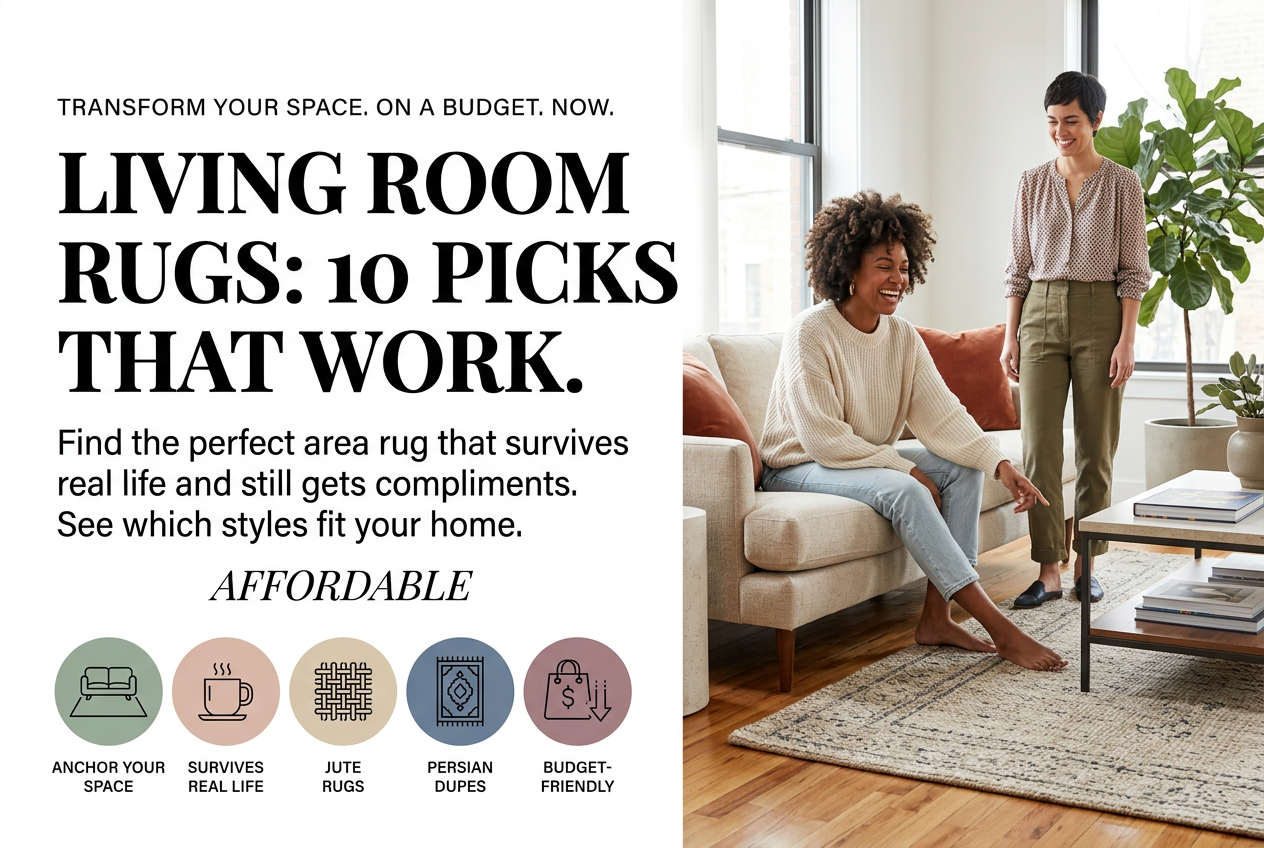
Two years of bare hardwood floors taught me one thing: a living room without a rug just feels unfinished, no matter how nice the furniture is. The room looked fine on paper — good sofa, decent lighting, plants in the corners — but something was always off. Then I put down a rug and the whole space finally made sense.
That’s what a good rug actually does. It isn’t decorative in the way a throw pillow is decorative. It anchors your seating area, softens the acoustics, and signals to anyone who walks in that the room was arranged with intention. The surprising part is you don’t need to spend $1,000 to get that effect. Budget-friendly rugs have genuinely improved over the past few years, and the gap between a $200 rug and a $900 rug is a lot smaller than it used to be — what matters more is picking the right material and size for how you actually live.
I’ve tested dozens of affordable area rugs over the past year. The 10 below are the ones that survived spilled coffee and a cross-town move and still get asked about when people visit.
Our Top Picks for Every Style
These rugs are organized by style so you can skip straight to what fits your room. Each one has passed the only test that actually matters: months of daily use.
Jute or Persian — Which Material Won’t Let You Down?
Here’s where most people go wrong. They fall for a color or pattern, order the rug, and then realize three weeks later that the material is completely wrong for their household. I did this once with a beautiful natural jute rug that I was convinced would look perfect. It did look perfect — for about six weeks, until the shedding started and my vacuum filter gave up.
Jute rugs have real appeal: they’re affordable, they photograph beautifully, and the texture reads as expensive in a way that synthetic rugs often don’t. But they shed fibers for months, feel scratchy until they’re fully broken in, and fall apart if they get wet. Worth it for a low-traffic study or a bedroom. Not worth it for a living room where people actually live.
Persian-style rugs at the budget end of the market are almost always polypropylene or a polypropylene-wool blend. That used to mean stiff and plasticky, but the better versions now have a softness that’s hard to distinguish from natural wool — and they handle spills in a way jute simply cannot. The one real downside is that the cheapest options, usually under $100, still look synthetic in a way that undercuts the whole aesthetic. The $150–$300 range is where the quality actually shows up: tight pile, colors that don’t fade after a few months, and enough weight that the rug stays put without a pad fighting it constantly. Actually, that’s not quite right — you still want a pad, but you’re not relying on it to do all the work.
Size Matters More Than You Think
A rug that’s too small is worse than no rug at all.
It creates this strange floating-island effect where your furniture seems disconnected from everything around it. The fix is simple: at minimum, the front legs of your sofa and any chairs should sit on the rug. That single rule eliminates most sizing mistakes. For a standard living room, that usually means an 8×10. Smaller spaces can work with a 6×9, and genuinely large or open-plan rooms need a 9×12 or 10×14 to avoid looking underfurnished.
Rectangular rugs. That’s the answer for almost everyone. Round rugs are having a moment right now and they can look striking, but they’re harder to place correctly, harder to find in budget price ranges, and unforgiving if your room has a conventional sofa-and-chairs layout. Save the round rug experiment for a reading nook or a dining area where it actually makes geometric sense.
Finding Real Deals (Not Just Sale Prices)
Online beats in-store on price, almost every time, because the overhead isn’t built into what you’re paying. Wayfair, Overstock, and Amazon carry the widest selections in the $100–$300 range, and the filtering tools make it easy to narrow by size, pile height, and material. Target and West Elm are worth a visit if you want to feel the texture before committing — there’s no substitute for running your hand across a rug when you’re deciding between a low pile and a shag.
Sign up for Wayfair and Overstock email lists before you buy anything. Both send 20–30% off coupons on a regular cycle, and on a $250 rug that’s real money. One more thing on reviews: a rug with 4.2 stars across 200 reviews tells you far more than a 4.9 rating from 15 people. The second number is almost always a new product without enough real-world feedback yet.
The difference between a rug you’ll own for five years and one you’ll quietly roll up and donate isn’t usually about spending more — it’s about being honest upfront about how your household actually uses the space. Pick the material that fits your life, get the size right, and the style part takes care of itself.
At Unwritten, our editors choose every product and story idea independently — we only recommend things we’d genuinely tell a friend about.
Frequently Asked Questions
What size rug works best for most living rooms?
An 8×10 rug fits most living rooms comfortably. The front legs of your sofa and chairs should sit on the rug — that’s the easiest way to tell if a size is working. Go up to 9×12 for larger rooms, or down to 6×9 if your space is more compact.
Are jute rugs good for living rooms with kids or pets?
Honestly, probably not. Jute sheds fibers for months, feels scratchy underfoot until it breaks in, and handles spills badly. It looks great in low-traffic spaces, but a polypropylene or wool-blend rug will hold up far better in a busy family room.
How much should I spend on a living room rug?
The $150–$300 range hits a sweet spot for quality without overpaying. Below that, polypropylene rugs can look plasticky and wear out faster. Above $300, you’re often paying for brand markup rather than a meaningful jump in durability or appearance.
Where are the best places to buy affordable area rugs?
Wayfair, Overstock, and Amazon consistently offer the widest selection in the $100–$300 range. Target and West Elm are worth visiting if you want to feel the texture in person first. Sign up for Wayfair and Overstock email lists — both send 20–30% off coupons regularly, which can save you $50–$100 on a single purchase.
Can a rug really change how a living room feels?
Yes, and faster than almost any other change you can make to a room. A rug defines the seating area, absorbs sound, adds warmth underfoot, and makes the space feel intentional rather than accidental. It’s one of the few purchases where the before-and-after difference is immediately obvious.