Three autumns in a row I pulled on a pair of boots in a shop and watched the shaft swallow my knee.
Here is the point, up front: petite fall boots are not a workaround or a compromise. They are just boots that fit right, and when boots fit right, everything else follows.
If you have spent the last three autumns squinting at boot ads and thinking ‘that shaft will hit mid-calf and make me look like I am wearing my mom’s shoes,’ I am here to tell you that petite fall boots exist, and they are actually good. The real game-changer? They are not some niche category you have to hunt for. They are just boots that understand proportions.
Here is the thing about petite-friendly boots: they are not about buying a smaller size and hoping it works. It is about shaft height, heel placement, toe shape, and overall silhouette. A 10-inch shaft on a standard boot might hit your knee awkwardly. The same boot in a petite cut? It lands exactly where it should. Proportion beats size. That changes everything about how an outfit comes together.
Under $100 and still standing in December
Okay, so I know petite sizing sometimes comes with a price tag. But it does not have to. There are genuinely good petite fall boots under $100, and I am not talking about the kind that fall apart by December.
The trick is knowing where to look. Fast-fashion retailers have actually gotten pretty good at petite boots because they know the market exists. Department stores often have petite sections online (even if your local store does not). And some specialty boot brands have caught on to the fact that petite customers are loyal customers.
What I look for in budget petite boots is real leather or quality faux leather, a cushioned insole (because you are probably going to walk in these), a heel that is actually comfortable, and a sole that is not paper-thin. Avoid anything with a heel that feels unstable. You will spend more replacing them than you saved buying them cheap.
Knee-high boots are where petite sizing earns its keep
Standard knee-high boots on shorter legs can look like you are drowning in fabric. This is where petite sizing really proves its worth. But petite knee-high boots? They hit the right spot without needing any alterations.
A true petite knee-high boot usually has a shaft that is about 14 to 15 inches tall, versus 16 to 17 inches for standard sizing. That inch or two makes a massive difference. Your leg looks proportional, the boot does not overwhelm your frame, and you actually get to enjoy wearing something that costs more than thirty dollars without immediately regretting it.
Over-the-knee boots are trickier, honestly. They can work on petite frames, but they need to be designed for shorter legs on purpose. Look for ones with a narrower shaft and a lower overall height. Pair them with fitted jeans or leggings, because the contrast between the boot and your leg creates a flattering line.
Ankle boots, for every occasion and every leg
Ankle boots are basically the denim of the boot world. They work with almost everything, and they are especially forgiving on petite frames. The key is finding ones that do not swallow your leg or make your ankle look like it is disappearing into fabric.
The best petite ankle boots hit right at the ankle bone, or maybe an inch above. They have a streamlined silhouette, so no excessive padding or bulk, and they are usually around 4 to 5 inches tall. That is the sweet spot where you get real boot coverage without the proportional weirdness.
What I love about petite ankle boots for fall is how versatile they are. Wear them with cropped trousers, jeans, midi skirts, or even dresses. They visually lengthen your leg because the boot ends where your leg naturally narrows, creating a clean line.
Why bother with a petite cut at all?
Let me be honest: wearing boots that do not fit your proportions is like wearing a dress that is three inches too long. You can make it work, but you are fighting it the whole time. Petite fall boots are designed with shorter inseams and proportionally scaled shafts, which means they actually look intentional on your frame instead of like you borrowed them from someone taller.
The other thing? They tend to have slightly lower heels and more balanced proportions overall. Actually, that is not quite right for every pair, so check the listing for heel height. Lower heels are not a limitation. It is smart design. A 2.5-inch heel on a petite boot hits differently than a 3-inch heel on a standard boot. You get the height and the style without feeling like you are teetering.
And then there is the confidence factor. When your boots fit right, you do not spend all day thinking about your outfit. You just wear it.
Four outfit formulas that actually work
Here is what I have learned about styling petite boots: the goal is a cohesive line from hip to toe. That sounds complicated, but it is really just about hemlines and proportions.
So where do the hemlines go?
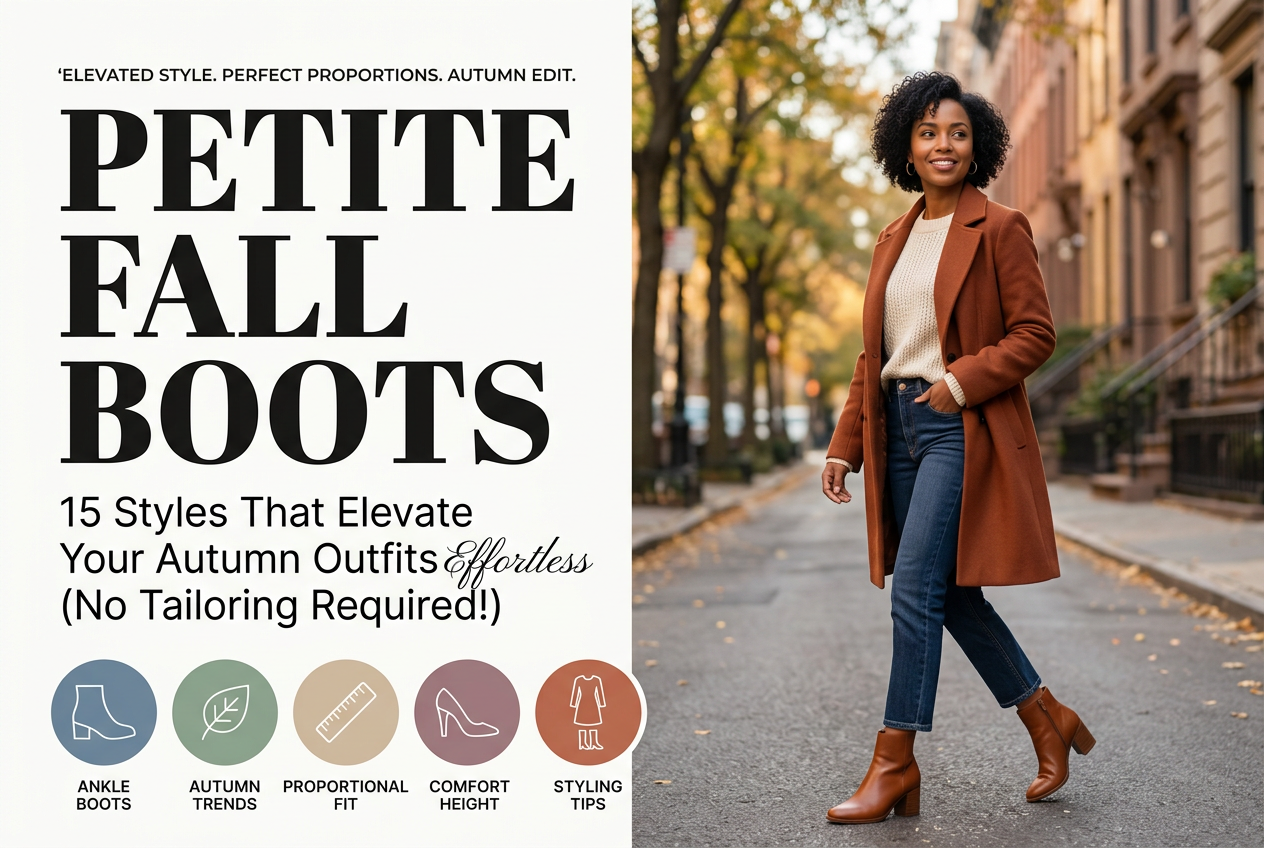
Cropped jeans with ankle boots. This is the easiest formula. Cuff your jeans so there is about a half-inch of ankle showing between the denim and the boot. It creates a visual break that makes your leg look longer. Throw on an oversized sweater and you are done.
Midi skirt with ankle boots. The midi hits mid-calf, and the ankle boot peeks out below. This works especially well with fitted maxis because the boot creates a visual anchor. Pair it with a tucked-in blouse for extra proportion control.
Leggings with knee-high boots. This is the one where petite sizing really shines. Your leg disappears into the boot, creating one long line. It is instantly elongating. Add a tunic or oversized sweater that hits mid-thigh.
Tailored trousers with ankle boots. Crop your trousers so they hit the top of your boot. This creates a clean line and makes your leg look longer. It is the most polished formula of the four.
Five questions before you click buy
Before you buy any boot, petite or otherwise, ask yourself these questions.
Does it hit where I want it to hit? (Ankle bone for ankle boots, right below the knee for knee-highs.) Can I walk in it for longer than five minutes? (If the answer is no, keep scrolling.) Does it feel like it is actually designed for my body, or does it feel like I am wearing a scaled-down version of something else? (The difference matters.) Would I wear this with at least three outfits I already own? (If you cannot answer yes, it is not the one.) Most importantly: does it make you feel good? Because that is the whole point. You are not buying boots because you have to. You are buying them because they make your fall outfits better, easier, and more you.
My own rule is simple: if a boot fails any one of those questions, it goes back. I would rather own two pairs that fit than five that almost do.
At Unwritten, our editors choose every product and story idea independently — we only recommend things we’d genuinely tell a friend about.
Frequently Asked Questions
How tall should a petite knee-high boot be?
A true petite knee-high boot usually has a shaft of about 14 to 15 inches, versus 16 to 17 inches for standard sizing. That inch or two keeps the boot from overwhelming your frame.
Where should an ankle boot hit on a petite frame?
Right at the ankle bone, or maybe an inch above it. Most petite ankle boots are around 4 to 5 inches tall, which gives real coverage without swallowing the leg.
Can I find good petite boots under $100?
Yes. Look for real leather or quality faux leather, a cushioned insole, a comfortable heel and a sturdy sole. Fast-fashion retailers, department store petite sections and specialty boot brands are all worth checking.
How do I style ankle boots with cropped jeans?
Cuff the jeans so about a half-inch of ankle shows between the denim and the boot. That small visual break makes your leg look longer.