
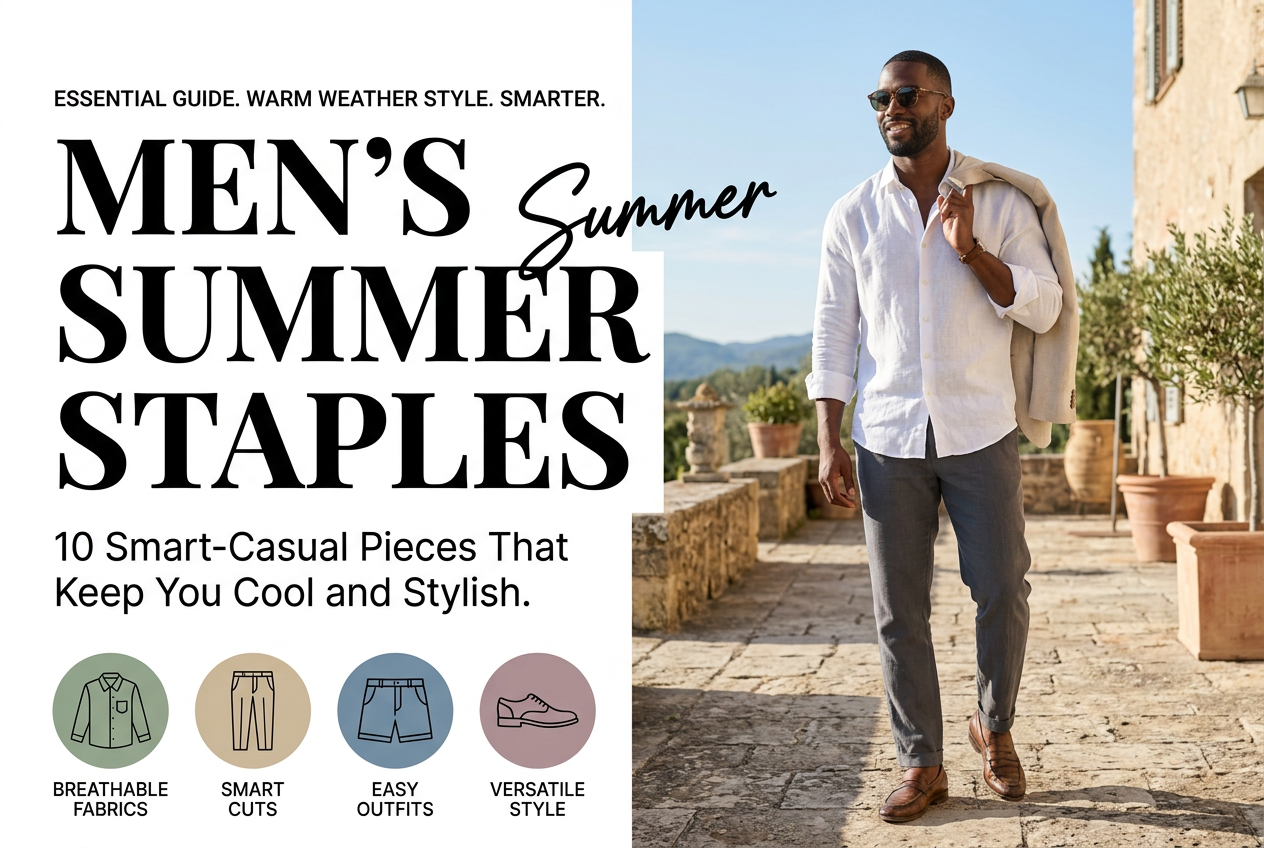
One good linen shirt will do more for your summer than an entire drawer of almost-right options. That’s not a hot take—it’s just what happens when you stop buying pieces that are fine and start buying pieces that actually work in heat, humidity, and the constant shuffle between air conditioning and direct sun.
Here’s what nobody says enough about warm-weather dressing: the whole thing gets easier once you accept that ten pieces beat thirty. Not ten boring pieces—ten pieces that genuinely play well together. A few linen shirts, a pair of lightweight trousers that actually fit, one killer pair of shorts, something to layer with, and shoes that won’t make your feet hate you by noon. When I first tried building a rotation this stripped-down, I kept second-guessing it, adding things back in, then slowly removing them again over the course of a July. By August I was down to basically what I’d started with. The math works.
Your Shirt Is Doing All the Work
Summer shirts carry the whole outfit. They’re the piece that reads as either pulled-together or melting, and the difference usually comes down to fabric choice before anything else. Linen is the obvious starting point—it moves air instead of trapping it, dries fast, and has a slight texture that catches light in a way that plain cotton simply can’t replicate. A white or natural linen shirt worn open over a plain tee, or tucked into lightweight trousers, somehow manages to look more expensive than it probably was. (Actually, that’s not quite right—it doesn’t look expensive so much as considered, which is better.)
Cotton-linen blends are worth considering if you’re someone who finds pure linen too aggressively wrinkled. You keep most of the breathability while cutting down on the texture, which makes it the smarter call if you’re heading somewhere with even a loose dress code. It irons more easily too, though let’s be honest about how often that’s happening in July.
Lightweight oxford cloth earns a spot in the rotation for one specific reason: structure. It photographs better than linen, holds its shape through a long day, and works for situations where linen’s relaxed character might read as underdressed. The tradeoff is airflow—it doesn’t breathe quite as freely. For anything casual, linen wins. For a dinner where someone might actually care how you look, oxford cloth is the more reliable choice.
What Actually Works Below the Waist?
Most guys get trousers wrong in summer by buying something too heavy, too wide, or in a color that absorbs heat. Lightweight chinos in khaki or stone are the MVP answer—formal enough that shorts would feel underdressed, light enough that you’re not essentially wearing upholstery in August, and versatile enough to pair with everything from a plain white tee to a linen overshirt. The fit detail that matters most: a slight taper through the leg, nothing that pools at the ankle, nothing so slim it restricts movement when you’re walking up stairs.
Linen trousers are the flex move for a reason. Yes, they wrinkle. That’s actually the point—a wrinkled linen trouser reads as intentional in a way that a wrinkled chino never quite does. They’re noticeably cooler than cotton, they dry faster after a sudden downpour, and they signal that you’ve thought about how clothes function in actual heat rather than just how they look on a hanger. Pair them with a tucked linen shirt and a leather sandal and you have a summer outfit that requires almost zero effort to pull off.
One pair of structured chino shorts is non-negotiable. Not athletic shorts, not cargo shorts—chino shorts in khaki, light gray, stone, or muted olive, hitting just above the knee. Two pairs is realistic if you wear shorts more than twice a week.
The Case for Actually Layering in Summer
Adding a layer when it’s hot sounds wrong. It isn’t.
The point of summer layering isn’t warmth—it’s moving between aggressive air conditioning and outdoor heat without looking like you grabbed whatever was closest. A linen overshirt handles this better than almost anything else: wear it over a tee when you need coverage, use it as a standalone shirt when you don’t, throw it over your shoulder when neither applies. It’s lightweight enough to not add bulk and breathable enough that wearing it outside doesn’t feel like a punishment. A cotton-blend bomber in a light color works for slightly more structured situations—not to keep warm, but to give you options when the morning starts cool before it gets properly hot.
For anything that reads as smart-casual—a dinner, a summer wedding with a vague dress code, a work event that isn’t quite formal—an unstructured linen blazer is the answer. It’s too relaxed and too wrinkled to function as proper suiting, but that’s exactly why it works in July. Pair it with lightweight trousers and you have something that covers almost any situation that isn’t black tie.
Shoes Matter More Than You Think
Wrong shoes in summer mean one of four things: overheating, blisters, looking like you’re dressed for a different season, or all three simultaneously. The foundation piece is a white leather sneaker—real leather, not synthetic, kept actually clean, with a silhouette that has presence without veering into chunky territory. It pairs with shorts, lightweight trousers, linen pants, and jeans without requiring any thought. That’s the baseline.
A canvas slip-on covers the genuinely casual end of the spectrum. Breathable, easy to get on and off, intentionally relaxed in a way that feels right for summer rather than lazy. Wear it without socks when the situation allows. Keep it clean—a dingy canvas sneaker looks neglected while a well-maintained one looks effortless, and the gap between those two readings is wider than most people expect.
A structured leather sandal or slide rounds out the rotation for situations where a full shoe feels overdressed but bare feet feel underdressed. This is not a controversial position. The only version of men’s sandals that deserves skepticism is the sport sandal with technical straps—a clean leather slide in tan or brown worn to a casual dinner is a completely different category.
Keep the Accessories Minimal
Summer accessories should add intentionality, not visual weight. A watch—nothing heavy or formal, a leather strap in a light color or a simple metal bracelet style—does double duty as functional and as the one piece of jewelry most guys wear without overthinking it. A bucket hat or baseball cap in solid cotton or natural linen works for time spent actually outside; keep the branding minimal or absent entirely. A simple leather belt in tan or brown. That’s the full list.
The best-accessorized summer outfit is one where you can’t quite identify what the accessories are. They’re just part of the whole thing.
The Rotation Actually Works
A linen shirt, lightweight trousers, canvas sneakers, and a watch is an outfit. Swap the trousers for chino shorts and it’s a different outfit. Add the linen overshirt and it works when the temperature drops in the evening or the restaurant is freezing. None of this is complicated—it just requires picking pieces that were designed to work together rather than pieces that all seemed fine in isolation.
Build the rotation slowly. One linen shirt that fits well and breathes properly is worth more than three that almost work. Start with the shirt, add the trousers, get the shoes right, and then fill in gaps based on what you’re actually reaching for versus what’s just hanging there looking good in theory. The men’s summer staples that earn their spot are the ones you’re still wearing in week six of summer without thinking about it—not the ones that seemed smart in May.
At Unwritten, our editors choose every product and story idea independently — we only recommend things we’d genuinely tell a friend about.
Frequently Asked Questions
How many pieces do I actually need for a summer wardrobe?
Honestly, ten well-chosen pieces will outperform thirty mediocre ones. You want a couple of linen shirts, one or two pairs of lightweight trousers, a solid pair of chino shorts, a versatile layer, and two pairs of shoes that can handle different situations. That’s it. Mix and match from there.
Is linen worth it, or is it just a wrinkle nightmare?
Linen is worth it specifically because of the wrinkles, not in spite of them. A slightly rumpled linen shirt reads as intentionally relaxed in summer—it’s the opposite of looking sloppy. The breathability alone makes it worth the tradeoff, especially in genuine heat and humidity.
What shoe actually works for everything in summer?
A clean white leather sneaker is the closest thing to a universal answer. It pairs with shorts, lightweight trousers, and linen pants without effort. Keep it actually clean and make sure the silhouette isn’t too chunky—you want something with presence, not something that looks borrowed from a hiking trail.
Can men wear sandals without it looking wrong?
Yes, but the style of sandal matters enormously. A structured leather sandal or slide—something you could theoretically wear to a casual dinner—reads completely differently than a sport sandal or anything with velcro straps. Stick to simple leather in tan, brown, or black and you’re fine.
What’s the best color palette for summer clothes?
Whites, naturals, stone, khaki, and light grays do most of the heavy lifting. They reflect heat, feel seasonally right, and mix together without much effort. Navy is the one deeper color that earns its place—it pairs with almost everything and doesn’t read as trying too hard.