
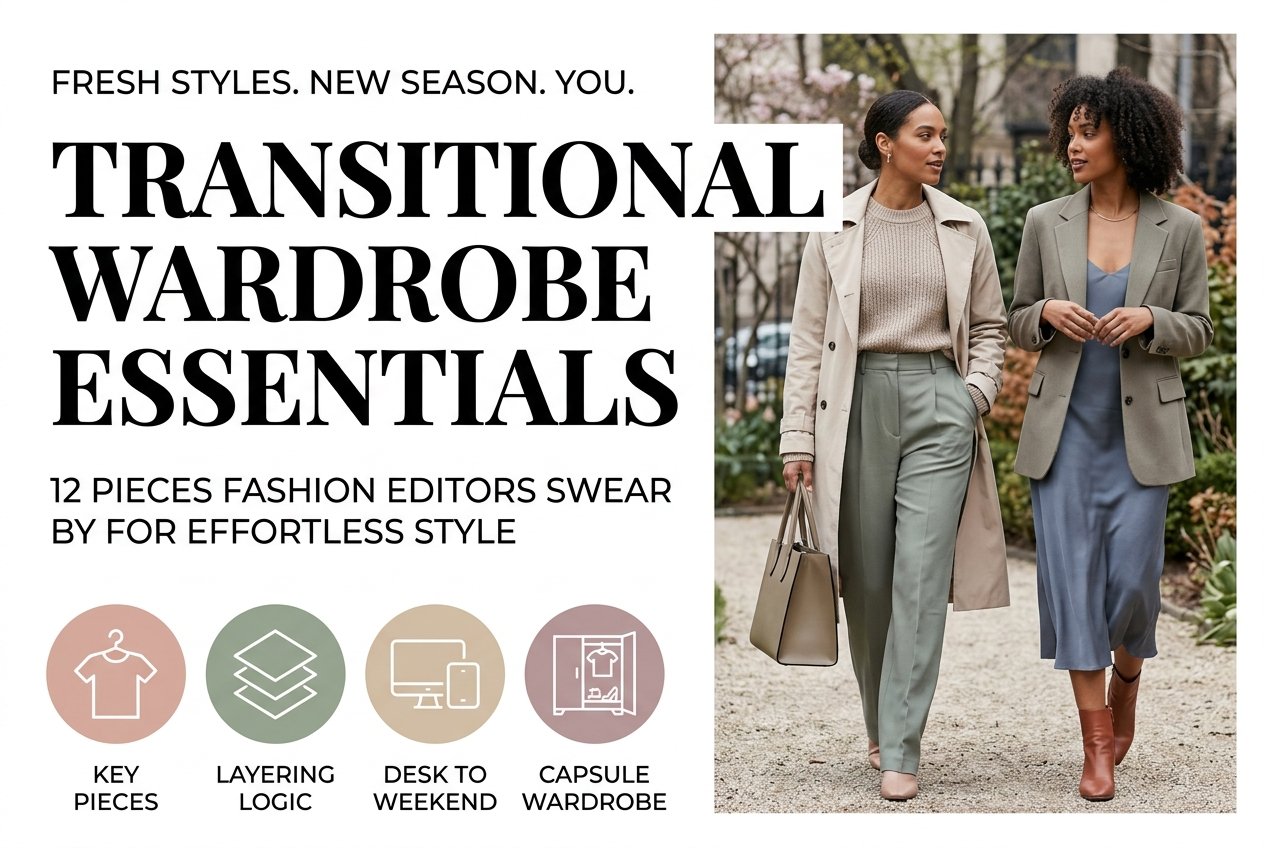
Late February hits, you open your closet, and nothing makes sense. Too warm for the heavy coat. Too cold for the linen. I’ve stood in front of my own wardrobe at 7am, genuinely paralyzed, wearing a parka over a sundress because I couldn’t figure out which season I was dressing for. That moment of confusion is exactly what a well-built transitional wardrobe is designed to prevent — and the fix is simpler than most style guides make it sound.
Here’s the thing most people get backwards: you don’t need more clothes. You need smarter ones.
Fashion editors have spent years cracking this exact problem, and the answer they keep landing on is the same. Versatility beats trend-chasing every time. Not “versatile” in the vague, meaningless way that word gets thrown around, but practically versatile — meaning a piece earns its closet space by working with at least five other things you already own. If it only goes one way, it’s not doing enough. This sounds obvious until you’re standing in a fitting room holding a beautiful terracotta jacket that literally matches nothing else you own, and you buy it anyway. (We’ve all done it. It’s fine. Donate it and move on.)
Why Layering Logic Changes Everything
The goal isn’t warmth or coolness in isolation — it’s the ability to adjust throughout a single day without carrying a suitcase. A morning that starts at 48°F and ends at 67°F requires a different approach than dressing for one consistent temperature, and most wardrobes aren’t built with that range in mind. The pieces that actually solve this problem share a few qualities: they’re mid-weight rather than extreme, they sit well both alone and under something else, and they don’t wrinkle into oblivion the second you layer them. Cotton-linen blends, lightweight merino wool, and ponte fabric hit this range reliably. Heavy denim and thick knits do not.
Fit matters more here than in any other category of dressing.
A button-up that’s slightly relaxed through the body layers cleanly under a blazer. One that’s fitted to your exact measurements bunches and pulls the second you add anything over it. A midi skirt with a relaxed waistband accommodates both a tucked-in fitted tee and a looser silk blouse. You’re engineering flexibility into the garment itself, before styling even enters the picture. This is why a $40 well-cut oxford shirt from a high-street retailer will outperform a $200 version with a too-tight fit every single time.
The 12 Pieces Worth Owning
A fitted long-sleeve tee is your engine. It works under slip dresses, under oversized sweaters, under structured blazers, and on its own with tailored trousers when the afternoon warms up. Buy it in at least two colors — white and one neutral that isn’t white. An oversized linen or cotton shirt is the other workhorse: wear it open over a camisole, half-tucked into wide-leg trousers, belted as a shirtdress, or thrown over a swimsuit. The cut does the work regardless of how you style it.
Then there’s the slip dress, which fashion editors return to obsessively because it genuinely bridges all four in-between scenarios: layer a long-sleeve underneath it when it’s cold, wear it solo with sandals when it warms up, throw a shirt over it when you need coverage, add tights and ankle boots for a completely different feel. One garment. Four distinct outfits. That’s the math you want every piece in your closet to do.
Tailored trousers in a neutral — warm gray, camel, or a soft navy — are non-negotiable. Not stiff formal trousers; something with enough give to survive eight hours of sitting without wrinkling into a disaster. Pair with a blazer and you’re office-appropriate. Swap the blazer for a silk camisole and you’ve got dinner. Wear with a striped long-sleeve on the weekend and it reads completely casual. A lightweight cardigan handles the moments when a blazer feels too structured and a sweater feels too heavy. A well-cut blazer — one with slightly soft shoulders rather than a rigid silhouette — moves between contexts better than almost any other single garment.
For accessories: one good scarf, a white sneaker, a leather loafer, a structured tote, and a crossbody. Actually, that’s it. The scarf adds warmth without bulk and can reframe an entire outfit depending on how you tie it. The shoes cover the range from casual to polished without requiring a seasonal swap. The bags handle every context between them. You do not need more than this.
Does Spending More Actually Help?
Sometimes. Not always. The honest answer is that investment pieces make sense in two categories: structured items where construction quality is visible (blazers, trousers) and shoes, where cheap materials deteriorate fast and comfort matters for obvious reasons. For everything else — tees, camisoles, basic knits — high-street options work just as hard at a fraction of the cost. Some editors buy five identical fitted tees from the same affordable retailer and call it done. That’s not laziness. That’s efficiency.
What doesn’t work is buying transitional pieces that only make sense as part of a complete outfit you haven’t assembled yet. The jacket that needs specific trousers that need specific shoes that you don’t own. Every piece in this list should work with what’s already hanging in your closet right now, not with a hypothetical future wardrobe. If it doesn’t, it’s not a transitional piece — it’s just something new.
Buy less. Wear more. Your closet should feel like a conversation between pieces that already know each other, not a collection of strangers hoping to be introduced someday.
At Unwritten, our editors choose every product and story idea independently — we only recommend things we’d genuinely tell a friend about.
Frequently Asked Questions
What is a transitional wardrobe?
A transitional wardrobe is a set of versatile pieces that work across seasons — not just in summer or winter, but in the awkward in-between weeks when mornings are cold and afternoons are warm. The focus is on layering-friendly fabrics, neutral colors, and pieces that can be styled multiple ways.
How many pieces do you actually need for a transitional wardrobe?
Honestly, fewer than you think. Most stylists point to around 10-12 core pieces: a fitted long-sleeve tee, tailored trousers, an oversized button-up, a slip dress, a lightweight blazer, a cardigan, a scarf, two pairs of versatile shoes, and a couple of bags. The goal is that every single item works with at least four or five others.
What fabrics work best for transitional dressing?
Look for cotton blends, lightweight wool, and linen (especially linen with a slight stretch). These fabrics breathe when it’s warm but don’t leave you freezing when the temperature drops. Avoid anything too heavy or too thin — the sweet spot is mid-weight fabrics that layer without adding bulk.
Can I build a transitional wardrobe on a budget?
Yes. The smartest move is to invest in two or three pieces you’ll wear constantly — a well-cut blazer, quality trousers — and fill the rest with high-street basics. A fitted tee from a fast-fashion retailer works just as hard as a designer one. Spend where fit and durability matter most, save everywhere else.
What colors should a transitional wardrobe focus on?
Neutrals are your foundation: cream, camel, warm gray, and navy. These layer together without creating visual chaos. Once you have your neutrals sorted, you can add one or two pieces in a muted pattern or a single accent color — something that still works with everything else rather than demanding its own dedicated outfit.