
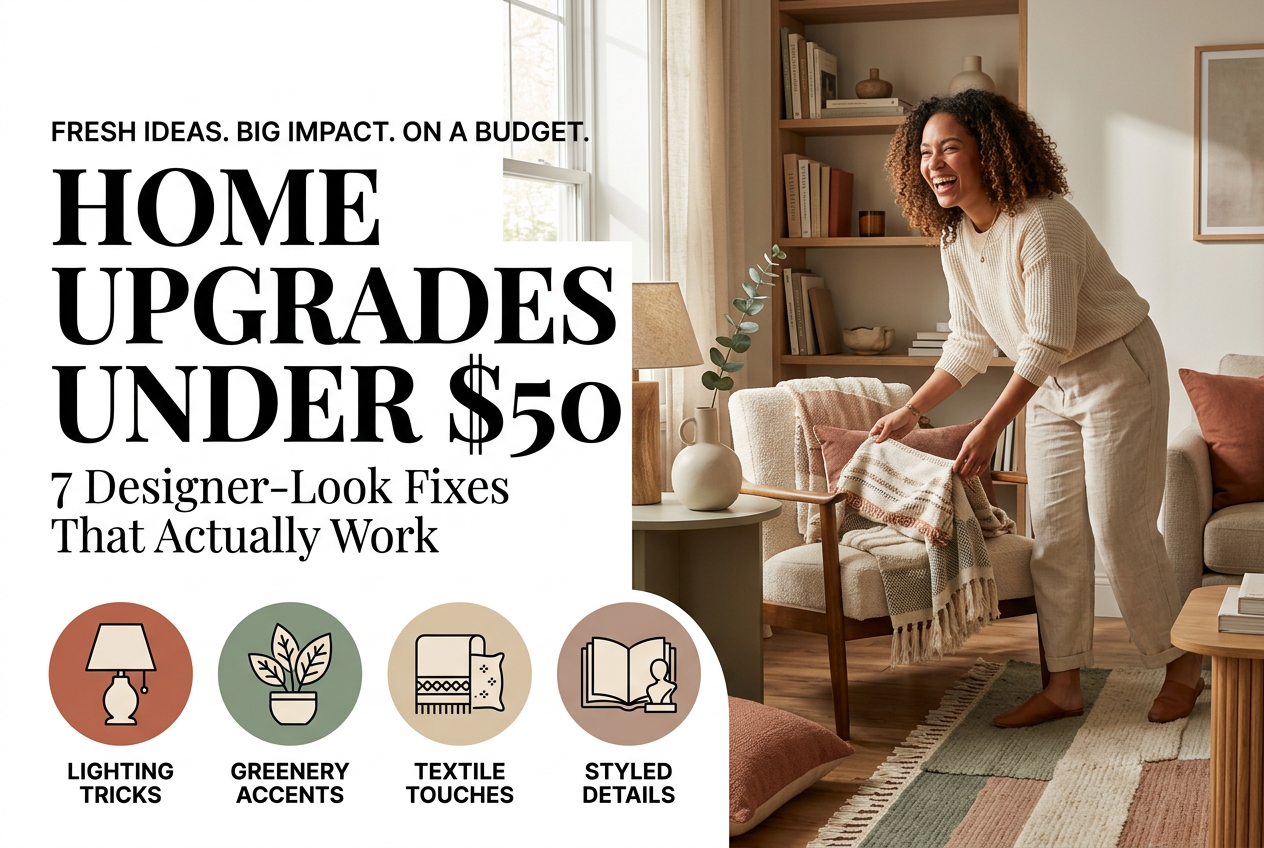
Last month I spent $47 on odds and ends for my apartment, and a friend walked in and asked if I had hired a designer.
Here is the whole lesson up front. Expensive-looking rooms are not expensive because of the big stuff. They look expensive because someone paid attention to light, texture, color and the small details, and that is exactly where home upgrades under $50 live. A better bulb. A throw pillow with some texture. A plant in a nice pot. A swapped-out knob. That is the entire trick, and everything below is just how to do it well.
Every product and story idea at Unwritten is chosen independently by our editors. We recommend only what we’d honestly mention to a friend.
So which cheap upgrades are actually worth your money?
No joke, the answer is not about buying expensive stuff. It is about knowing which inexpensive stuff matters. People who style homes for a living have specific moves that punch way above their price tags. The beauty of a tight budget is that you have to be intentional, because you cannot just throw money at the problem. You end up picking only the changes that genuinely shift how a room feels, and, spoiler, it is usually not furniture at all. It is light, texture, color and the small details that make someone walk in and say, ‘Wait, did you renovate?’ Here are seven home upgrades under $50 that designers actually recommend, and why they work so well.
Twenty minutes and a screwdriver
This is the upgrade that feels almost too simple to work. Changing cabinet knobs and drawer pulls, along with your light switch covers, takes maybe 20 minutes and costs $15 to $30. People notice the change without quite knowing why the room feels different.
Put a matte black or brushed gold knob where the builder-grade chrome used to be, and the vibe shifts completely. It looks more intentional. More expensive. Suddenly your basic dresser or kitchen cabinets feel chosen, not just accepted. (Mine took 25 minutes, mostly because I dropped a screw behind the dresser.)
Light switch covers work the same way. Swap those plastic builder plates for wood or metal ones, or even ceramic. Your fingers touch a light switch several times a day, so upgrading it is both practical and surprisingly impactful. I know it sounds weird, but your subconscious notices these details.
Is bad lighting the real problem in your room?
Probably. Bad lighting will tank even a beautiful room, while good lighting costs almost nothing and transforms everything. It is the designer secret that actually feels like a secret, mostly because nobody talks about it.
Layered lighting, which just means combining overhead light with softer task and ambient sources, is what makes a space feel intentional instead of harsh, and the good news is that you do not need to rewire anything, because smart bulbs and clip-on lamps do the heavy lifting and string lights help too.
A $20 warm-toned smart bulb in your main fixture changes the entire mood of a room. Seriously. Swap it out and suddenly your space feels like somewhere people want to sit and stay awhile.
The trick interior designers use? They add light sources at different heights. One overhead and one on a side table, then maybe a third tucked behind a plant. It sounds fussy, but it is not. It just means your space stops feeling like a fluorescent office.
Stop buying tiny succulents
A single live plant in the right spot does more for a room than you would expect. And I am not talking about a tiny succulent on a shelf. I mean a real plant, something with actual presence. A pothos vine, a snake plant, a rubber plant or a monstera cutting in a propagation jar. Something that makes you feel like you are not living in a box.
Designers love plants because they add color and life without looking like you are trying too hard, and the leaves bring texture as a bonus. They also hide awkward corners. Put a tall plant in a bare corner and suddenly that corner has a purpose. The whole room feels more finished.
Pots matter more than people think. A $30 plant in a $5 plastic pot looks cheap. That same plant in a $12 ceramic pot looks intentional. Pair that pot with a plant stand, another $15 to $20, and you have a whole vignette, with pot and stand still well under $50. It is the kind of thing that makes guests ask, ‘Where did you get that?’
Mismatch your pillows on purpose
Textiles give you the most visual impact for the least money. A new throw pillow costs $15 and a new throw blanket costs $20. Together, they make your couch look like it belongs in a magazine.
The designer move is texture mixing. Pair a velvet pillow with a linen one. Add a chunky knit throw over something silky. When fabrics have different textures, the whole arrangement looks more curated and expensive. It is the opposite of buying a matching set, which, honestly, looks kind of flat.
Curtains are another game-changer most people overlook. Trade thin, sad curtains for something with real weight and color and the whole room photographs and feels different. Heavy linen or a subtle pattern makes windows look intentional instead of like an afterthought. Budget $30 to $45 for a decent pair, depending on your window size.
Frames that refuse to match
Art does not have to be expensive. A framed print from an online artist costs $20 to $40. Three of them arranged on a wall costs $60 to $120. But that arrangement, whether it is a gallery wall or a simple trio, makes a room feel like someone actually designed it.
The designer trick is to mix frame styles and sizes, just slightly. Do not buy a matching set. Get one gold frame, one black frame, one natural wood frame and one white frame, and mix vertical and horizontal orientations. It looks more collected and more intentional than a perfectly coordinated set ever could, and a lot more expensive.
Mirrors are another artful accent that does double duty. They reflect light and make a space feel bigger, which adds visual interest too. A decorative mirror under $40 can anchor an entire wall. Lean it against the wall instead of hanging it (which, honestly, is easier anyway) and you have an instant focal point.
The other thing worth knowing is that these upgrades are reversible. You are not committing to anything. You can try something and see if it works. If it does not, swap it out. That is actually how designers work: they layer things in, then step back and adjust. You can too. Start with one or two changes and see how they feel. Odds are good your space will already feel more like ‘you’ and less like a generic apartment.
If I had only $50 and one afternoon, I would buy a warm smart bulb and new cabinet knobs, then start layering from there. Everything else on this list is a bonus. Those two moves change how a room feels the most, and together they cost $50 or less.
Frequently Asked Questions
What is the cheapest home upgrade that makes the biggest difference?
A warm-toned smart bulb in your main fixture. At about $20, it changes the mood of a whole room.
How do I make a couch look more expensive for under $50?
Mix textures. Pair a velvet pillow with a linen one and add a chunky knit throw over something silky. A pillow runs about $15 and a throw about $20.
How long does it take to change cabinet knobs?
About 20 minutes, and it usually costs $15 to $30. People notice the difference without quite knowing why the room feels better.
Should I hang or lean a decorative mirror?
Leaning it against the wall is easier and still gives you an instant focal point. A decorative mirror under $40 can anchor an entire wall.
Where should I start if I am not sure which upgrade to pick?
Start with one or two changes and see how they feel. These upgrades are reversible, so you can swap anything out if it does not work.