
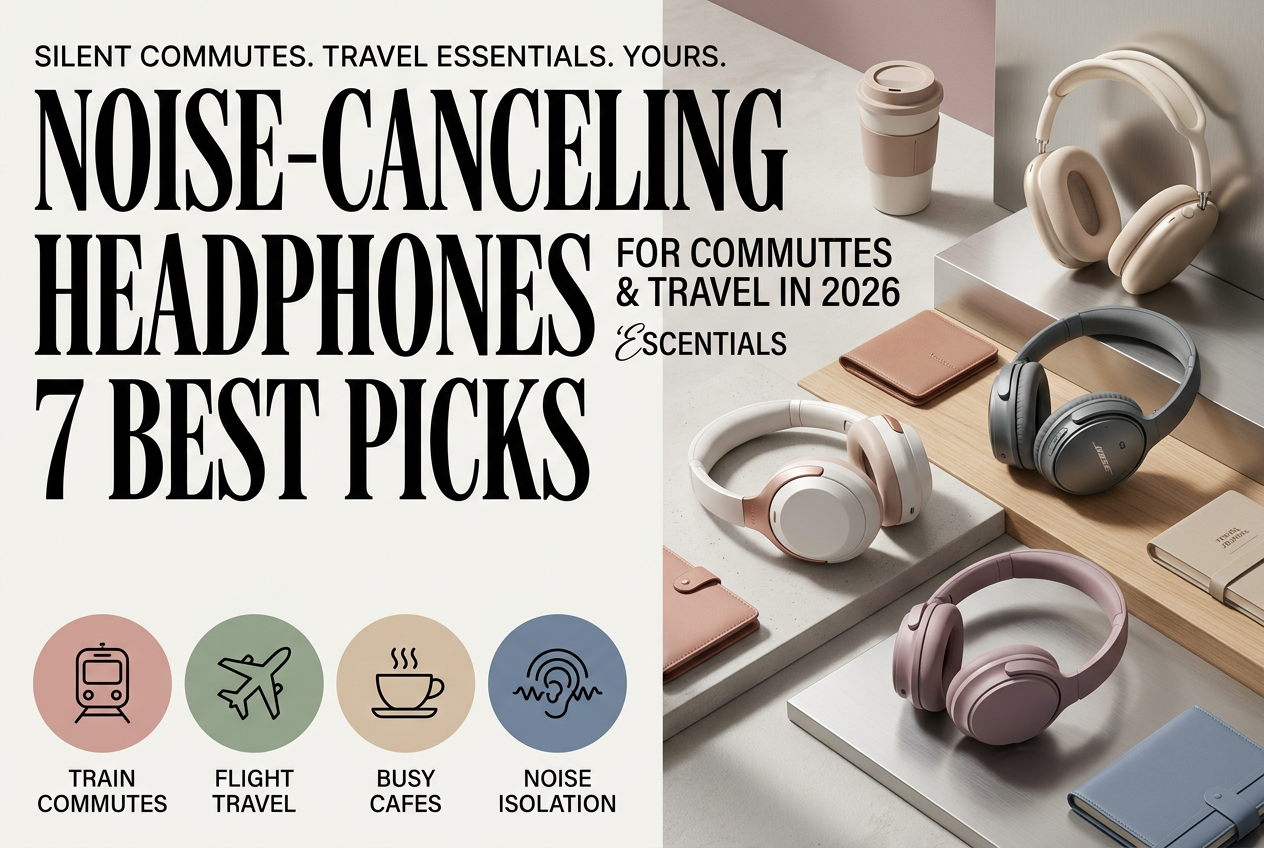
I once sat through a seven-hour flight next to a man who narrated every turbulence bump out loud. No headphones. Never again.
That trip is why I’ll argue, without hesitation, that a good pair of noise-canceling headphones is one of the few purchases that actually changes your daily quality of life — not just for flights, but for train commutes, crowded buses, open-plan offices, and anywhere else the world insists on being loud at you. The technology isn’t magic, exactly. Built-in microphones pick up ambient sound and the headphones generate inverse sound waves to cancel it out before it hits your ears. The result is a kind of acoustic bubble. You can still hear a gate announcement if you need to, but the constant low-level roar of engines and strangers just… disappears.
There’s a practical health argument here too, one that doesn’t get mentioned enough: when ambient noise is already suppressed, you keep your listening volume lower. Lower volume over years of daily commuting adds up to meaningfully less hearing damage. So this isn’t just a comfort purchase.
Not All ANC Is the Same
The spec sheets won’t tell you this, but noise-canceling headphones vary enormously in how their ANC actually feels to wear. Sony’s approach is aggressive — it goes hard after low-frequency rumble, the kind produced by airplane engines and subway cars, and it does so well enough that some users report a faint pressure sensation in their ears (which just means it’s working). Bose takes a smoother, less intense approach that some people strongly prefer precisely because it doesn’t create that sealed-cabin feeling. Sennheiser lands somewhere in between, prioritizing comfort and battery life over maximum cancellation power. None of these is wrong. They’re just different philosophies, and knowing which one suits you matters more than any single spec.
So which should you buy?
The Over-Ear Options Worth Your Money
Sony’s WH-1000XM5 is the closest thing to a consensus pick among frequent travelers right now. The dual noise-sensor technology adapts to your environment — commute the same route daily and it actually learns the acoustic profile of that specific train or bus. Battery life is 30 hours with ANC on, which is enough to get through most long-haul flights without anxiety. Sound quality leans detailed and crisp, which makes them excellent for music and not just background noise blocking. The ear cups run warm after extended wear, and the price is steep, but if you want the most effective ANC available in an over-ear headphone, this is it.
Bose’s QuietComfort 45 does something different and arguably more important for long commutes: it’s extraordinarily comfortable. The headband padding is genuinely plush, and the ear cups use a soft synthetic material that doesn’t get sticky after two hours of wear the way some competitors’ do. Their ANC is effective without being aggressive, which is a real feature for people who find Sony’s approach claustrophobic. Battery life is 24 hours. Sound is warm and balanced — great for podcasts, audiobooks, long playlists. The trade-off is that in a very loud environment, like a crowded airport gate, the Bose doesn’t isolate quite as completely as the Sony.
Sennheiser’s Momentum 4 Wireless is the sleeper pick. Sixty hours of battery life with ANC on. I’ll just let that sit there. It’s lighter than both the Sony and Bose models, which matters when you’re carrying it around all day, and the sound signature is neutral and detailed in a way that audiophiles tend to appreciate. The ANC isn’t as powerful as Sony’s in genuinely loud environments — an airport terminal during a delay, say — but for daily train or bus commuting, it’s more than sufficient. If battery anxiety is your primary concern, this is your headphone.
Earbuds: Smaller, But How Much Worse?
Not everyone wants to wear over-ear cans on their commute. Fair.
Apple’s AirPods Pro (2nd generation) are the obvious starting point for anyone already in the Apple ecosystem. The ANC is solid, the transparency mode — which lets ambient sound in when you need to hear an announcement or a colleague — works beautifully, and the adaptive audio feature adjusts automatically based on your environment. About six hours per charge, 30 hours total with the case. The seamless handoff between iPhone, iPad, and Mac is genuinely convenient in a way that’s hard to replicate with other brands. One real caveat: on Android, they’re noticeably less polished. Actually, that’s not quite right — on Android, several features don’t work at all. Know your ecosystem before you buy.
Sony’s WF-C700N earbuds offer more aggressive noise cancellation than the AirPods at a lower price. They’re built specifically with commuting in mind, with a secure fit that holds up on bumpy rides, about eight hours of battery per charge, and punchy sound that works well for music. The fit requires some trial and error with different ear tip sizes — I went through three pairs before finding the right seal — but once you nail it, they stay put reliably. Good value option if you’re not committed to the Apple ecosystem.
Bose’s QuietComfort Ultra Earbuds bring that signature smooth ANC to a compact form. Comfort is exceptional for earbuds — they’re clearly designed for extended wear, and they don’t create the ear fatigue that some tighter-fitting earbuds do after an hour. Six hours per charge, effective (if not aggressive) noise cancellation, and the overall refinement you’d expect from Bose at this price point. They’re expensive. But if Bose’s headphone philosophy clicks with you, the earbuds translate it faithfully.
What Actually Matters When You’re Shopping
Battery life, comfort, ANC quality, and sound character are the four things worth evaluating — in roughly that order for commuters. Build quality matters too, since travel headphones get thrown in bags and exposed to temperature swings in ways that home listening gear never does. Read reviews from people who describe commuting conditions similar to yours. Someone who rides a quiet suburban train has different requirements than someone on the New York City subway.
Start by deciding over-ear versus earbuds. For commutes over 90 minutes, over-ear headphones are almost always more comfortable and provide better isolation. For shorter trips or people who want something pocketable, earbuds make sense. Then figure out your ecosystem and your ANC preference — aggressive or smooth — and the choice narrows itself down quickly.
You don’t need to spend $400 to get genuinely good noise cancellation. Mid-range options across all these brands perform well. The premium models offer refinements, not revolutions. Whether those refinements are worth the premium depends entirely on how many hours per week you’re wearing them.
My honest take: buy the most comfortable pair you can afford in your chosen form factor, and don’t chase specs. The headphone you actually wear every day is worth more than the technically superior one sitting in your bag because the headband gives you a headache.
At Unwritten, our editors choose every product and story idea independently — we only recommend things we’d genuinely tell a friend about.
Frequently Asked Questions
How long should noise-canceling headphones last on a single charge?
For over-ear models, aim for at least 20 hours with active noise cancellation running. Earbuds typically offer 6-8 hours per charge, with the charging case extending that to 24-30 hours total. Sony’s WH-1000XM5 hits 30 hours; Sennheiser’s Momentum 4 claims an almost unbelievable 60.
Do noise-canceling headphones damage your hearing?
Actually, they can protect it. Because ANC reduces ambient noise, you don’t need to crank the volume to drown out background sound. Listening at lower volumes over time is meaningfully better for your long-term hearing health.
Are noise-canceling earbuds as good as over-ear headphones?
Close, but not quite. Over-ear models physically cover more of your ear and generally produce stronger ANC. That said, the AirPods Pro 2nd gen and Sony WF-C700N come surprisingly close for a device that fits in your pocket.
Why does active noise cancellation sometimes feel like ear pressure?
ANC works by generating sound waves that are the inverse of ambient noise, effectively canceling it out before it reaches your eardrums. Some people perceive this as a slight pressure sensation. It’s harmless — if anything, it means the ANC is working aggressively.
Sony or Bose — which brand is better for commuting?
Depends what bothers you more. Sony’s noise cancellation is more aggressive and better at killing low-frequency rumble like engine drone. Bose feels smoother and less ‘pressurized,’ and their headband comfort is genuinely exceptional for long wear. Neither is objectively better — they’re just different.