
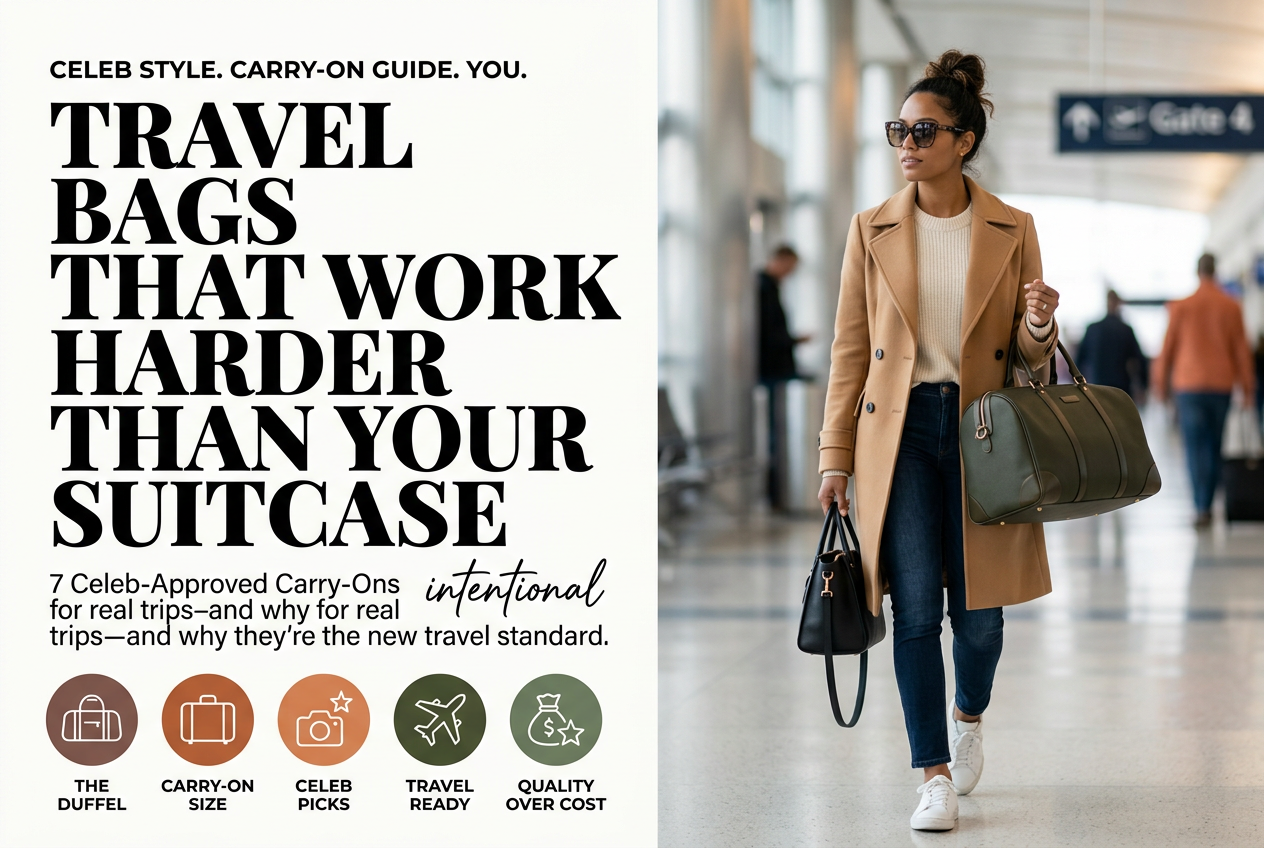
Here is the thing nobody mentions about airport paparazzi photos: the bag is usually the most interesting part. Not the outfit, not the sunglasses. The bag. Because while everything else might be borrowed from a stylist, the travel bag a celebrity is actually hauling through Terminal 4 at JFK at 6am is almost always a personal choice—something that has to work, not just photograph well. And what you keep seeing, over and over, is that the people who travel constantly have quietly abandoned oversized rolling suitcases in favor of structured carry-ons and duffels that look intentional even when they’re clearly exhausted.
That shift matters for the rest of us too.
Why does this actually change how you should pack?
A travel bag that functions as your carry-on means you stop thinking about luggage as two separate categories—the nice bag you use daily and the utilitarian thing you drag out twice a year. One good bag handles a business trip on Tuesday, a long weekend in October, and the spontaneous flight you booked at 11pm because the fare was too good. I have a friend who spent years buying cheap rolling bags that cracked at the seams after four flights, then finally bought one well-made duffel and hasn’t thought about luggage since. That is the actual value proposition here: not luxury for its own sake, but the specific relief of solving a recurring problem once.
Celebrities who move between film sets, press tours, and personal trips understand that every item they carry has to justify its existence. A bag that only works for one type of trip is a bag that creates logistics. The ones worth carrying slip between contexts without asking you to adapt to them.
What’s actually trending in 2026
Four things are defining travel bag design right now, and they all point in the same direction: less bulk, more thought.
Minimalist structure is everywhere. The heavily padded, logo-covered bags that dominated the early 2020s are giving way to clean silhouettes in neutral tones—structured duffels that hold their shape when half-empty, totes with enough internal architecture that they don’t collapse the moment you set them down. There is something almost architectural about the best ones. They have personality without ornamentation.
Multi-pocket intelligence has gotten genuinely useful, which was not always true. The hidden compartment used to mean a single zippered pouch you could never find anything in. Now it means a laptop sleeve positioned so you can actually reach it at security without removing everything else, TSA-friendly organization that keeps liquids accessible, and exterior pockets placed where your hands actually go. Unglamorous, yes. But this is what makes a bag worth carrying daily rather than just occasionally.
Sustainable materials have crossed from niche to standard. Recycled nylon, organic cotton canvas, responsibly sourced leather—these are showing up at every price point now, and the quality has caught up with the ethics. (Actually, that is not quite right: in some cases the quality has surpassed conventional materials. High-grade recycled nylon is more abrasion-resistant than a lot of virgin polyester.) Celebrities who are publicly vocal about sustainability are choosing these materials partly for the values signal and partly because they genuinely perform better over time.
Finally, weight optimization. The best travel bags in 2026 are notably lighter empty than their predecessors—which sounds minor until you are at your airline’s 15-pound carry-on limit and every ounce of bag weight is an ounce you cannot spend on clothes.
The duffel had its moment. It earned it.
Something shifted a few years ago and the duffel went from gym bag to the travel bag serious travelers actually prefer. Part of this is practical: a duffel fits overhead bins more easily than a rigid rolling case, moves faster through security, and sits under the seat in front of you when the overhead is full. Part of it is aesthetic. A duffel reads as intentional in a way a rolling suitcase never quite does—it says you packed what you needed and nothing more, which is its own kind of confidence. When I first started using a duffel for work trips instead of a carry-on roller, I was skeptical I could fit everything. I was wrong. The flexibility of a soft-sided bag actually lets you pack more efficiently than a rigid case, because you are not fighting the geometry of the container.
The key specs to look for: enough structure that the bag does not look deflated when it is half-full, a base that sits flat so it does not tip over constantly, and at minimum one exterior pocket large enough for a water bottle. Pockets, always.
Pack smarter, not more
A good travel bag does something a mediocre one cannot: it forces discipline. There is no room for the three backup options you will never wear. Every item has to earn its spot, and that constraint is genuinely freeing once you stop fighting it.
Start with packing cubes. I know this sounds fussy—I thought so too—but separating clothes by category means your bag stays organized after airport security has rearranged everything, and you can find what you need at midnight in a dark hotel room without unpacking completely. One small pouch for chargers and cables. Another for toiletries. Laptop and documents in a dedicated sleeve, never loose.
Roll your clothes. It works.
Pack your heaviest items at the bottom or closest to your back, whichever applies to your bag’s structure—this keeps weight distribution sane and makes carrying easier over long terminal walks. And leave roughly 20 percent of your bag empty intentionally. You will buy things. You will pick up a book. You will acquire a souvenir you did not plan for. The travelers who arrive home with bags that look like they might explode are the ones who left no margin, and they are miserable at baggage claim.
Choose a bag you actually like looking at. This sounds superficial and it is not. You are going to spend a significant amount of time with this object—hoisting it, searching through it, sitting next to it in middle seats. If it feels like a choice rather than a default, that changes how you travel. The celebrities who look effortless in airport photos are not performing effortlessness. They have just stopped tolerating things that make travel harder than it needs to be. That is a reasonable standard for the rest of us too.
At Unwritten, our editors choose every product and story idea independently — we only recommend things we’d genuinely tell a friend about.
Frequently Asked Questions
What kind of travel bags do celebrities actually use at airports?
Most celebrities opt for structured duffels or oversized totes that fit in overhead bins—bags with dedicated laptop compartments, clean silhouettes, and materials that hold up to frequent use. Brands known for thoughtful construction tend to show up repeatedly in paparazzi airport shots.
Can a travel bag really replace a rolling carry-on suitcase?
For trips under a week, yes—especially if you pack with intention. A well-structured duffel or travel tote with smart compartments can hold as much as a standard carry-on while being faster through security and easier to stow overhead.
What should I look for in a travel bag that doubles as a carry-on?
Prioritize a dedicated laptop sleeve, at least one exterior quick-access pocket, and dimensions that fit major airline overhead bin requirements (typically under 22 x 14 x 9 inches). Weight matters too—a heavy empty bag leaves less room for your actual stuff.
Are sustainable travel bags actually durable enough for frequent travel?
The best ones are. Recycled nylon in particular has improved dramatically—it resists abrasion better than many virgin polyesters and the hardware on quality eco-conscious bags is built for repeated use. Avoid anything with plastic zippers regardless of the material story.
How do packing cubes work with a duffel-style travel bag?
Packing cubes essentially give a soft-sided bag the internal structure a hard case has built in. Use one cube per clothing category, keep electronics in a flat pouch near the top, and you’ll be able to find anything without unpacking everything at your hotel at midnight.