
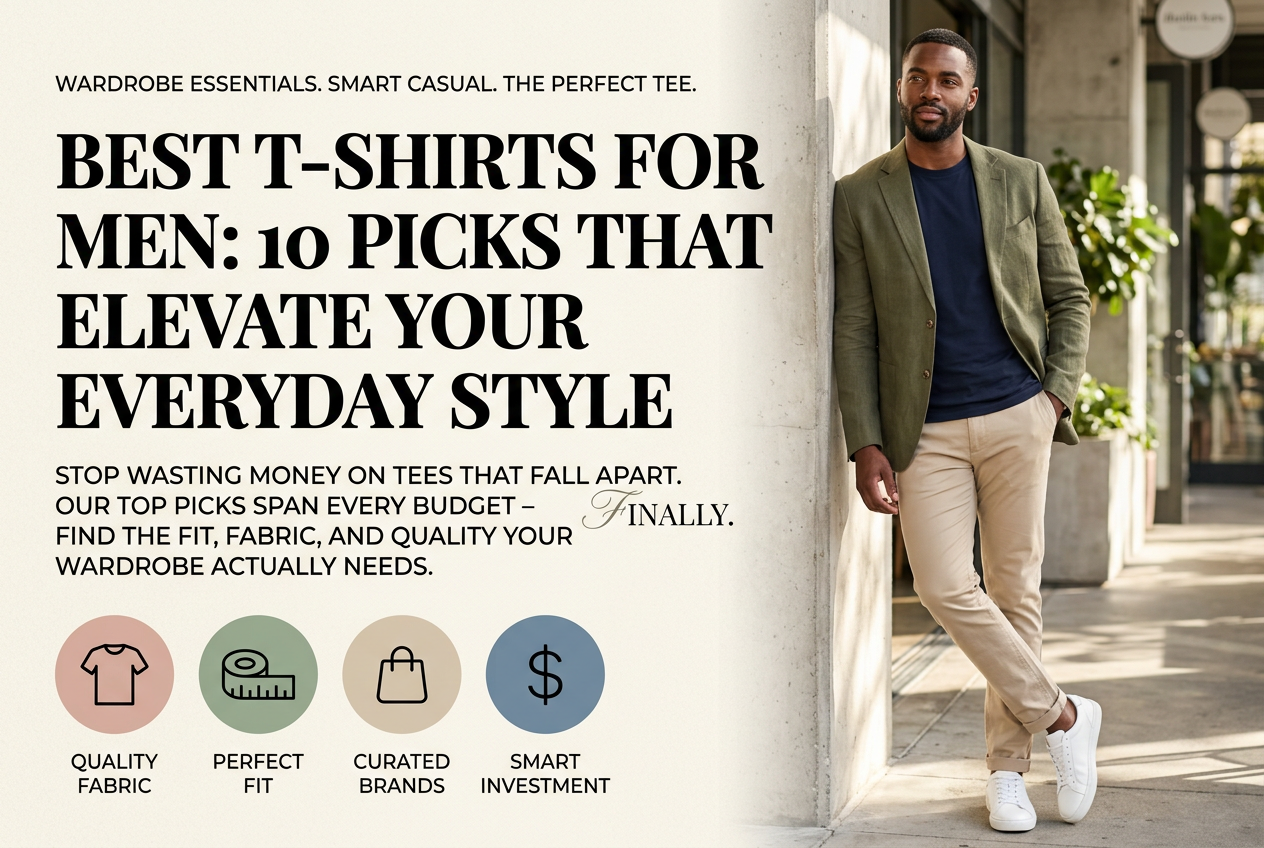
You already own the most versatile piece of clothing in your wardrobe. You just might be buying the wrong version of it.
Here is what most guys figure out too late: a $50 t-shirt that lasts three years actually costs less than a $15 tee you replace every six months. Run the math. It is brutal. And beyond the economics, there is something that happens when you put on a shirt that fits correctly and feels like actual fabric against your skin — your posture changes. You stop fidgeting. You feel less like you grabbed whatever was on top of the pile and more like someone who made a deliberate choice. That might sound like a lot to ask of a t-shirt, but that is exactly the point.
Why Most Guys Get This Wrong
A t-shirt works under a blazer on a client call, under an open linen shirt at a summer barbecue, solo with tailored trousers, and with sweats when you have nowhere to be. No other piece in your closet does all four. So when the neckline stretches out after four washes, or the fabric goes thin and see-through, or the color fades to that weird grayish-purple — you are not just losing a shirt, you are losing a foundational piece that everything else depends on. I went through probably eight or nine cheap tees in two years before I finally bought two good ones and stopped the cycle entirely. The difference was immediate and obvious.
Cheap tees start looking tired fast.
What Actually Makes a T-Shirt Good?
Fabric weight matters more than most people realize. Quality tees typically land between 150 and 200 grams per square meter — anything lighter feels insubstantial, anything much heavier gets stiff. Around 180 grams is where most well-made everyday tees sit, and you can genuinely feel the difference when you hold two tees side by side. Beyond weight, look for combed cotton (short fibers removed, which makes it softer and stronger), pima cotton (longer staple fiber, resists pilling and fading), or ring-spun cotton (twisted during production for a smoother, more durable yarn). Any of these beats generic “100% cotton,” which tells you essentially nothing. Construction details also separate good tees from forgettable ones: flat, even seams rather than puckered ones; a reinforced tape at the neckline rather than a raw edge; a double-stitched hem. These are small things. But they are what you are actually paying for when a tee costs more.
One thing brands almost never mention loudly enough: pre-shrinkage. Some brands treat their fabric so the tee barely changes after washing. Others do not, and you end up with something that fits perfectly exactly once. If a brand does not mention pre-shrinking, assume it will shrink and size up accordingly.
The Picks
Every man needs a white t-shirt that does not look like it belongs in the gym. This is the one. The fit is true to size without bagging, the fabric has enough weight that it does not show everything underneath, and it stays white through repeated washing without going dingy. Pair it with dark jeans and a blazer, or wear it solo on a Saturday. It is the kind of tee that makes you wonder why you bothered with cheaper versions for so long.
Black tees are harder to get right than white ones. Cheap versions fade to a strange grayish-purple after a handful of washes because the dye is not locked in properly. This one holds its color. The sleeve length is proportional to an actual human arm (not those weird short sleeves that make your arms look truncated), and the fabric feels like clothing rather than something you grabbed at an airport. This is the default grab for almost any casual occasion — actually, that is not quite right. It works for plenty of semi-casual ones too.
Organic cotton is softer and more durable than standard cotton because it is grown without synthetic pesticides and processed more carefully. This tee gets noticeably softer with every wash instead of slowly breaking down. Yes, it costs more upfront. But if you rotate through five or six core tees regularly, buying two really good ones instead of six mediocre ones makes practical sense. The environmental benefit is a genuine bonus, not the main selling point.
Pima cotton is the good stuff — softer than regular cotton, resists pilling, fades slower. This tee is the kind of thing you buy once and immediately wish you had bought three more. The neckline holds its shape season after season. The color stays true. Fair warning: once you own a pima cotton tee, standard cotton starts feeling noticeably cheap by comparison, which is either a feature or a problem depending on your budget.
Summer tees need to work differently. This one sits around 150 grams, light enough that it does not feel like a blanket when it is 85 degrees out, but with just enough texture that it does not cling to your body like a second skin. It breathes. You can move in it. And because the cut is correct, it does not look sloppy even though it is not a slim fit. This is what you reach for when it is hot and you still want to look like you made a decision this morning.
A henley is not technically a t-shirt. The button placket at the neck makes it slightly more polished than a crew neck, but it is still casual enough for jeans and sneakers. Layer it under an open shirt, or wear it solo. The fabric on this one is substantial without being heavy, and the fit follows your body rather than hanging off it. It is the piece you reach for when you want to look like you put in a little more thought without actually putting in much more thought.
If you prefer clothes that actually follow your body, this is your option. Fitted without being tight, proportional sleeve length, enough stretch that you can move without the waist going baggy after a few wears. It holds its shape. This is what you wear when you want to look intentional without looking like you tried too hard — which, honestly, is the goal most days.
Gray is the most versatile color in your closet, but only the right gray. Too light and it reads washed out. Too dark and it starts feeling more formal than it should. This one is that middle ground — substantial enough to wear solo, neutral enough to work with navy, black, khaki, or denim. Layer it under a jacket or wear it alone. Most guys who buy this one end up buying two more within a month.
This is the splurge. The seams are perfectly even. The fabric is soft but holds its shape. The neckline tape does not curl or stretch. The hem is double-stitched. These are details most people will never consciously notice, but you will feel every single time you put it on. If you are buying one tee to last you five years, this is the one to buy.
No tricks, no gimmicks. A straightforward crew neck in a classic cut that will not go out of style because a well-made basic never does. Good fabric, solid construction, a fit that works on most body types. Buy it in a few colors and stop thinking about it.
Wear Them Better
People underestimate how far a t-shirt can reach in an outfit. A white tee with dark denim and clean white sneakers works for coffee or a casual dinner — the fit is what makes it look intentional rather than accidental. A gray tee under a blazer with tailored trousers reads as smart casual without trying too hard. A black tee under a cardigan. A henley under a denim jacket. The tee is not the focus in any of these; it is the foundation. Which is exactly why it has to fit correctly, because a poorly fitting tee under a jacket still looks poorly fitted.
Texture contrast is underused. A smooth cotton tee under a linen jacket, or a pima cotton tee under a textured sweater, creates visual interest without requiring you to think too hard about it. Small contrasts like that are what make an outfit feel considered rather than assembled.
Keep Them Looking Good Longer
Wash cold. Turn them inside out before washing. Air dry when you can, and use low heat when you cannot — heat is the main thing that breaks down fabric over time. Do not overload the washer, because tees need room to move and friction causes pilling. Fold them rather than hanging them, since hangers stretch out the shoulder over time. Treat stains immediately rather than letting them set and then washing repeatedly trying to get them out, because that repeated washing is what actually damages the fabric.
None of that is complicated. It is just what you do when you care about your things lasting.
The honest take: most guys spend more money on cheap tees than they would on good ones, get worse results, and never connect the two facts. Buying fewer, better t-shirts is not a luxury decision — it is just a smarter one.
At Unwritten, our editors choose every product and story idea independently — we only recommend things we’d genuinely tell a friend about.
Frequently Asked Questions
What fabric is best for men’s t-shirts?
Pima and combed cotton are your best bets. Both resist pilling, hold color longer, and soften with age rather than breaking down. Ring-spun cotton is a close third — the spinning process creates a stronger, smoother yarn than standard cotton.
How do I stop my t-shirts from shrinking?
Wash in cold water and air dry whenever possible. Heat is what causes shrinkage and fiber breakdown. If a brand does not mention pre-shrinking, buy one size up on your first order and wash it before wearing.
How much should I spend on a quality t-shirt?
Somewhere between $30 and $60 is the sweet spot for most guys. A $50 tee that lasts three years costs you less per wear than a $15 tee you replace every six months. The math is brutal once you run it.
Can a t-shirt work in a smart casual outfit?
Yes, easily. A well-fitted crew neck in white or gray under a blazer with tailored trousers reads as intentional, not lazy. The fit has to be right — an oversized tee under a structured jacket just looks like a mistake.
How should a t-shirt fit?
The shoulder seam should sit at the edge of your shoulder, not drooping down your arm. The hem should hit around mid-hip. Sleeves should end near mid-bicep. If you are constantly tugging at the hem or adjusting the neckline, it does not fit.