
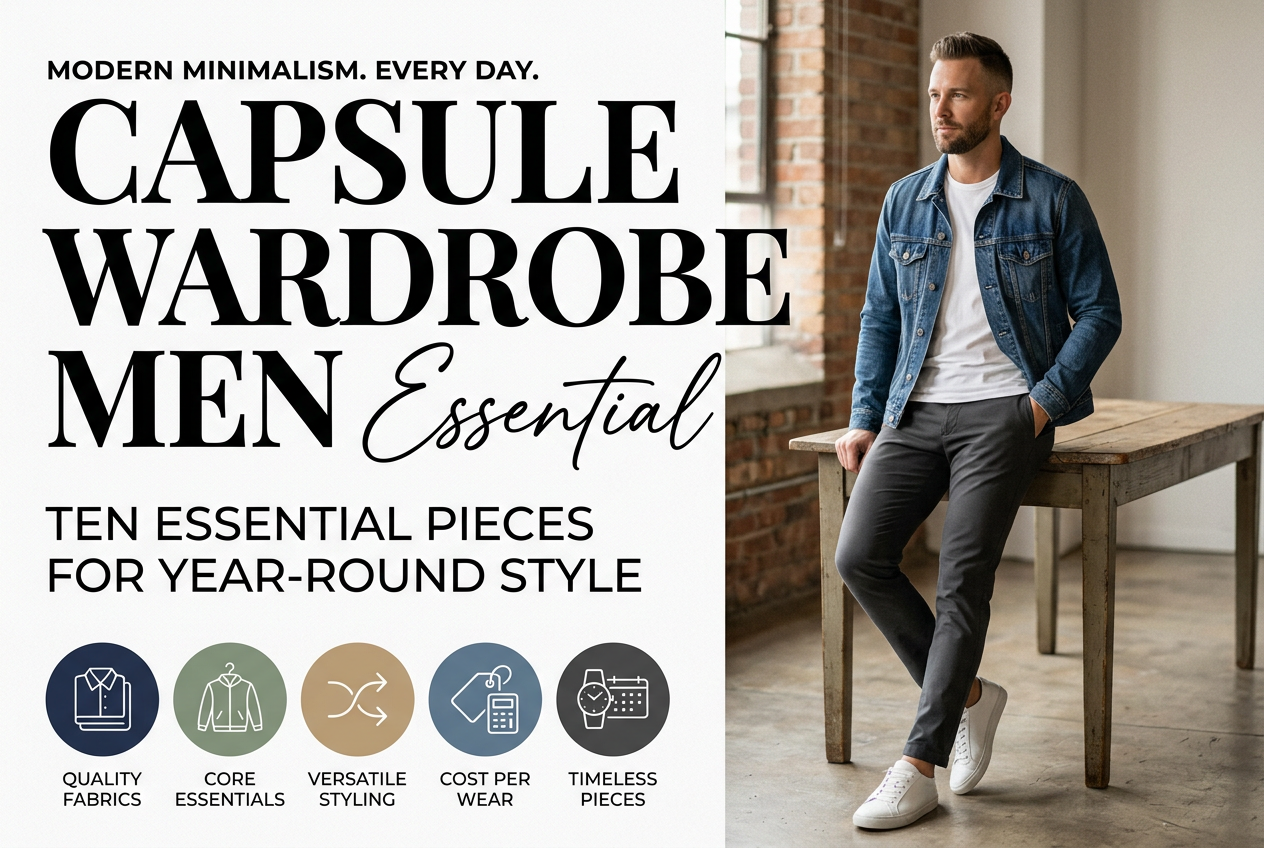
Ten pieces. That’s it. Not because minimalism is a personality, but because ten really good things that actually work together will beat a hundred mediocre ones every single time — and once you’ve built it, getting dressed on a Tuesday morning stops being a decision at all.
Here’s the thing most capsule wardrobe guides won’t tell you upfront: the freedom isn’t in owning less. It’s in owning things that never let you down. When I finally cleared out the pile of “maybe someday” shirts and committed to a short list of pieces I genuinely reached for, I stopped wasting money. Full stop. The impulse buys dried up because there was no gap left to fill with something cheap and hopeful.
What the capsule concept actually is
People hear “capsule wardrobe” and picture five shirts rotating like monastery robes. That’s not it. A capsule is a curated set of basics and layering pieces where everything pairs with at least three other things you own, nothing is a one-season novelty, and the whole system works across weather without requiring you to think too hard. For men, this means leaning on neutral colors — navy, gray, white, olive, tan — quality fabrics that age rather than deteriorate, and silhouettes that won’t look embarrassing in three years.
Cost-per-wear becomes the only math that matters. A $200 jacket worn 150 times costs $1.33 a wear. A $40 trendy shirt worn five times costs $8. Once you start calculating it that way, cheap stops looking cheap and expensive stops looking expensive.
Decision fatigue disappears. You stop buying things on impulse. Your clothes start fitting your actual life instead of some imagined version of it.
Tops and bottoms — the unglamorous foundation
Start with two white t-shirts. Not graphic tees, not anything with a logo. Plain white cotton crew necks. One for wearing solo, one for layering under shirts and jackets. You will reach for these constantly, and they’ll be the first things to wear out, so having two from the start saves you from a gap later. Add a gray and a navy. That’s your t-shirt rotation — four pieces, dozens of combinations, all blank canvases that let whatever you layer over them do the talking.
For structured tops, an Oxford cloth button-down in white and one in light blue handle the smart-casual range that most men need covered. Wear them tucked with chinos, open over a t-shirt, or as a lightweight layer in spring. The more you wash them, the better they get. (Actually, that’s not quite right for all fabrics — but for OCBD specifically, the softening is real and it’s one of the few cases where laundering improves the garment rather than degrading it.)
Bottoms: one pair of dark-wash jeans, fitted but not skinny, hemmed so they just graze the top of your shoe. Navy chinos for when jeans feel too casual. Olive chinos because they pair with nearly everything in a neutral palette and feel slightly unexpected without being loud. That’s seven pieces total. You can already build more than fifty outfits from this alone, which sounds like a marketing claim but is genuinely true when you map it out.
Does layering have to be complicated?
No.
A single merino wool sweater in navy or charcoal does more work than most men expect. It goes over a t-shirt in October, under a coat in January, and handles the “it’s a little chilly” problem without committing to a full outer layer. Merino specifically is worth the price premium because it doesn’t retain odor, it regulates temperature across a wider range than cotton, and a well-cared-for merino sweater will still look good in five years. One sweater. That’s the move.
A lightweight overshirt — Eisenhower-style or camp collar — adds a different dimension. Wear it open over a t-shirt on mild days, buttoned under a jacket when it’s colder, or on its own when the weather can’t make up its mind. It sits in the gap between shirt and jacket, which is exactly where most men’s wardrobes have a hole. For serious cold, a structured wool coat in charcoal or camel handles the rest. For transitional weather, a bomber or harrington in navy or olive bridges sweater and coat without looking bulky, because every piece in the system was chosen to work with the others rather than compete with them.
Shoes: fewer than you think
Most men own too many pairs, most of which they never wear. Three pairs covers almost everything.
White leather sneakers are the workhorse — jeans, chinos, casual button-ups, even shorts. They’ll develop character over time, which is fine. Invest in real leather rather than synthetic and the aging will look intentional rather than shabby. Pair two is a simple leather shoe for slightly dressier situations: a derby, a loafer, or a chukka boot in brown or tan. It works with both chinos and jeans and handles any occasion where sneakers feel too relaxed. Pair three is a minimal canvas sneaker in gray, navy, or black — the backup for when your white sneakers are in the wash, carrying the same versatility in a different register.
If you want a fourth, a Chelsea boot in brown or black dresses up chinos instantly and adds texture to colder-month outfits. But three pairs genuinely gets you through the year without much fussing.
How to actually build yours
Audit what you already wear before buying anything. Not what you think you should wear or what you wore to a job you left three years ago — what do you actually reach for on a normal Wednesday? Those pieces are your clues. If you never wear shorts, don’t add capsule shorts. If you work remotely and live in t-shirts and joggers, build around that reality rather than fighting it with a wardrobe built for a life you don’t have.
Keep 80% of your palette in neutrals. One accent color — maybe a burgundy sweater or forest green chinos — is fine and adds personality. Two accent colors and things start to feel like noise rather than intention. Fit matters more than price. A well-fitted $60 shirt beats an expensive one that doesn’t suit your body. Basic tailoring — hemming trousers, taking in a waist, adjusting sleeve length — costs $15 to $30 per piece and is almost always worth it because it’s the difference between something you wear and something you own.
Build gradually. Start with the foundation pieces, wear them for a few weeks, and let the gaps reveal themselves. Maybe you realize you need a better transitional layer. Maybe the olive chinos aren’t working for your life. Your actual daily experience will tell you what’s missing more accurately than any list, including this one. The framework isn’t a prescription — swap navy for black if you hate navy, skip the overshirt if you live somewhere it’s either hot or freezing with nothing in between. The point is building something you’ll reach for, not something you’ll resent.
The real test is simple: can you grab any top, any bottom, any pair of shoes from your collection and walk out the door without second-guessing it? If yes, you’ve built something that works. If not, something in the system isn’t earning its place.
At Unwritten, our editors choose every product and story idea independently — we only recommend things we’d genuinely tell a friend about.
Frequently Asked Questions
How many pieces does a men’s capsule wardrobe actually need?
Ten to fifteen is a realistic starting point for most men. The number matters less than whether each piece pairs with at least two or three others you already own. A tighter, more functional collection beats a larger one with gaps.
What colors should anchor a men’s capsule wardrobe?
Navy, white, gray, olive, and tan form the core. These neutrals mix without effort. One accent color — burgundy, forest green, or rust — adds personality without breaking the system. More than one accent and things start to clash.
Is a capsule wardrobe worth it if I work from home?
Especially then. Without an office dress code forcing structure, it’s easy to default to whatever is closest. A small, intentional wardrobe removes that friction and means you’re dressed in something you actually like, even on days you never leave the house.
How do I start building a capsule wardrobe without spending a lot upfront?
Don’t buy everything at once. Start with what you already own and wear regularly. Identify the two or three gaps causing the most frustration — usually layering pieces or a second pair of versatile trousers — and fill those first. Let your actual life show you what’s missing.
Can a capsule wardrobe work across all four seasons?
Yes, and that’s the whole point. The same t-shirts that go under a coat in January work alone in July. The chinos you wear with white sneakers in May work with boots in November. Layering is the mechanism. You’re not swapping out a wardrobe seasonally — you’re adding and subtracting layers from the same core pieces.