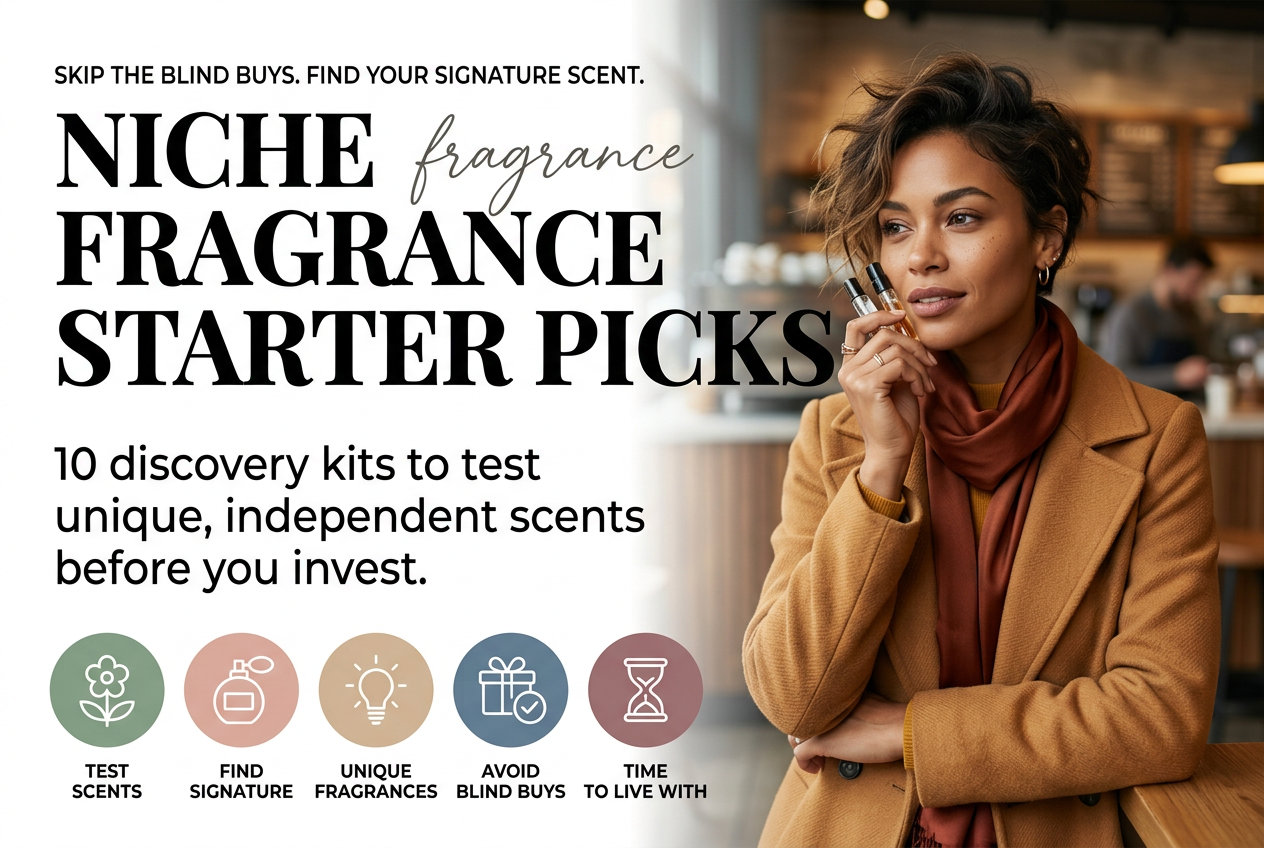
Someone walked past me in a coffee shop last winter and I stopped mid-sentence. Whatever they were wearing — woody, slightly smoky, with something almost edible underneath — I thought about it for the rest of the day. That’s what a real signature scent does. And the frustrating part is you can’t manufacture that by speed-testing strips under fluorescent department store lighting while a salesperson hovers nearby.
Here’s what I’ve learned after going through an embarrassing number of full bottles I no longer wear: niche fragrance starter picks — the discovery kit format from independent and luxury niche houses — are the only sane way to actually find a scent that sticks. Not because they’re trendy, but because they give you time. Time to live with something, see how it behaves on your skin at 8am versus 8pm, decide whether you’re still reaching for it on day four.
Why Buying Fragrance Blind Is Just Expensive Gambling
You spray something on a test strip. It smells interesting for maybe forty-five seconds. You convince yourself that’s enough information to justify dropping $120, and then three weeks later the bottle sits untouched because it turns out you don’t actually like it when it’s on you in a closed car or a warm office. We’ve all done this. The discovery kit model exists specifically because of this problem — and honestly, it’s one of the few cases where the smarter option is also the cheaper one.
A quality niche fragrance starter picks set runs between $30 and $80 for five to ten samples. That math alone should settle it. But the real advantage isn’t the price — it’s the format. You’re at home, on your own schedule, wearing one scent for several days straight instead of sniffing eight things in twenty minutes with an increasingly confused nose. You get to notice whether a fragrance makes you feel like yourself or like you’re performing a version of yourself. That’s a distinction you cannot make in a store.
Niche houses also tend to have actual stories behind their scents. Small-batch production, a founder’s obsession with a specific region or botanical, ingredient combinations that would never survive a focus group. That context isn’t just marketing — it makes the scent feel like something you chose rather than something that was chosen for you by a billboard.
How to Actually Use a Discovery Kit
One scent at a time. Three days minimum per fragrance, no exceptions.
Your nose adapts fast, which means the version of a scent you experience on day one is not the version you’ll experience on day three. The top notes — the first impression, usually citrus or something bright — fade within an hour. What you’re left with is the heart and base: the woody undertones, the musks, the resins, whatever the perfumer actually built the scent around. Some fragrances that seem unremarkable at first spray become genuinely compelling once those deeper layers open up. Others peak immediately and go flat. You won’t know which is which unless you wait.
After you’ve worked through several samples, look for patterns in what you liked. Did every scent you wanted to keep wearing have a dry woody quality? Were you consistently drawn to things with a green or herbal edge? This is more useful than any scent quiz online, because it’s based on your actual reactions rather than your assumptions about yourself. (I was convinced I was a «clean and fresh» person for years. Turns out I like things that smell slightly like old libraries. Took three discovery kits to figure that out.)
Also worth knowing: your preference will shift. A scent that feels perfect in October might feel wrong in June. That’s not inconsistency — that’s just how fragrance works with seasons and skin temperature and mood. Some people maintain a small rotation of two or four scents rather than one true signature. Both approaches are completely valid.
The Kits Worth Starting With
These kits are from houses that treat fragrance as craft rather than commodity.
Good Niche Fragrance Doesn’t Have to Cost a Fortune?
Actually, that’s not quite right as a question — it’s just true. Some of the most interesting discovery kits come from emerging brands that price low on purpose because they’re trying to build an audience. That’s your opening. You get genuinely original work at a fraction of what an established niche house charges, and if you find something you love, you’re in early.
Watch for seasonal or themed sets — «scents inspired by coastal landscapes» or «minimalist florals» type releases. These rotate and sometimes go on sale, which pushes the value even higher. A few houses also offer travel-sized versions of their full line at a per-ounce price that beats buying the bottle outright, which makes them perfect for extended testing before you commit to the larger size.
Making Your Samples Last
Store them somewhere cool and dark. Light and heat degrade fragrance, and if you’re planning a slow, methodical exploration over several weeks, a drawer beats a bathroom shelf every time.
One or two sprays per test session is genuinely enough — you’re evaluating, not marinating. A single small sample can last two to three weeks of daily testing if you’re not oversaturating. Between scents, take a day off entirely or wear something completely familiar. Nose fatigue is real, and if you jump from one new fragrance to another without a break, everything starts to blur together in a way that makes your notes useless.
Once you’ve identified what you love, you have options: buy the full bottle of your top pick, build a small rotation of three or four favorites, or use what you’ve learned about your preferences to go deeper into a specific house or genre. There’s no correct next step. Some people find one scent and wear it for a decade. Others treat fragrance like a wardrobe and rotate constantly. The discovery kit just gives you the information to make that choice deliberately rather than by accident.
Finding a scent that feels genuinely yours — not aspirational, not borrowed from someone else’s taste, just right — is one of those quiet pleasures that sounds small until it’s actually part of your daily life. These kits are the most direct path there.
At Unwritten, our editors choose every product and story idea independently — we only recommend things we’d genuinely tell a friend about.
Frequently Asked Questions
What is a niche fragrance discovery kit?
A niche fragrance discovery kit is a curated set of sample-sized bottles from independent or luxury perfume houses. Instead of committing to a full bottle blind, you get to test multiple scents at home over several days to find what actually works with your skin chemistry and lifestyle.
How much do niche fragrance discovery kits usually cost?
Most quality discovery kits run between $30 and $80 for five to ten samples. That’s often less than a single full bottle from the same house, making them a smart way to explore before you spend big.
How long should I test a fragrance sample before deciding?
Give each scent at least three full days of wear. Fragrance evolves on your skin throughout the day and smells different once your nose has adjusted to it. A scent that wows you on day one might feel flat by day three — or the reverse.
Can I find my signature scent from just one discovery kit?
Maybe. Some people nail it on the first try. Others need two or three kits before a pattern emerges in what they’re drawn to. Either way, pay attention to what the scents you love have in common — that’s where your real preference lives.
Are niche fragrances better than designer ones?
Not automatically better, but often more original. Niche houses tend to prioritize unusual ingredients and smaller-batch production over mass-market appeal. You’re more likely to find something that feels genuinely personal rather than something designed to please everyone.