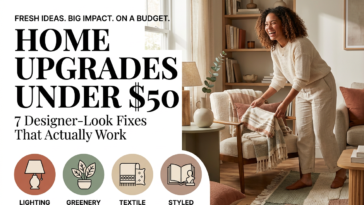

Last month I found a solid wood side table for $15 at a local estate sale, and I am still a little giddy about it. Pure luck, honestly. I had spent way too much time scrolling designer Instagram accounts before that, and the one thing I took from all of them is that the best spaces are built on intention, not on price tags.
Here is the part I wish someone had said to me earlier. Decorating on a budget forces you to be intentional. You cannot buy everything, so you actually think about what you want and why. That is the same process designers use, they just have bigger budgets. Your living room can look designed without the designer price tag, and a few thoughtfully chosen pieces, arranged with confidence, can take a room from ‘meh’ to ‘magazine-worthy’ without emptying your wallet.
So what does designer-approved living room decor under $50 actually look like?
The secret is that designer-approved living room decor does not have to cost a fortune. Some of the most impactful pieces I have found are hiding on Amazon, at Target, on Wayfair sale pages and in small shops, all priced under $50.
They are not cheap knockoffs or trendy junk that will feel dated in six months. They are solid, stylish pieces. Plenty of professionals use the same things in their own homes.
Where I actually find the good stuff
Amazon is the obvious answer, but it is not the only place worth checking. Target’s home section has been genuinely impressive lately, with clean lines and good quality at prices that will not make you wince. Wayfair has constant sales if you are patient. Facebook Marketplace and local thrift stores are goldmines if you have time to hunt. That $15 table was pure luck, I will admit, but hunting is a skill and it gets easier every time. Some weeks you find nothing at all, and that is part of it.
The key is knowing what to splurge on and what to save on. Splurge on the pieces you will use constantly, like your favorite throw blanket or a side table you will set drinks on every day. Save on trendy items and anything purely decorative. And always, always read the reviews. A $40 throw pillow that falls apart in three months is not a deal.
Is it decorated or designed?
Here is what separates ‘decorated’ from ‘designed’: accessories. A room with just furniture feels empty, no matter how nice the couch is. Add a stack of books, a small plant, a candle and a decorative object, and suddenly the space has personality. The best part is that most of these cost next to nothing, and they are the easiest things to swap out when you fancy a change. Think about what you actually use and love. Do you light candles every night? Buy a nice one in a scent you genuinely enjoy and put it somewhere visible. Do you read? Stack your favorite books on a side table with a decorative bookend. This is not decor for decor’s sake. These are pieces of your actual life, styled beautifully.
Pieces that do two jobs
When designers talk about ‘elevating’ a space, they usually mean adding layers of texture and color, plus a bit of personality, without overwhelming the room. The trick is choosing pieces that do more than one job. A throw pillow adds color and comfort at once. A side table can be functional and beautiful. A mirror bounces light around and makes the room feel bigger. None of these are luxury items, but they feel luxurious.
Budget does not mean boring
Some of my favorite pieces came from digging through the ‘under $50’ section of places I would normally skip. Take throw blankets. What is the difference between a $12 one that feels cheap and one that feels expensive? Quality fabric and a thoughtful color. The same goes for wall art and accent lighting, and for anything you use to style a bookshelf. You are not paying for a brand name. You are paying for something that actually looks and feels good in your space.
Restraint makes the room
The difference between a styled room and a cluttered room often comes down to restraint. Pick a color palette, maybe three colors plus neutrals, and stick with it. That does not mean everything has to match. It means your throw pillows and wall art, plus the accessories, should feel like they belong together, not like you grabbed whatever was on sale.
Group items in odd numbers: three candles, five books, two plants and a vase. Odd numbers feel intentional in a way that even numbers do not. (Actually, ‘odd numbers’ is a rule of thumb, not a law, so break it when a pair of matching vases just looks right.) Leave some breathing room instead of filling every surface. A styled shelf with five carefully chosen objects feels more curated than one crammed with fifteen things. And finally, mix textures: smooth ceramic next to soft linen next to rough wood. That is what makes a space feel designed.
Start with one or two pieces from this list and see how they feel in your space. Then build from there.
You have got this.
If I had to pick one, I would start with the throw blanket. You will touch it every day, which is exactly why it is worth getting right.
At Unwritten, our editors choose every product and story idea independently — we only recommend things we’d genuinely tell a friend about.
Frequently Asked Questions
Can you really get designer-looking living room decor for under $50?
Yes. Throw pillows, blankets, mirrors, candles and accent lighting can all look high-end when you pick quality fabric, a thoughtful color and a cohesive palette.
Where can I find cheap living room decor that looks expensive?
Amazon and Target’s home section are good starting points, Wayfair runs frequent sales, and Facebook Marketplace, thrift stores and estate sales can turn up solid wood pieces for very little.
What should I splurge on and what should I save on?
Splurge on things you use every day, like a favorite throw blanket or a side table. Save on trendy items and purely decorative pieces, and always read the reviews.
How do I make a living room look styled instead of cluttered?
Stick to one color palette, group items in odd numbers, leave some breathing room on surfaces and mix textures such as ceramic, linen and wood.
How many colors should I use in a living room?
A good rule of thumb is about three colors plus neutrals. Things do not need to match exactly, but they should feel like they belong together.