In January I bought a fragrance that smelled like the future, and by June it smelled like everybody else’s bathroom.
The short version of what I learned: your scent should feel personal, not prescriptive. What you want from fragrance matters more than any trend, and everything below is just a way to figure that out.
The fragrance world moves faster than most of us realize. What smells fresh and modern in January can feel dated by June, and what seemed niche last year is suddenly everywhere. That is the beauty of scent. It keeps evolving, shaped by everything from climate worry to nostalgia.
If you rotate perfumes like outfits (or you have worn the same signature scent for five years), the fragrance trends 2026 are worth paying attention to. Not because you need to abandon what you love. Understanding where scent is heading simply helps you make smarter choices about what to buy next. Maybe you will find a note combination that becomes your obsession. Maybe you will finally understand why your best friend swears by something you never considered.
Here is what is actually happening in perfumery right now, and how to make it work for you.
Why does 2026 smell different from 2024?
The fragrance industry is not pulling these trends out of thin air. They are rooted in real shifts: how we travel, what we care about environmentally, which decades we are romanticizing, and what our nervous systems actually need. 2026 feels different from 2024 because we are different. We are more aware of ingredients and more willing to experiment beyond the department store classics.
What interests me is that these trends do not point in one direction. They are splintering into distinct lanes. Some people crave maximum comfort and edibility (yes, perfume you almost want to eat). Others go the opposite way and seek sparse, architectural scents that feel almost medicinal. A quieter group is collecting scents tied to specific places or memories, as if they were gathering olfactory postcards.
The connective thread? Intentionality. People are thinking harder about why they wear what they wear.
Nostalgia is back, just not the way you expect
Everyone is talking about Y2K coming back, and yes, fragrance is part of that. But this wave is not only about recreating the fruity, playful scents of the early 2000s. It is more specific than that. There is a growing run of fragrances inspired by particular moments: the smell of a certain decade’s drugstore, the perfume your mom wore in 1987, a childhood summer, a grandmother’s hallway. Fragrance as memory.
What is different is the execution. Brands are not slapping retro packaging on old formulas. They take the emotional core of a nostalgic scent and reinterpret it for 2026, so you might get the warmth and comfort of a 90s fragrance with more sophisticated ingredients and better longevity.
Interest in vintage fragrances themselves has also surged. People hunt down discontinued scents, swap bottles online, and treat collecting like vinyl collecting. I spent a whole weekend last spring chasing a perfume I remembered from my aunt’s dresser (I never found the exact one, though the close cousin I did find is better than my memory of it). If you are curious about older fragrances from childhood or your parents’ bathrooms, this is the moment to explore.
Fragrance for weather that cannot make up its mind
This one is harder to name, but it is real. As weather patterns shift and seasons feel less predictable, fragrance is adapting. We are seeing more scents made for in-between weather, not quite spring and not quite summer. They work equally well on a 65-degree day and a 75-degree day. They do not feel heavy in humidity, and they do not vanish either.
There is also growing interest in what you might call climate-conscious fragrance: scents made with sustainable ingredients, minimal packaging or carbon-neutral production. It is not just about smelling good anymore. It is about knowing the bottle lines up with your values. Some brands now say where their ingredients come from, how they are sourced and what the environmental footprint looks like.
The notes trending here? Fresh florals with some green depth. Citrus that feels natural rather than synthetic. Woody notes that are not aggressively masculine. Aquatic scents that smell like actual water (mineral, clean, slightly cool) instead of the artificial ‘ozonic’ fragrances that dominated the 2000s.
Gourmand grows up
Gourmand fragrances never really left, but they have been quietly evolving. The 2010s gave us syrupy, almost cloying versions that smelled like a dessert aisle. The 2026 version is more restrained. Think caramel with a whisper of salt. Vanilla layered with something slightly bitter: coffee, dark chocolate, tobacco leaf and even a little smoke. Honey that smells like it came from actual bees, not a candy factory.
This trend speaks to something real. We want comfort without feeling like we are wearing a cupcake. These fragrances work because they are warm and familiar yet complex enough to stay interesting after the hundredth wear. They are the olfactory equivalent of a cashmere sweater, the thing you reach for when you need to feel held.
The best part is that gourmands are forgiving. They suit most skin chemistries and last reasonably well. Prices are usually friendly too. If more abstract trends have intimidated you, start here.
Silent luxury, now in a bottle
On the opposite end from gourmand sits what some people call ‘silent luxury’ or ‘stealth wealth’ fragrance. These scents have maybe three or four notes at most. They are not loud. They do not announce themselves, and you have to lean in to smell them. Think of a perfectly tailored white button-down shirt.
This trend appeals to people who find most fragrances overwhelming. It also suits anyone who wants something for professional settings that will not dominate a conference room. And honestly, it appeals to everyone tired of fragrance being about projection and performance. Sometimes you just want to smell nice for yourself.
The notes tend toward the abstract: single florals like iris or peony, clean woods, subtle musks and maybe a whisper of spice. Minimalist fragrances often have incredible longevity because nothing is wasted or redundant. Actually, that is not quite right for every bottle, since a few sheer ones fade fast on my skin, but the well-made ones last. Every note is doing work.
Layering is the new normal
This is less about a specific scent and more about how we wear fragrance. Layering, combining a body oil with a perfume, is becoming the norm rather than the exception. People treat fragrance like makeup, a collection of products that work together to build a personal scent profile.
Customization is growing too. Some brands now let you adjust concentration or swap out notes, and some offer semi-personalized scents. It moves us away from the idea that there is one ‘right’ fragrance for you and toward the idea that you can build something uniquely yours.
Even without full customization, people are getting creative. A light eau de cologne under a heavier perfume. A scented body lotion with an entirely different fragrance on top. It sounds complicated, but it is actually liberating: you can wear several fragrances you love without them fighting each other, as long as you are intentional about it.
Your scent journey, minus the pressure
So which lane are you in?
Here is the thing about fragrance trends: you do not have to follow them. That said, understanding them helps you make more intentional choices.
Start by asking what you actually want from fragrance. Comfort? Sophistication? Calm? Something that makes you feel like a different version of yourself? Do you want people to smell you when you enter a room, or something intimate that is mostly for you? Your answers matter more than any trend.
Once you know that, use the trends as a framework. If you are drawn to comfort, explore the refined gourmand space. If you care about environmental impact, look into sustainable brands. If you want something that works year-round in unpredictable weather, lean into the climate-conscious scents. If you are bored with your current fragrance, experiment with layering or try something from a different trend entirely.
The beauty of 2026 is that there is genuinely something for everyone. The gourmand person and the minimalist can both find their thing. You are not forced into one direction.
The picks that earn their place
The fragrances resonating right now tend to do one thing exceptionally well. They are not trying to be everything to everyone. Each one solves a specific problem or delivers on a specific promise.
The gourmands getting the most love are not the ones that smell like dessert. They are the ones that smell like a warm hug that also happens to have complexity. The sustainable fragrances people actually wear smell amazing first and happen to be eco-friendly second.
Among the minimalists, the ones gaining traction are those where every single note earns its place.
When you shop, pay attention to what actually makes you stop and smell. Not what you think you should like, but what makes you happy. That is your fragrance trend right there. That is your scent story. If I had to bet, I would put my money on the quiet, well-made scent over the loud one, because it keeps getting better with every wear and you never get tired of it. I bought my January bottle for the hype and it sat in a drawer by June, while the plain musk I picked up on a whim is nearly empty. Buy what you reach for, and ignore the rest of the noise, including the noise in this article.
At Unwritten, our editors choose every product and story idea independently—we only recommend things we’d genuinely tell a friend about.
Frequently Asked Questions
What are the biggest fragrance trends in 2026?
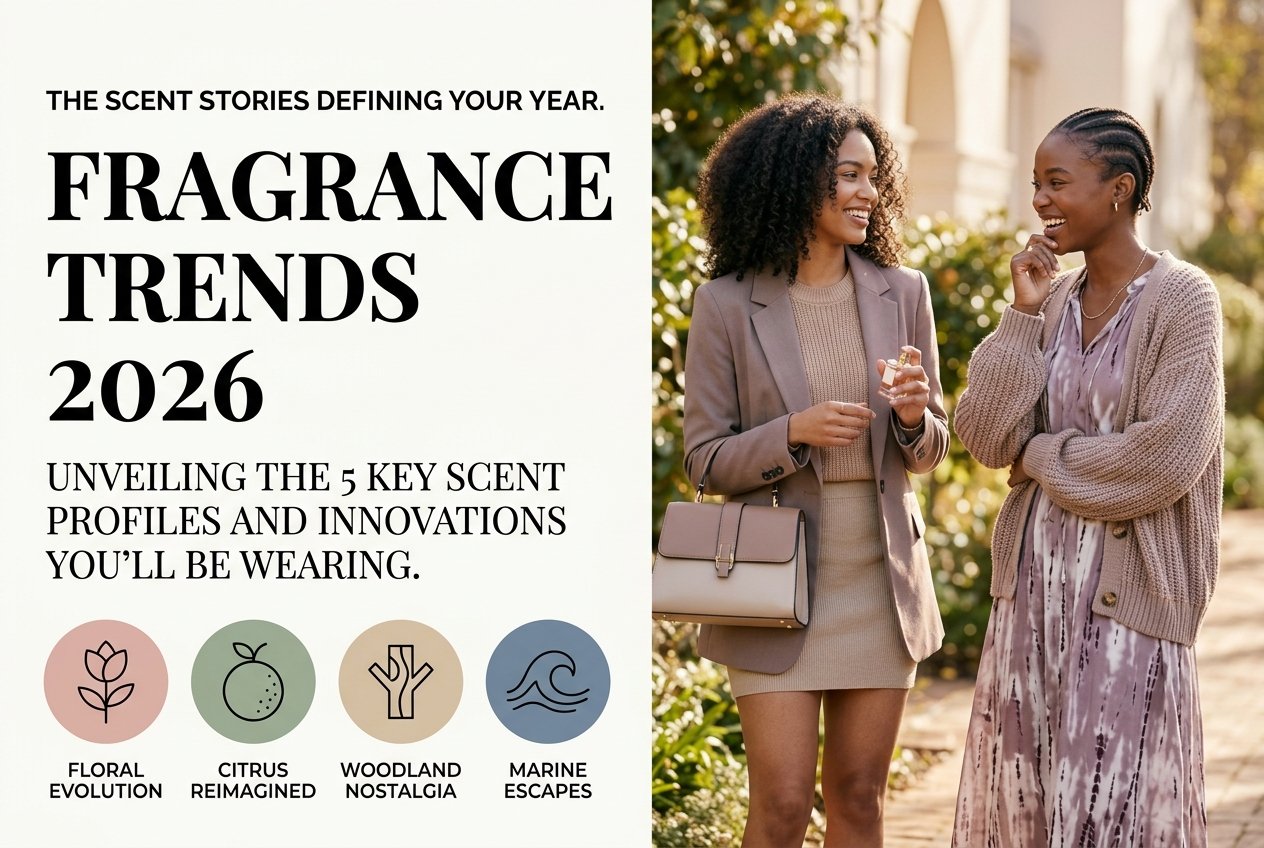
Five stand out: refined gourmand scents, climate-conscious fragrances made for unpredictable weather, nostalgia scents that reinterpret past decades, minimalist ‘silent luxury’ scents with only a few notes, and fragrance layering or customization.
Are gourmand fragrances still popular in 2026?
Yes, but they have matured. The syrupy dessert gourmands of the 2010s have given way to restrained versions, such as caramel with a hint of salt or vanilla paired with coffee, dark chocolate or tobacco leaf.
How do I start layering fragrances without them clashing?
Start simple: a light eau de cologne under a heavier perfume, or a scented body lotion with a different fragrance on top. Pick pieces you already love and be intentional about how they sit together.
Do I have to follow fragrance trends?
No. Your scent should feel personal, not prescriptive. Use the trends as a framework once you know what you want from a fragrance, whether that is comfort, sophistication, calm or something intimate that is mostly for you.