
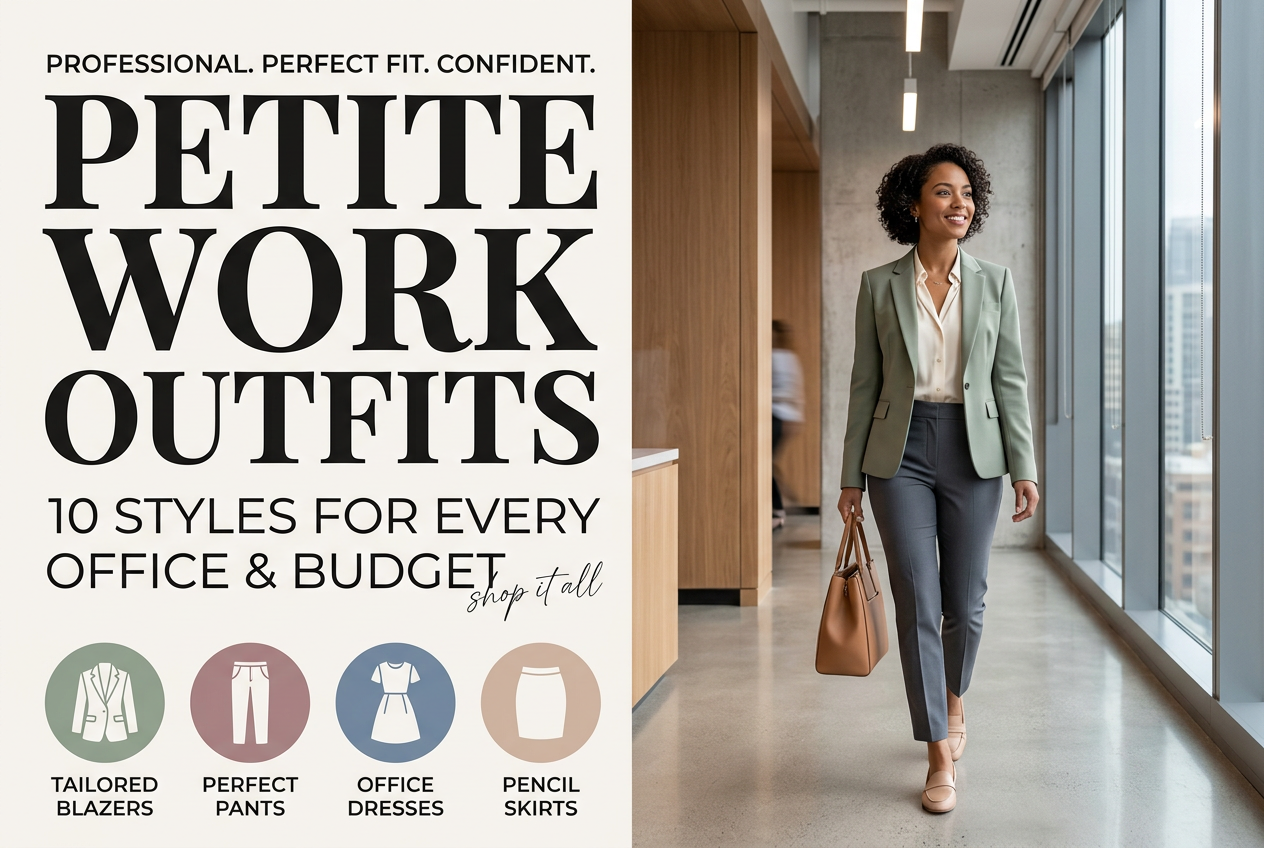
Here is what nobody tells you about petite work outfits: the problem was never your body. It was always the clothes.
I figured this out the hard way—after years of rolling trouser hems, safety-pinning blazer sleeves, and convincing myself that a blouse “mostly” fit. The moment I started shopping specifically for petite proportions, I stopped dreading getting dressed for work. That sounds dramatic. It is not.
Regular-sized blazers swallow you whole. Trousers pool at your ankles. Midi skirts hit mid-calf in all the wrong ways, and suddenly you look like you raided someone else’s wardrobe. Shopping intentionally for your frame—shorter sleeves, adjusted rise, scaled proportions—is not a workaround or a compromise. It is just how clothes are supposed to work. And once you build a petite work wardrobe that actually fits, you will not go back.
The Blazer Question
A well-fitted blazer is your most powerful professional tool. Full stop. The trick is finding one actually proportioned for a shorter frame—shorter sleeves, a nipped waist, a length that ends at your hip bone rather than somewhere awkward on your thigh. When a blazer fits properly, it sharpens your whole outfit without you having to think about it. Pair it with tailored trousers or a pencil skirt for boardroom days, or throw it over dark jeans on a casual Friday. Either way, it does the heavy lifting.
A structured wool version in navy or charcoal handles serious meetings. A linen-blend in cream or soft gray works through spring and summer. And if you want to add personality without risking professionalism, a jewel tone or low-key pattern is exactly the right move—just make sure the scale of any print is proportioned to your frame, because what reads as subtle on a 5’8″ frame can feel overwhelming on someone shorter.
Dresses & Skirts That Do Not Overwhelm You
A good dress eliminates half the styling math on mornings when you are already behind. For petite frames, the goal is finding cuts that define your waist without drowning you—A-line silhouettes, structured fabrics, and midi lengths that fall just below the knee rather than at your calf. (Actually, that last point is worth repeating: a standard midi and a petite midi are genuinely different garments. One looks intentional. The other just looks long.)
Sheath dresses in solid colors are your reliable professional option. They read clean on video calls, work year-round with the right layers, and transition from solo wear to blazer-and-meeting mode without any effort. Pair a fitted top with a petite midi skirt when you want something slightly more relaxed that still reads as completely put-together.
Trousers: Where Fit Actually Matters Most
A standard trouser with a 30-inch inseam on a petite frame is just a wide-leg pant that pools around your ankles. That is not a style choice—it is a fit problem.
Petite trousers cut to a 27 or 28-inch inseam change everything. Look for a high rise that sits at your natural waist rather than your hip—this lengthens your leg line and creates a cleaner silhouette. Straight-leg and tapered styles tend to work better than wide-leg on shorter frames, which can get visually overwhelmed. And here is something I genuinely believe: a $60 pair of trousers tailored to your exact inseam will look sharper than a $200 pair that is too long. Tailoring is not a luxury expense. It is a finishing step.
What Makes a Blouse Actually Work?
Shoulder seams that land on your actual shoulder. Sleeves that end at your wrist, not your knuckles. A hem that hits at your hip without ballooning outward. These are not unreasonable standards—they are just things standard-sized blouses routinely fail to deliver on petite frames.
A crisp white button-down is the obvious starting point, but do not stop there. A soft chambray shirt, a cream silk blouse, something with a subtle stripe—these add dimension to your rotation without feeling like a risk. What matters as much as the cut is the fabric. Look for structured cotton blends that hold their shape past 10 a.m. Flimsy materials wrinkle fast, and constant retucking is the opposite of polished.
Shoes and Bags: Proportion, Not Magic
Accessories do something real for petite professionals: they pull the eye upward and create vertical lines that elongate your silhouette. This is not a trick. It is proportion and visual balance working together.
Pointed-toe shoes—whether flats or heels—extend your leg line in a way that rounded toes simply do not. A modest 2-inch heel adds height and polish, but comfort is non-negotiable here. You are not impressing anyone if you are visibly uncomfortable by early afternoon. For bags, a structured satchel or compact tote in a neutral color (black, caramel, navy, or a warm gray) reads as intentional and works with everything. Oversized totes can overwhelm a shorter frame—a bag that is roughly proportional to your torso tends to look most balanced.
Four Rules Worth Keeping
Tuck your tops. Untucked hems shorten your leg line and add visual bulk you do not need. A full tuck, a front tuck, or a side half-tuck all create definition and proportion—any of them work better than leaving things loose.
Try monochromatic dressing. Wearing the same color head to toe creates an unbroken vertical line that makes you look both taller and more intentional. Navy blazer, navy trousers, navy flats is a genuine power move. Add a white blouse if you want contrast without breaking the silhouette.
Invest in tailoring. A $50 hem turns a mediocre pair of trousers into something that looks expensive. Most dry cleaners offer basic tailoring, and it is worth every penny. Petite bodies deserve clothes cut for petite bodies—not clothes that are then folded, pinned, and forced into shape.
Scale your patterns. Small prints and subtle textures add personality without overwhelming a shorter frame. Large-scale prints can work, but they require more intention—make sure the pattern is not wearing you.
Building the Wardrobe Without Losing Your Mind (or Your Budget)
Start with one quality blazer in a neutral color. That is your foundation. From there, add two pairs of trousers—one neutral, one with a little more character—and three or four blouses you actually want to wear. Dresses, skirts, and shoes can come in as your budget opens up.
Most major retailers carry petite-specific sections now, and the fit difference compared to standard sizing is not subtle. Always check the listed inseam before buying trousers or jeans online—do not assume “petite” means it will work for your specific measurements. Brands vary, and a half-inch in the wrong direction is the difference between polished and perpetually hemming.
The bigger shift, though, is mental. Once you stop fighting standard sizing and start shopping for your actual proportions, getting dressed stops feeling like a problem to solve every morning. Clothes that fit are not a luxury. They are the baseline. You should have had them all along.
At Unwritten, our editors choose every product and story idea independently — we only recommend things we’d genuinely tell a friend about.
Frequently Asked Questions
What blazer length works best on petite frames?
Look for blazers that end at or just above your hip bone—not mid-thigh. A shorter, nipped-waist cut keeps your proportions balanced and makes you look taller without heels.
What inseam length should petite women look for in trousers?
Most petite trousers run 27 to 28 inches. That said, measure your own inseam and compare before buying—’petite’ sizing varies by brand and a half-inch difference can mean the difference between polished and pooling at your ankles.
Can petite women wear wide-leg trousers to work?
Yes, but fit at the waist and length are everything. A high-rise wide-leg trouser hemmed to your exact inseam can absolutely work. The problems start when you’re wearing a standard-length pair folded under at the hem.
Are midi skirts a good choice for petite professionals?
A petite-specific midi that falls just below the knee reads as professional and polished. A standard midi that hits mid-calf is a different story—it visually shortens your leg line and can feel frumpy rather than elegant.
What bag size works best for petite frames in an office setting?
A structured satchel or compact tote in a neutral color tends to look most balanced. Oversized bags can overwhelm a petite frame, while something too small looks like an afterthought. Aim for something you can fit a laptop in without the bag wearing you.