
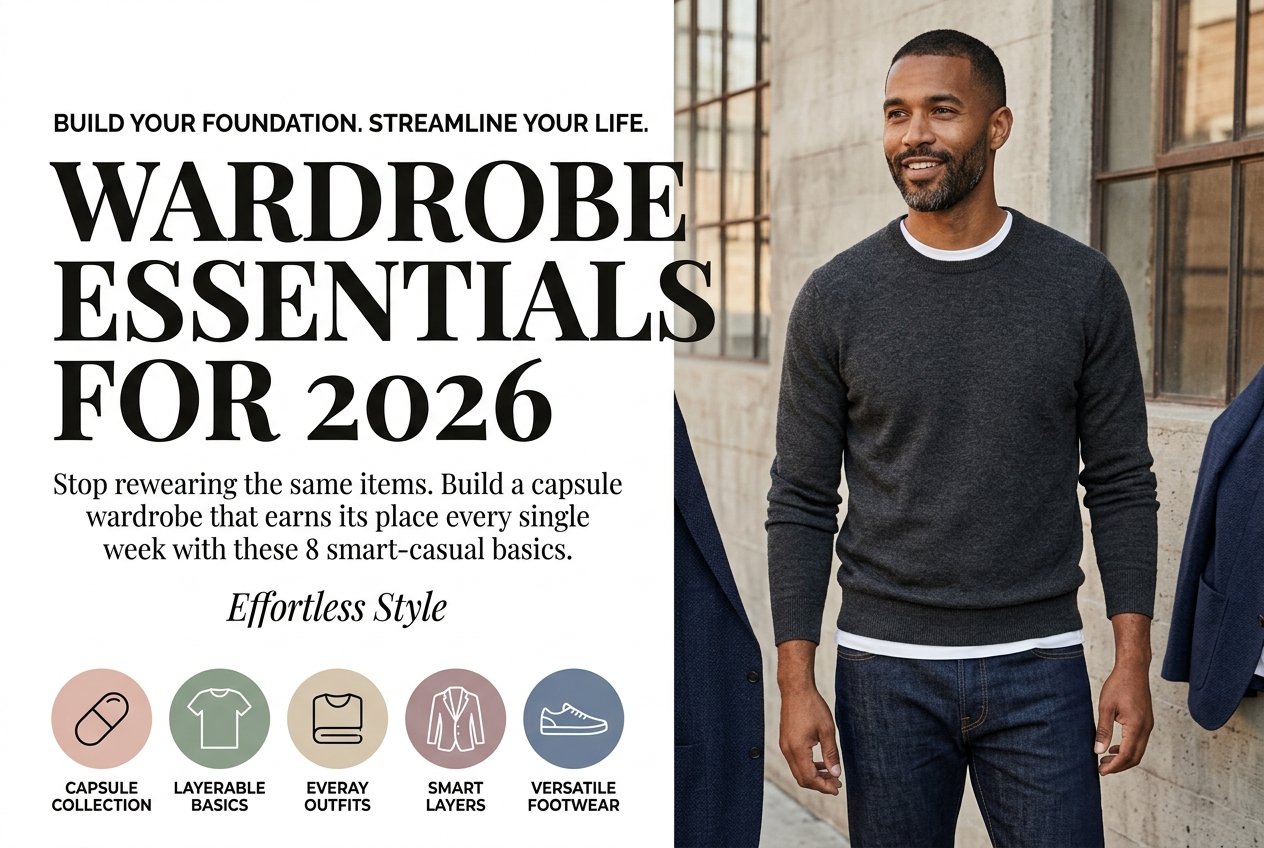
There’s a blazer in the back of my closet I bought for a wedding in 2021. Wore it once. Still has the dry-cleaning tag on it. And yet I kept buying things, kept filling space, and kept reaching for the same five pieces every single week — not because I planned it that way, but because those five pieces just worked.
That’s the whole argument for a capsule wardrobe right there.
Not a restrictive uniform, not a minimalist statement — just a thoughtful foundation of pieces that play well together, feel good to wear, and actually get pulled off the hanger. The opposite of impulse buying. When you get this right, you stop standing in front of your closet at 7am running through options that don’t pan out. You know what you have, you know how it fits, and you move on with your morning.
The goal isn’t to own less for the sake of it. Own the right stuff. Pieces that earn their place through actual wear, not just potential wear.
Why boring clothes are the good ones
A white crew-neck t-shirt does not turn heads. Nobody is complimenting your dark indigo jeans. And that’s exactly the point — these pieces aren’t trying to be anything, which means they can be everything else you need them to be.
Cost per wear is the metric that quietly changes how you think about all of this. That $180 merino sweater you reach for twice a week from October through March? Do the math — you’re probably under $2 per wear after two seasons. The $38 shirt you bought because it was on sale and wore exactly twice? That’s $19 per wear. When you start seeing clothing in those terms, the logic of investing in quality essentials stops feeling like a splurge and starts feeling like the only sensible approach. You’re not paying for trend cycles or the novelty of something new. You’re paying for longevity, for fabric that still looks right after 60 washes, for seams that don’t give up on you.
There’s also the decision fatigue angle, which sounds abstract until you’ve lived the alternative. When you know your pieces work together — actually tested combinations, not theoretical ones — you’re not overthinking every morning. You grab what’s clean, it looks intentional, and that’s it. That mental space adds up.
The 8 pieces worth owning
These aren’t trendy. They’re not cutting-edge. They’re the skeleton that everything else hangs on, and most days you won’t need anything else.
1. White Crew-Neck T-Shirt
Works under everything. Looks clean solo on a warm day. When it starts to pill or fade, you replace it without sentiment. Don’t overthink this one — just get a few that fit well through the shoulders and move on.
2. Dark Indigo Jeans
Not black, not light wash. Dark indigo sits in that sweet spot where it looks considered without demanding attention — casual Friday at the office, drinks with friends, Saturday errands, all of it. Find a fit that’s genuinely comfortable (not just acceptable) and commit to it. This is your workhorse.
3. Oxford Button-Down Shirt
White or light blue. Crisp but not stiff. Wear it buttoned over a t-shirt on cooler days or solo when you need to look a step sharper. It’s the bridge between casual and polished, and it earns its place more often than almost anything else in this list.
4. Crew-Neck Sweater
Gray or navy. Cotton blend is fine; merino is better if the budget allows. Your layering piece for spring and fall, your standalone option when it’s cool but not cold — a good sweater feels substantial without being heavy, and it makes even the most basic outfit look like you gave it a second of thought.
5. Casual Blazer
Navy or charcoal, unstructured so it doesn’t read as formal. Throw it over jeans and a t-shirt and you suddenly look like you have your life together. (You don’t. The blazer doesn’t need to know that.)
6. White Sneakers
Clean, minimal, not chunky. Canvas or leather, doesn’t matter much — what matters is the fit and how they feel after eight hours. This is the foundation of your casual footwear and it goes with nearly everything else in this list.
7. Neutral Chinos
Khaki, tan, or olive. A step up from jeans but still casual. These work for weekend plans, relaxed work environments, or just when you want something different without committing to a whole new direction. They’re the flexibility piece — not the most essential thing here, but they expand your options without requiring anything new around them.
8. Casual Leather Shoes
Desert boots, loafers, or simple leather sneakers. Something that works for slightly dressier situations without going full formal. This rounds out your footwear and covers the gap between the gym and somewhere that matters a little — dinner, a work thing, a first date where you want to look like you tried.
How much should you actually spend?
You don’t need to spend a lot. You also shouldn’t spend the minimum on everything. There’s a middle ground, and that’s where most people who dress well actually live.
Accessible brands give you solid basics at prices that don’t hurt — decent fabric, acceptable construction, pieces that’ll last a season or two. For something like white t-shirts or casual jeans, that trade-off is usually fine. You’re not betting your whole wardrobe on one piece, and you’ll replace them anyway.
Actually, that’s not quite right — the real question isn’t cheap vs. expensive, it’s where the cost-per-wear math breaks in your favor. A $220 unstructured blazer you wear 80 times costs less per use than a $90 one that starts looking tired after 15 washes and a couple of dry-clean cycles.
The practical approach: buy your white t-shirts and basic jeans at accessible price points, then spend real money on your sweater, blazer, and leather shoes. Longevity where it matters, reasonable cost where it doesn’t.
Building it without wasting money
Don’t buy everything at once. Seriously — that’s the fastest route to a closet full of pieces that technically match the list but don’t actually work together in real life, on your body, for how you actually spend your time.
Start with what you genuinely need right now. Office-heavy schedule? Prioritize the button-down and blazer first. Mostly casual life? Start with t-shirts, jeans, and the white sneakers. The core eight stay the same; the order of acquisition shifts based on your actual life, not a theoretical one.
Then test combinations in real rotation. Does the sweater work with those chinos? Does the shirt layer cleanly under the blazer? Wear the same outfit twice in one week. See what you reach for without thinking. See what sits there untouched after three weeks. That’s real data, and it’ll guide your next purchase better than any style guide — including this one.
Add slowly. Give yourself permission to be bored by your wardrobe for a month before deciding something’s missing.
The part nobody says out loud
Rewearing clothes is normal.
You’re not supposed to wear everything once and rotate through a parade of outfits. That white t-shirt? Wear it three times a week. Those jeans? Wear them until they need washing. That’s not laziness — that’s how people who dress well actually operate. The capsule wardrobe just makes it intentional instead of accidental, which is the whole difference between a closet that works and one that just has a lot of stuff in it.
Shoes change the whole equation more than any other variable. The same jeans and t-shirt combo reads casual with white sneakers and noticeably sharper with leather loafers. You haven’t changed your clothes — you’ve changed the read. Proportions work the same way: if your jeans fit well and your shirt fits well, you look good. That’s it. No trend required. Fit is the only thing that’s actually timeless here, and it costs nothing extra once you find it.
Build this over six months, not a weekend. The wardrobe that actually works for you isn’t the one that follows the list perfectly — it’s the one you’ve worn enough to know is honest about who you are and how you actually dress. That version is worth waiting for.
At Unwritten, our editors choose every product and story idea independently — we only recommend things we’d genuinely tell a friend about.
Frequently Asked Questions
How many clothes does a man actually need?
Most guys function well with 20-30 pieces total, including shoes. The number matters less than whether each piece works with at least three others. If something only has one use case, it’s probably taking up space.
What’s the difference between a capsule wardrobe and a minimalist wardrobe?
A capsule wardrobe is about versatility — pieces that mix and match easily. Minimalism is about owning less. They overlap, but a capsule wardrobe can still have 40 pieces as long as they all earn their place through regular wear.
Should I buy cheap basics or invest in quality from the start?
Both, strategically. White t-shirts and casual jeans are fine at accessible price points since they wear out and need replacing anyway. Your blazer, leather shoes, and merino sweater are worth spending more on — you’ll feel the difference after 50 wears.
What colors should men’s wardrobe essentials be?
White, navy, gray, charcoal, and olive cover almost everything. These neutrals work together without effort, which is exactly the point. Avoid building a capsule around statement colors — they’re harder to combine and date faster.
How long does it take to build a capsule wardrobe?
Realistically, 6 to 12 months. Buying everything at once is the fastest way to end up with pieces that don’t actually work together. Add one or two items, wear them for a few weeks, then decide what’s missing.