
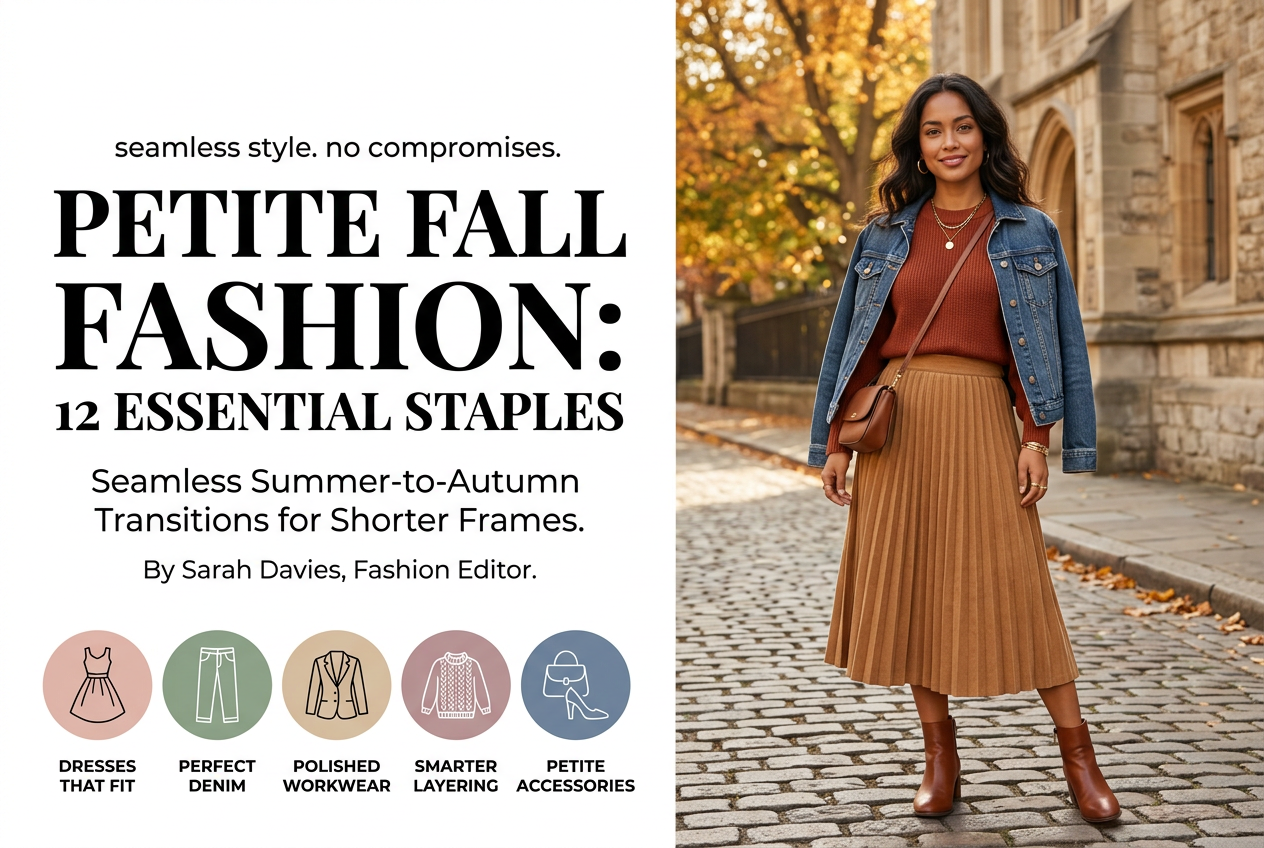
Here is the thing nobody tells you when you are 5’2″: the problem is never your body. It is that most fall fashion is engineered for someone who is five inches taller than you, and the industry just expects you to deal with it via hemming tape and wishful thinking.
That framing actually matters, because once you stop trying to make regular sizing work and start shopping with your frame in mind, getting dressed for fall stops feeling like a puzzle with missing pieces. I spent three autumns buying “close enough” jeans before I tried a pair cut specifically for a petite inseam, and the difference was embarrassingly obvious. The waist sat where it was supposed to. The hem grazed my ankle instead of bunching on my shoe. Done.
This guide covers twelve fall staples chosen specifically for shorter frames—dresses that do not require hemming, denim that actually fits, workwear that reads as polished rather than borrowed, and a few accessory notes that make a real difference on a petite silhouette. No complete wardrobe overhaul required.
Why Layering Is Actually Easier When You Are Petite
Counterintuitive, but true. The summer-to-fall transition is where petite dressing quietly wins, because layering done right creates intentional proportions instead of accidental volume. A fitted cardigan over a slip dress. A cropped linen shirt tied at the waist. These combinations work because each layer is doing something specific—defining the waist, skimming the shoulder, stopping at the right place on the hip. What does not work is anything that adds fabric without adding structure: chunky knit wraps, oversized blanket scarves worn as shawls, or a boyfriend blazer you bought hoping it would look effortless. It will not. It will look like you grabbed something on the way out the door.
Your summer pieces are not going anywhere. That flowy sundress you lived in from June through August? Throw a fitted denim jacket over it, swap the sandals for ankle boots, and you have an early September outfit that looks completely deliberate. The key word across every layer is fitted at the shoulder. Shoulders are non-negotiable—if something is swimming at the shoulder seam, no amount of belting or tucking will save the silhouette.
Dresses That Do Not Need a Tailor
Petite dresses are genuinely underrated as a category, and I think it is because the marketing around them tends to be either condescending or invisible. But the construction difference is real: the armhole sits correctly, the waist hits where your actual waist is, and the hem length is calculated for a shorter leg. A petite midi does not drag. A petite wrap dress does not have four extra inches of fabric pooling at the hem.
For early fall, you want dresses that pull double duty—wearable solo on a warm day in late August, layerable when October shows up. The best fabrics for this window are cotton blends, lightweight structured knits, and chambray. Heavy wool crepe is too much for August; a tissue-weight cotton is not enough for October. The sweet spot is a fabric with enough body to hold its shape but enough give to not feel suffocating at 75 degrees. Avoid anything with heavy gathering at the waist or large-scale prints—both have a way of making a petite frame disappear into the fabric rather than wearing it.
Fit-and-flare cuts. Defined waistlines. Midi or mini lengths, nothing in between.
The Denim Problem (And How to Actually Fix It)
Buying regular jeans and planning to hem them is not a solution. It is a compromise that costs you money and still leaves you with proportions that are slightly off, because petite denim is not just shorter—it also has a shorter rise, narrower thigh proportions in many cases, and a waistband that is designed to sit at the right point on a shorter torso. Regular jeans hemmed to petite length still have a regular rise. That matters more than most people realize.
For fall specifically, you want two pairs at minimum: one in a medium wash that works with sneakers and flats for casual days, and one in dark indigo or black that pulls an outfit into evening or office territory without trying too hard. A petite straight-leg in either of those washes is more versatile than it gets credit for—it works with ankle boots, with loafers, even with low-top sneakers without reading as too trendy or too conservative. Actually, that is not quite right: it does lean slightly classic, which is exactly what you want from a foundational fall piece.
Look for brands that treat petite sizing as a real category, not an afterthought. The difference between a brand that genuinely develops petite fits and one that just shortens the inseam is immediately obvious when you put the jeans on.
Office Dressing That Does Not Require Tailoring Either
A petite blazer is not a regular blazer that got taken in. The button placement is proportional to a shorter torso. The sleeve length accounts for shorter arms. The body length does not hit at the widest point of your hip, which is where a regular blazer tends to land on a petite frame and which is, unfortunately, the least flattering place for a jacket to end. These are not small differences. They are the difference between a blazer that looks like yours and a blazer that looks like you borrowed it.
For the early fall office transition, a petite button-down in a structured cotton or poplin is the most useful single piece you can own. It works solo in August, tucked into trousers with a blazer in September, or layered under a cardigan when the office AC finally stops running full blast in October. Pair it with petite trousers—not hemmed regular trousers, actual petite-cut trousers—and you have a work outfit that requires zero fussing once you are dressed. A petite sheath dress does the same job with even less effort. Cardigan in summer, blazer in fall. Done.
Boots and Bags Actually Change the Outfit
Accessories carry more weight on a petite frame than on a taller one, and this is not a styling opinion—it is geometry. A structured bag creates a visual anchor. The right boot either elongates your leg or cuts it in half, depending on the silhouette. These choices matter.
For boots: pointed toe over round toe, always, if length is a priority. A slimmer shaft looks more proportional than a chunky, wide-calf boot on most petite frames. Ankle boots work, but a boot that hits just below the calf can actually create a longer line than an ankle boot if the shaft color matches your pants or tights—the unbroken color line reads as height. A boot that cuts across the widest point of your calf in a contrasting color does the opposite.
For bags: medium-sized and structured. An oversized tote is not just inconvenient—it visually shrinks you relative to the bag. A crossbody in a proportional size, a small structured satchel, or a top-handle bag in a compact silhouette all read as intentional. Same logic applies to scarves: a silk neck tie or a smaller knit wrap adds texture and polish without swallowing your upper body the way a massive blanket scarf does. Delicate layered necklaces, structured earrings, one good ring. Draw the eye up and keep the volume small.
The honest version of petite fall fashion advice is this: buy less, but buy things that were actually made for your body. Two pairs of petite jeans that fit are worth more than six pairs of regular jeans you are always fighting with. A blazer that sits correctly off the rack is worth the slightly higher price tag compared to a cheaper blazer you will spend money tailoring and still not love. Start with the jeans and the blazer. Build from there. Everything else follows.
At Unwritten, our editors choose every product and story idea independently—we only recommend things we’d genuinely tell a friend about.
Frequently Asked Questions
What counts as petite sizing in women’s fashion?
Most brands define petite as 5’4″ and under, though the cut differences go beyond just length. Petite sizing typically adjusts the inseam, sleeve length, shoulder width, and waist placement so proportions actually work on a shorter frame rather than just being a scaled-down version of standard sizing.
Can petite women wear midi dresses without hemming?
Yes, but only if the dress is cut in a petite size. A regular midi on a 5’2″ frame usually hits at an unflattering ankle-grazing length that reads as an accident rather than a style choice. A petite midi is engineered to hit at the true midi point on a shorter leg.
What jeans inseam length should petite women look for?
Most petite inseams run between 25 and 28 inches, compared to the standard 30–32 inch inseam. The right length depends on your height and how you want the hem to fall—at the ankle for a clean break, or slightly cropped for an intentional look with sneakers or flats.
Do oversized sweaters ever work on petite frames?
They can, with the right pairing. The trick is balancing volume on top with something fitted on the bottom—slim jeans, leggings, or a mini skirt. An oversized sweater worn with wide-leg trousers or a maxi skirt tends to swamp a petite frame entirely.
Are petite clothes only for short women or also for small builds?
Primarily for height. Petite sizing addresses proportional length issues first. If you’re 5’3″ but curvy, you may still need petite lengths but a different size within the petite range. Many brands now offer petite sizing across multiple fits (slim, curvy, straight) to account for this.