
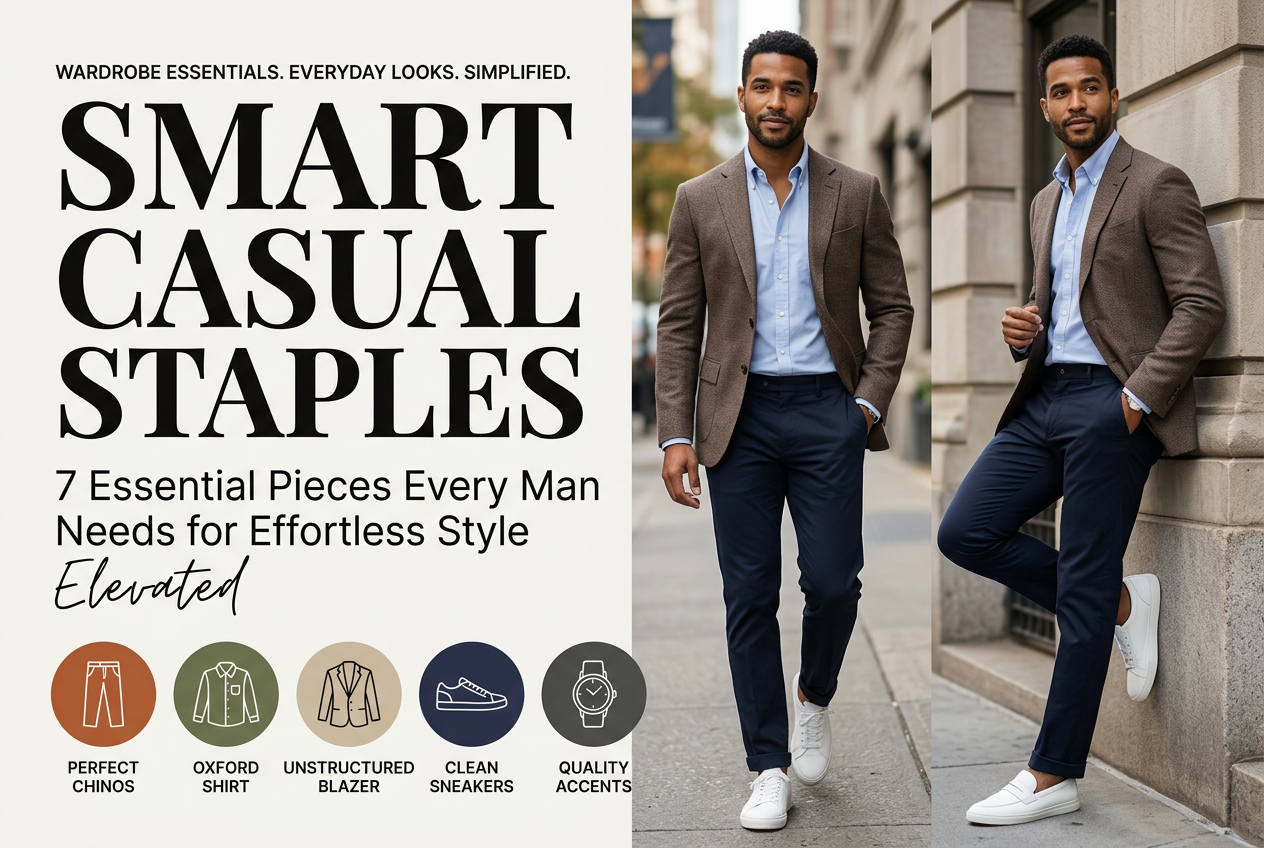
Here’s the thing nobody tells you when you’re staring into a packed closet at 8am with nowhere to be in 20 minutes: the problem usually isn’t that you don’t have enough clothes. It’s that nothing works together. I went through this exact moment about three years ago, pulled out seventeen shirts, and couldn’t make a single outfit I actually wanted to wear in public. That’s when I stripped everything back and started over with smart casual staples that actually talk to each other.
The math, once you see it, is obvious. One well-chosen pair of chinos pairs with at least five shirts you already own. A single oxford cloth button-down works over jeans, under a blazer, or tucked into dress pants for something more formal. Cost-per-wear collapses fast when pieces actually earn their closet space — and that’s the whole point of building around smart casual staples instead of chasing whatever looked good on someone else last season.
Where Do You Even Start?
Bottoms first. Always. Your pants and chinos are the anchor for every outfit you’ll pull together, and they need to do serious work across different situations. Two pairs of well-fitting chinos in neutral colors — one stone or khaki, one navy — will handle roughly 80% of your smart casual needs on their own. Add one pair of dark jeans that actually fit your body (not the proportions of whoever modeled them online), and the foundation is locked. What kills most guys here isn’t the color choice or even the brand. It’s fit. Too baggy and you look like you borrowed someone else’s wardrobe. Too tight and every movement becomes a negotiation. You want enough room to sit, walk, and move without thinking about it, with the inseam landing right at the top of your shoe — no bunching, no fabric pooling around your ankles like you’re wading somewhere.
Shirts That Actually Pull Weight
An oxford cloth button-down in white or light blue is non-negotiable. Full stop. It goes from casual Friday to weekend plans to a last-minute dinner without blinking, and it layers under a blazer or over a t-shirt depending on the temperature. A solid crew neck sweater in charcoal or navy adds warmth and texture without requiring any real coordination effort. And here’s the piece most guys skip entirely: a quality long-sleeve henley. It sits in a specific gap between a button-down and a plain t-shirt — more intentional than one, more relaxed than the other — and once you have one in rotation you’ll wonder what you were doing before.
Fabric matters more than most guys expect when they’re buying shirts online.
Cotton blends with a small amount of stretch feel better across a full day, hold their shape longer, and actually look like they’re fitted to a human body rather than draped over one. Avoid anything that feels thin when you pick it up. Thin fabric wrinkles within an hour, looks cheap regardless of what you paid, and communicates a kind of carelessness that undercuts everything else you’re wearing. Weight in a shirt is a feature, not an accident.
One Jacket. Not Five.
A navy or charcoal blazer is the single most versatile thing you can own. It dresses up jeans instantly, works over a henley for something relaxed, and slides over an oxford for anything that needs a little more polish. The fit is where most guys go wrong with blazers, and honestly it’s worth getting this one thing altered if needed: shoulders should sit right at your shoulder point without hanging off, sleeves should end at your wrist bone, and the length should hit mid-thigh. Too long and you look like you raided your father’s closet. Too short and something just seems off, even if nobody can name it. Beyond the blazer, a lightweight overshirt or shirt jacket in a neutral color handles in-between weather and casual office settings without pushing you into full blazer territory when that feels like too much.
Your Shoes Are Doing More Work Than You Think
Clean leather sneakers in white or a neutral tone are genuinely useful across jeans, chinos, and casual dress pants. They’re comfortable enough for a full day on your feet and polished enough that you don’t look like you’re heading to a workout. A pair of suede or leather loafers in brown or tan rounds this out — dressier than sneakers but still approachable, and they work well with either chinos or dark jeans depending on what else you’re wearing. (Actually, I’d prioritize the loafers over a second pair of sneakers if I had to pick. They cover more ground.) The one rule that applies to all of it: keep them clean. Scuffed, dirty shoes tank an otherwise solid outfit faster than almost anything else. A basic shoe cleaner and five minutes every couple of weeks is all it takes.
Accessories: Less Than You Think
A leather belt in brown and one in black solve nearly every situation. They should match your shoes — brown with brown, black with black — which sounds like a small detail until you notice it on someone else and realize how much it matters. A clean, simple watch in silver or gold-tone with a leather strap or an understated bracelet adds polish and is genuinely one of the few accessories people notice in person, particularly when you’re shaking hands or reaching across a table. Beyond that, keep it minimal. One ring or bracelet if that’s your style. Nothing that jingles, clinks, or asks for attention on its own.
Smart casual staples work because they remove the decision entirely.
You’re not trying to construct an outfit from scratch every morning or prove anything with what you’re wearing. You’re just trying to look like someone who has his act together — and that, consistently, is more compelling than any trend could be. Start with these pieces, mix them deliberately, and pay attention to what actually gets worn versus what just takes up space. The wardrobe will sharpen itself from there.
At Unwritten, our editors choose every product and story idea independently — we only recommend things we’d genuinely tell a friend about.
Frequently Asked Questions
How many smart casual staples do I actually need to start?
Seven core pieces will cover the vast majority of situations: two pairs of neutral chinos, one pair of dark jeans, an oxford button-down, a crew neck sweater, a navy blazer, and one clean pair of leather sneakers. That’s it. You can build from there once you see what gets worn.
What’s the difference between smart casual and business casual?
Smart casual is more relaxed. Business casual usually means no jeans and often requires a collared shirt. Smart casual lets you wear dark jeans with a blazer and clean sneakers and still look pulled together. The line is blurry, but smart casual gives you more room to move.
What colors work best for smart casual staples?
Stick to navy, charcoal, stone, khaki, white, and light blue as your base. These four colors play well with each other, which means almost anything you pull from the closet will coordinate without much thought. Add one or two muted accent colors once the foundation is solid.
Are expensive smart casual staples worth it?
Not always, but cost-per-wear math matters here. A $180 pair of chinos you wear twice a week for three years costs less per wearing than a $40 pair that pills and fades after six months. Spend more on fit and fabric, less on brand names.
Can I wear smart casual to a job interview?
Depends entirely on the company. A navy blazer over dark chinos and a white oxford is safe for most creative, tech, or casual office environments. For anything in finance, law, or formal corporate settings, go full business dress. When in doubt, overdress slightly.