The shoulder seam is what sold me. On my first Buck Mason tee it landed exactly where my shoulder ends, which sounds like nothing until you have owned a dozen tees where it doesn’t.
Here is the short version, so you can stop reading if you like. Buck Mason essentials won’t make you fashionable in the Instagram sense. They do something quieter and more useful, because they make getting dressed feel effortless. That is worth paying for.
I own three of their t-shirts. That’s not a flex, it’s a confession. But I reach for them constantly, because they are the kind of basics that disappear into your rotation so smoothly that you forget you own them until you’re folding laundry and thinking, ‘Wait, how many of these do I have?’
None of it is trendy. Nothing here is designed to turn heads or to say anything beyond ‘I’ve got my life together’. What the brand does is solve one specific problem: the gap between fast fashion that falls apart after three washes and designer basics that cost $200 and leave you anxious about wearing them. Buck Mason sits right in the middle, with thoughtful construction and honest materials, at prices that don’t need justifying to your partner.
If you’re building a men’s smart casual wardrobe that works across seasons and situations, Buck Mason is probably on your radar already. If not, here’s why these pieces deserve a closer look.
What makes a Buck Mason tee worth the money?
Buck Mason started in 2012 with a plain idea: make really good basics without the markup. No complicated supply chains and no middlemen. The brand makes most of its pieces in Los Angeles, which gives it tighter quality control and the ability to change things quickly when something isn’t working.
That matters more than it sounds. A t-shirt made in LA can be adjusted and refined in ways that offshore production doesn’t easily allow, so you aren’t paying for a logo or a heritage story. You’re paying for a company that cares whether the shoulder seam sits right. (Yes, I keep coming back to the seam. It’s the first thing I check on any tee now.)
The same thinking applies to fabric. Buck Mason sources from mills that put durability and feel first. Its cotton is usually combed or pima-blended, which gives you less pilling and better drape, and the fabric feels softer after repeated washes. It’s the kind of detail that doesn’t matter until you own something cheaper and realize how much it does.
Cost per wear is the quiet obsession.
A $68 t-shirt that lasts five years and looks better after 50 washes beats a $15 shirt that’s baggy and faded after one summer. Buck Mason gets this instinctively.
Tees first, then the oxford
Start here. Every capsule wardrobe needs a baseline, and for most men that means a solid crew-neck tee and a white oxford button-down.
The crew tee is deceptively simple. It isn’t trying to be anything except a well-fitting, durable t-shirt. The sleeves hit right (not too long, not too short), the body has just enough structure that it doesn’t cling, and the neckline doesn’t sag after a dozen washes. You’ll find yourself buying multiples in different colors, which is exactly the point.
The oxford is where the LA manufacturing really shows. The fabric has weight without feeling stiff. The collar rolls naturally. The buttons are decent quality, which sounds trivial until you’ve replaced cheap buttons on cheaper shirts. Wear it to casual dinners, over a t-shirt on cool days, or tucked in when you need to look intentional. I leave the top button open and roll the sleeves, and it still looks deliberate.
The henley sits between casual and put-together. It’s a t-shirt with authority, basically. Wear it alone in warmer months, or layer it under a sweater or overshirt when the temperature drops.
Most guys get the bottoms wrong
This is where a lot of guys stumble. They nail the tops, then pair them with jeans that fit nowhere or look like they came from 2003. Buck Mason’s bottoms are cut for actual bodies. Not too slim, not too baggy, just proportional.
The denim has a specific weight and weave that feels substantial without being rigid. It breaks in quickly, so within a few wears you forget you’re wearing jeans. The indigo holds for a long time, which means you aren’t replacing them every year. Most importantly, they fit like they were designed for humans, with legs of different lengths and thighs of different widths, not for runway models. I tried four brands of jeans before I stopped caring about the label on the back pocket. Actually, that is not quite right: I stopped caring about the label when I stopped noticing the jeans at all.
The chinos are where smart casual actually lives. Khaki is the obvious pick, but honestly, navy or olive will earn more rotation in your closet. They pair with everything, and they’re durable enough for real wear, not just sitting at a desk. They also hit that tonal sweet spot between casual and intentional.
One small criticism. The chinos can run a touch narrow in the thigh if you have muscular legs. They’re cut for a trim fit, which works well for most builds, but you may need to size up if you’re broader through the legs. Check the fit guide before you order.
Layering is the whole trick
Layering is the secret to looking like you know what you’re doing with clothes. Buck Mason’s outerwear is designed for exactly that. It isn’t so heavy that you can’t wear it over a sweater, and it’s structured enough to look intentional on its own.
The overshirt is criminally underrated. It’s a button-up cut and weighted like a light jacket. Wear it open over a tee, or buttoned up as a shirt. It works from spring to early fall, and even as a layer in winter. This is the piece that lets a capsule wardrobe function across seasons without buying whole new outfits.
The bomber, or a similar structured jacket, adds dimension to basics without demanding a full investment in a formal coat. It’s what you reach for when you want to look like you tried, though you’re really wearing the same jeans and tee as yesterday.
Seven pieces, twenty outfits
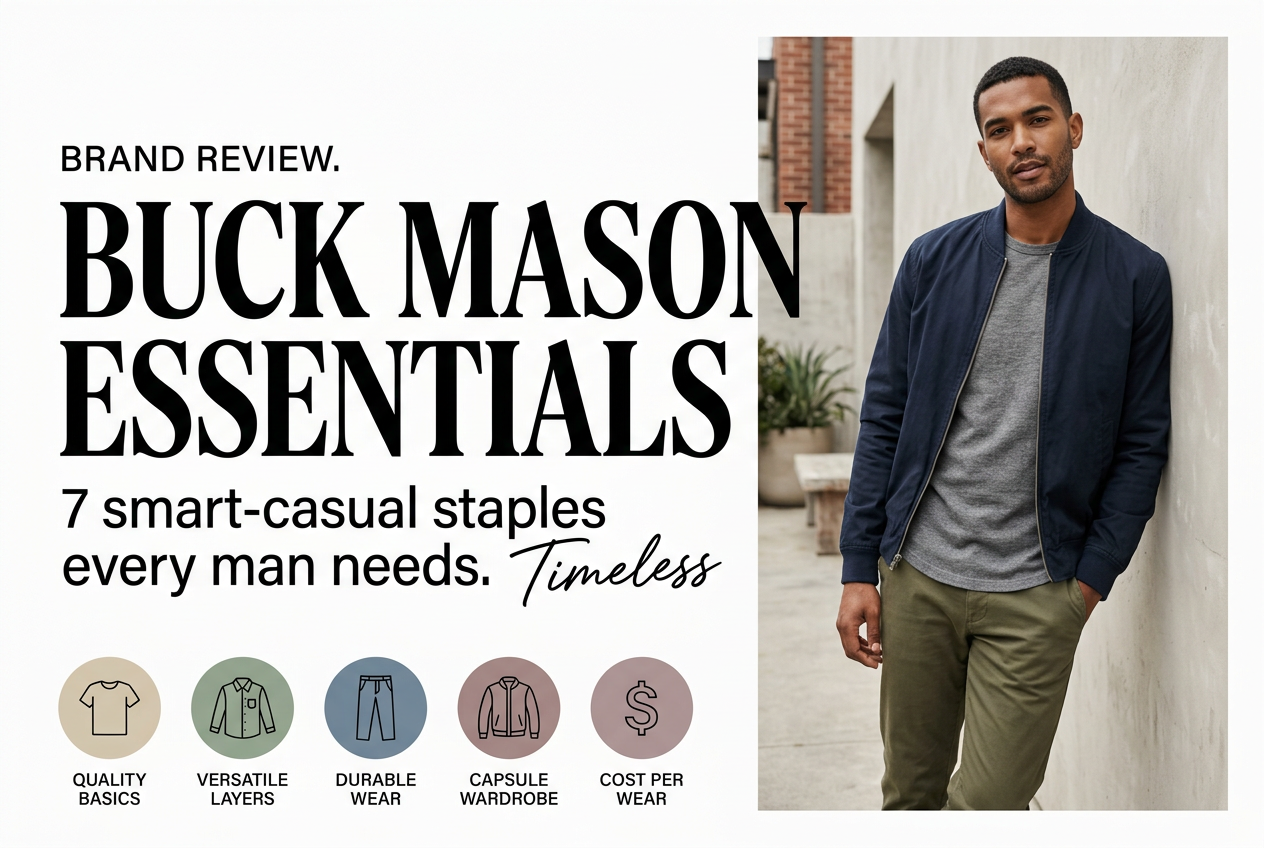
Here’s the math. Seven pieces of Buck Mason essentials can form the backbone of a working capsule wardrobe. Two tees (say white and gray), one oxford, one henley, one pair of denim, one pair of chinos, and one overshirt or jacket. That makes seven. From there you can mix and match roughly 20+ outfits, depending on how you style them.
The cost-per-wear calculation goes like this. A $68 tee worn twice a week for five years is 520 wears, which comes to about 13 cents each. A $15 fast-fashion tee that you wear maybe 10 times before it looks tired costs $1.50 a wear. Suddenly the Buck Mason pricing looks reasonable.
This isn’t about being precious with your clothes. It’s about owning pieces that actually work. They’re designed to be lived in, so they get better with wear, not worse. The fabric softens, the fit breaks in, and you stop wondering whether they’re ‘nice enough’ for whatever you’re doing.
So where do you start?
Pick one or two pieces. See how they fit your body and your life. If they work (and honestly, they probably will), expand from there. Build slowly, because a real capsule wardrobe isn’t something you buy in one shopping trip. It builds up over months, as you figure out what actually works for you.
My vote: buy the oxford first. It does more work than anything else on this list, and if it fits, you’ll trust the rest of the brand.
At Unwritten, our editors choose every product and story idea independently — we only recommend things we’d genuinely tell a friend about.
Frequently Asked Questions
Where does Buck Mason make its clothes?
Most of its pieces are made in Los Angeles. That gives the brand tighter quality control and the ability to change things quickly when something is not working.
Which seven pieces make a Buck Mason capsule wardrobe?
Two tees (white and gray), one oxford, one henley, one pair of denim, one pair of chinos and one overshirt or jacket. Together they mix and match into roughly 20 outfits or more.
Do Buck Mason chinos run true to size?
They are cut for a trim fit and can run a touch narrow in the thigh. If you are broader through the legs, size up, and check the fit guide before you order.
Is a $68 t-shirt really worth it?
Worn twice a week for five years, a $68 tee works out to about 13 cents per wear. A $15 tee worn ten times before it looks tired costs $1.50 per wear.